Fulper Pottery Company

Fulper Pottery Company was an American ceramics manufacturer based in Flemington, New Jersey, that operated from the early nineteenth century until the mid-1930s. Founded around 1814 as the Hill Pottery, the company produced utilitarian stoneware for most of its history before introducing Vasekraft, its first art pottery line, in 1909. Under this and later lines, Fulper became an important producer within the American Arts and Crafts movement, known for an extensive range of molded forms finished in mirrored, flambé, matte, luster, and crystalline glazes.
Fulper's art pottery developed under a group of designers and technicians: potter John Kunsman Jr., ceramic engineer J. Martin Stangl (who joined the firm in 1910), and chemist Cullen W. Parmelee were all involved in its forms and glaze chemistry. Early products included the "First Fifteen" cabinet vases and a line of pottery-based electric lamps, and the company received the Medal of Honor for its pottery at the 1915 Panama–Pacific International Exposition. Production peaked between 1917 and 1923, when Fulper's catalog offered 200 to 300 forms and its wares were sold through roughly 1,200 retail stores in the United States as well as international distributors. The art pottery line contracted through the 1920s as Fulper introduced other product brands, and J. Martin Stangl acquired the company in 1930. Fulper's art pottery line was discontinued in 1934, after which production continued under the Stangl Pottery name.
Fulper pottery is held in the collections of the Metropolitan Museum of Art, the Smithsonian Institution, the Los Angeles County Museum of Art, and the Art Institute of Chicago, among other institutions. In 2018 the Metropolitan Museum of Art accessioned a group of Fulper works from the collection of Robert A. Ellison Jr.; the accompanying publication, American Art Pottery: The Robert A. Ellison Jr. Collection, devotes a chapter to the company's history and production.
History
Origins (1814–1899)
The pottery that became the Fulper Pottery Company was founded around 1814 in Flemington, New Jersey, as the Hill Pottery, producing utilitarian stoneware such as drain pipes, crockery, and jars from local red earthenware clay.[2] Abraham Fulper, an employee of the pottery, acquired the business around 1860. After his death in 1881, his sons continued the pottery under a series of partnership names, including G. W. Fulper & Brothers and later Fulper Brothers & Co.[2] That firm went bankrupt in 1898, and the business was reincorporated the following year as the Fulper Pottery Company.[3] The new company was officially incorporated on March 24, 1899, by four members of the Fulper family: George W. Fulper (president), Mary C. Fulper, Edward B. Fulper (vice president), and William H. Fulper (secretary and treasurer), with William also serving as the pottery's manager.[2]

A key turning point for the firm came in 1895 when the Fulper brothers purchased the O. H. Smith and Brothers Pottery, also in Flemington, along with the patent rights to Smith's stoneware water cooler. The resulting line of "Germ-Proof" water filters and fire-proof cookware became a steady commercial success, giving the company the financial stability to later experiment with an art pottery line.[2][3]
Early experiments and the road to Vasekraft (1897–1909)
Although Fulper's move into art pottery is most often dated to 1909, the firm had experimented with decorative glazed wares for at least a decade by that time. A three-handled vase dated 1897 shows an early attempt at a colored glaze, and a slip-cast stoneware pitcher dated 1902, inscribed as the "first cast piece" produced at the pottery, points to an early shift toward mold-cast pottery and colored glaze work.[2]
The 1902 pitcher was made by John Kunsman Jr., a potter who joined the Fulper works in 1889 after training with his father, also a potter, in Germany and France before the family immigrated to the United States.[4] Around 1905–1909, Kunsman developed a short-lived line loosely based on Native American pottery, likely influenced by similar work at the Clifton Pottery in Newark, New Jersey.[4] Kunsman later recalled that both he and William H. Fulper were responding to the growing market for art wares.[4]
Fulper's first public art-pottery line, Vasekraft, was announced in trade advertisements in December 1909, timed to the Christmas gift season. The initial pieces were advertised as hand-thrown and finished in an "Old Rose Matte" glaze, marketed as comparable to antique Chinese wares.[4][5]
Glaze development and the arrival of Stangl (1908–1911)
The company's early glaze research is often credited entirely to ceramic engineer J. Martin Stangl, who joined Fulper in early 1910. However, the pottery's surviving glaze formula notebooks (handwritten volumes still held by Fulper family descendants) show glaze experiments dating back to at least March 1908, more than a year before Stangl's arrival and before the Vasekraft line existed. These notebooks document trials in a range of matte and crystalline glazes, contradicting Stangl's own later recollection that Old Rose Matte was the only viable glaze the firm had achieved before he arrived.[6] Much of this early experimentation was guided by Cullen W. Parmelee, a chemistry professor who in 1902 became the first faculty member of the Department of Clay-Working and Ceramics at Rutgers University and who advised Fulper on glaze chemistry.[6]
Stangl, a graduate of the Royal Ceramic Technical School in Bunzlau, Germany, was hired in early 1910 to redevelop the Vasekraft line after its initial 1909 launch performed poorly.[5] He served as the pottery's superintendent from at least October 1911.[7] William H. Fulper, who owned and managed the company, also took part in the design process; Stangl later said that Fulper supplied many of the ideas while he executed the designs.[7] Kunsman also remained involved in design work during this period. According to a later recollection by William H. Fulper's grandson, William H. Fulper III, Kunsman gave live wheel-throwing demonstrations as part of the firm's promotional exhibitions, including displays at retail venues such as Tiffany & Co., Ovington's, and Bailey, Banks and Biddle.[8] In the pottery's later years, the designer Ogden Winner Kugler (also credited by Fulper III as having "developed the lion's share of the forms") became its chief designer.[7]
Growth and peak production (1911–1923)
With Stangl's technical contributions, Fulper relaunched Vasekraft with new forms and glazes, expanding the line from about 35 products in mid-1910 to well over 100 by 1912.[5] The company employed around 75 people by 1911.[9] That year, Fulper introduced its pottery lamps and exhibited Vasekraft nationally, and in 1915 Fulper received the Medal of Honor for its pottery at the 1915 Panama–Pacific International Exposition in San Francisco.[10]
The years 1917–1923 marked the company's peak output, with 200 to 300 forms offered in each catalog.[10] By 1919 Fulper pottery was sold through about 1,200 retail stores across the United States and distributed internationally to shops in Europe, Australia, Japan, Canada, Central America, and South America, with company showrooms in New York, Chicago, Los Angeles, San Francisco, London, Paris, Milan, and Buenos Aires.[11]
Decline, the 1929 fire, and transition to Stangl Pottery (1924–1934)
Beginning in 1924, Fulper introduced several new, more limited product lines (Fulper Porcelains, Fulper Fayence, and later Fulper Primitive) and the art pottery catalog shrank accordingly, from 195 forms in 1923 to 99 in 1924, and to as few as 37 by 1933.[11] Trade publications describe William H. Fulper and J. Martin Stangl as co-leaders of the company in this period.[11] In early 1928 the company opened a new production facility in Trenton, at the former plant of the Anchor Pottery Company.[11] William H. Fulper died of a heart attack on October 15, 1928, at age 56, after which Stangl assumed sole direction of the business.[11]
On September 19, 1929, a fire destroyed Fulper's main pottery complex in Flemington. Art pottery production was shifted to the company's second Flemington plant, while other production moved to the Trenton facility.[11] J. Martin Stangl acquired the company in 1930.[12][9] Fulper introduced its Moderne, or Art Deco, forms during this period, reflecting the broader design trends popularized at the 1925 Exposition Internationale des Arts Décoratifs et Industriels Modernes in Paris.[11]
Despite the change in ownership, the pottery continued to be produced and marked under the Fulper name for several more years. According to Martha Stangl, J. Martin Stangl's daughter and a manager at the pottery, the Fulper art pottery line was discontinued in 1934, when the second Flemington plant was converted into a retail showroom; production was marketed under the Stangl name from that point on.[13] The company was not formally re-registered as the Stangl Pottery Company until 1955.[9][14]
Pottery

Design influences and forms
Fulper's Vasekraft and later art pottery lines show a wide range of stylistic influences that evolved significantly over the company's history. Fulper's designers had access to nearby museum collections, including those of the Princeton University Art Museum, the Newark Museum, and the Philadelphia Museum of Art; William H. Fulper was himself a member of the Metropolitan Museum of Art and may have encountered its collections directly or through the museum's Bulletin.[7] According to Hibel, Hibel, and DeFalco, Vasekraft-period Fulper pottery can be understood within three broad stylistic streams: Arts & Crafts designs, Asian-influenced, and Classical-influenced.[17] These were followed by distinct transitions into Art Deco and Art Moderne design vocabularies during the 1920s and early 1930s.[16][18] Although a small group of early forms complicate this these groups; while Hibel, Hibel, and DeFalco place these forms within the Arts & Crafts stream, Frelinghuysen, Eidelberg, and Spinozzi instead trace them to progressive German design of the period.[17][19]
Arts & Crafts forms

Fulper played an important role in the American Arts and Crafts movement,[18] combining simple geometric forms and organic shapes[15] with the company's innovative glaze program; its restrained ornamentation and rich glazes reflect the movement's preference for naturalistic forms and functional design.[17] However, applied relief decoration remained relatively rare in the line; the company more often pursued naturalism through form and glaze alone.[19] The cattails vase pictured here is one such exception, its molded relief accentuated by a green-and-brown glaze that pools in the recesses of the design.[19] By contrast, a smaller group of early Vasekraft vases moved in a different direction, toward a more architectural vocabulary of spare, symmetrical bodies with faceted, buttressed shoulders, described by Hibel, Hibel, and DeFalco as an early, rare Jugendstil form that surfaced too infrequently to have stayed in production long.[21] Frelinghuysen, Eidelberg, and Spinozzi trace the same forms to progressive German design, comparing them to ceramics by the architect Peter Behrens and contrasting their variegated glazes with the uniform matte finishes Gates Potteries (Teco) used on similar geometric shapes.[19]
Asian-inspired forms

Fulper drew direct inspiration from historic Chinese ceramic forms and glazes, adapting these traditions into its early Vasekraft designs. Two loan exhibitions likely served as important sources for this influence, one mounted in 1914 at the Knoedler Gallery in New York, and a second staged two years later at the Metropolitan Museum, together bringing together more than two hundred ceramics from China, Japan, and Korea.[22] Kornacki documents that several of the "First Fifteen" cabinet vases correspond closely to classical Chinese vessel types, including peach-bloom forms of the Kangxi period, an octagonal vase of the Qianlong period, hexagonal vases of the Southern Song dynasty, long-necked bottles of the Western Han dynasty, and a double oviform vase resembling Qing dynasty snuff bottles.[15] Elephant head handles on model Nos. 5 and 8 also reflect common decorative motifs in Chinese ceramics.[15]

Some pieces in the Ellison Collection can be linked to specific prototypes. A large Fulper vase closely follows the melon-shaped body, ringed collar, and trumpet neck of an eleventh-century Northern Song Dynasty vase, though Fulper nearly doubled its scale and replaced the original's subtle bluish-white glaze with a bolder combination of bright blue and green. At fifty dollars, it was among the more expensive pieces listed in the pottery's 1922 catalog.[22] A smaller, globular vase similarly adapts a Ming Dynasty design, closely related in form, but slightly reduced in size, with the original's milky-gray glaze replaced by more vivid flambe colors.[22] One Fulper vessel in the collection, decorated with elephant-head handles deep, irregular throwing rings inside cusped finestra, is described by Frelinghuysen, Eidelberg, and Spinozzi as the only known example of its form. While some of its elements are common to Chinese and Japanese ceramics and metalwork generally, the authors could not identify a specific model for the piece as a whole.[23]
Classical-inspired forms
Other early Vasekraft forms drew on Classical and European historical styles. Several Vasekraft forms echo Greco‑Roman amphorae, while octagonal and hexagonal vases reflect geometric traditions found in Chinese and European classical ceramics alike.[17] One ewer in the Ellison Collection may be modeled on an ancient Greek hydria, possibly one Fulper could have seen at the Metropolitan Museum as a member.[7] Although its finish departs sharply from that source, with dark, dripped glazes flowing over a bare, buff-colored body that give the piece an appearance closer to Japanese ceramics than Greek ware, described by Frelinghuysen, Eidelberg, and Spinozzi as "an amalgam of different cultural influences."[24] In 1914, Fulper briefly experimented with ornate historical revival styles in its lamp line, producing models in Empire, Jacobean, Renaissance, and Louis XIV modes. These designs were published in trade journals, though their commercial production remains uncertain.[25]
 |
 |
|
Left: Fulper Pottery Shape No. 489[17] (c.1909–1917).[16] Right: the Two-handled pottery vase of Amenhotep (c. 1550–1295 B.C.) (MET 60.38) Scholars have noted similarities between Shape No. 489 and Egyptian and Cypriote forms.[8][17] | |
Later Fulper shapes: Art Deco and Art Moderne
By the mid‑1920s Fulper's design language shifted decisively away from the Asian, Classical, and Arts & Crafts influences of the Vasekraft era. Late Fulper forms adopted the geometric profiles, stepped contours, and streamlined silhouettes associated with Art Deco, reflecting broader trends in American design.[16]
Glazes
Fulper's promotional materials framed glaze, rather than applied decoration, as the true measure of a pottery's quality, declaring that "without a glaze it lacks the finish of completeness, like a solid picture without a frame."[19] This philosophy has been linked to the influence of Charles Fergus Binns, a foundational figure in American studio ceramics; Fulper may have had direct contact with Binns as early as the late 1890s, when Binns directed the Technical School of Science and Art in Trenton, New Jersey, and the firm's first glaze experiments coincide with Binns's influential 1903 article "In Defence of Fire" in The Craftsman.[19] Hibel, Hibel, and DeFalco describe Fulper's glaze program as one of the most ambitious in American art pottery, noting that the company produced over 100 glazes during the Vasekraft era.[17] Fulper's catalogs made an even larger claim, boasting that "Vase-Kraft has thousands" of glazes — a figure Kornacki notes referred to fewer than a hundred standard formulas in practice.[25]
Glaze variation and kiln behavior
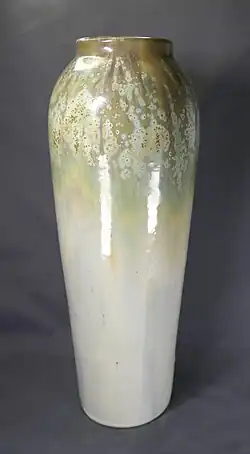
Fulper's glaze program involved thorough experimentation. For one glaze alone, the company tested ninety-two different blends during development.[26] Their glazes relied on single-firing techniques and natural clay bodies, which together produced dramatic variation between individual pieces. Company promotional materials described how heat was built up in the kiln over several days and carefully monitored during both firing and cooling, a technique other American potters, including M. Louise McLaughlin and Merrimac Pottery, had also adopted by this period.[6] As Blasberg notes, "The effect of single firing, that is, firing the clay body and glaze together at one time, made the fusion of the two more complete and the result often resembled organic substances such as cucumber skins, volcanic lava or mineral specimens of igneous rock."[8] This fusion was further enhanced by Fulper's use of minimally refined clays; in Evelyn Marie Stuart's 1914 description of Vasekraft, "the glaze 'steals' from the body in firing, particles of mineral in the body producing variations in color or crystalline effects in the glaze."[27]
Flambé and crystalline glazes were especially sensitive to kiln conditions, with elements such as crystal size, density, and color balance shifting from one firing to the next.[17] As summarized in The Fulper Book, "Cucumber Crystalline and Leopardskin Skin Crystalline are either the same glaze formulas responding differently in different kilns, or... almost identical formulas with one or two modifications."[28]
Glaze types
Fulper offered its Vasekraft glazes in six principal classes defined by tone, surface quality, and optical effect:[29]
- Mirrored glazes - Highly reflective surfaces resembling polished metal or "patches of sky in single color."
- Flambé glazes - Iridescent, flowing color transitions described as "the gorgeous colors seen in the sky at sunset in autumn."
- Lustre glazes - Mirrored surfaces with oil‑slick iridescence, compared to "oil on water" or soap bubbles.
- Crystal glazes - Surfaces containing visible crystalline structures, from swirling reflections to frost‑like patterns; Fulper noted that "a satisfactory explanation of the cause of the formation of crystals is yet to be made."
- Matte glazes - Velvety or softly textured finishes inspired by foliage, fruit skin, or melon rind.
- Wistaria [sic] - Unique to Fulper pottery, "the wistaria class are glazes with a pastelle texture, colors ranging through all wistaria shades."[29]
Glaze examples
 Two pieces on the left showing variations of the Mirror Black glaze. The large piece on the right shows Gun Metal Black.[17]

 Detail of a flambe glaze.[17]
 Fulper Pottery Company detail of a flambe glaze.
 Fulper Pottery Company detail of the Cucumber Crystalline glaze.
 Detail of a dark matte blue glaze.
 Vases showing two variations of the Wistaria glaze.[17]
 Detail of Wistaria Glaze.[17]
Special product lines
Lamps

Fulper Pottery introduced its Vasekraft lamps in 1911 as part of its move from utilitarian wares into art pottery. The lamps were immediately noted for their fully ceramic construction: both bases and shades were made of glazed pottery rather than the metal or art‑glass assemblies typical of the period. Contemporary reviewers described them as "entirely original" and praised the unified aesthetic created by pairing pottery bases with pottery shades. Fulper promoted the lamps through exhibitions, trade shows, and magazine advertising, and they quickly became the centerpiece of the Vasekraft line.[25]
The lamps were produced in a wide range of forms but shared consistent features—pottery shades inset with translucent art‑glass pieces and high‑temperature glazes in mirrored, flambé, crystal, matte, or luster finishes. Glass insets ranged from simple jewels to complex multicolored patterns, creating lamps that appeared cohesive when unlit and vividly luminous when illuminated. Production peaked between 1911 and 1914, and Fulper received the Medal of Honor at the 1915 Panama‑Pacific International Exposition for its Vasekraft display. Most lamp models were discontinued by 1915, with limited production continuing until about 1918–1919. Despite their short manufacturing span, Kornacki describes Vasekraft lamps as "some of the most significant works of decorative lighting made during the early twentieth century," citing their technical innovation and their role within the Arts and Crafts movement.[25]
Vasekraft lamps have brought premium prices at auction in recent years. In a February 2023 sale of works from the Robert A. Ellison Jr. collection, a Leopard Skin Crystalline-glazed example sold for $44,100 against an estimate of $9,000–12,000, and a flambé-glazed example from the same sale sold for $20,160 against an estimate of $10,000–15,000.[31][32]
First Fifteen

The First Fifteen were a group of small cabinet vases introduced by Fulper in 1910–1911 as part of the early Vasekraft line. Assigned model numbers 1 through 15, they were finished in Fulper's mirrored, matte, crystal, and flambé glazes and marketed in the company's 1912 and 1914 catalogs. Many of the shapes were inspired by historic Chinese pottery, including forms of the Kangxi period, hexagonal and octagonal vases from the Song and Qing dynasties, and long‑necked bottles from the Han dynasty. Other designs incorporated gourd forms and elephant‑head handles, reflecting Fulper's stated admiration for Chinese ceramics.[15]
Although all fifteen models were produced until at least 1914, only three (Nos. 4, 11, and 13) continued in later catalogs, reissued under new model numbers (018, 016, and 017) and sold in Fulper's gift‑box line. These forms remained in production until 1923, making them the most common First Fifteen forms found today. The other twelve were discontinued in 1914 and are now exceedingly scarce, making complete sets difficult to assemble. The First Fifteen have received attention in collector literature because of their early place within the Vasekraft line and their relative scarcity.[15][17]
Gift Boxes

Fulper introduced its "Gift Thoughts in Texted Boxes" line in 1915, packaging small Vasekraft forms in decorated boxes with printed verses. These "Gift Box" items included vases, bowls, flower frogs, coasters, candleholders, ashtrays, potpourri jars, bulb cups, and novelty pieces like cocktail mixers, honeypots, incense burners, and children's banks. The boxes often contained extras like flower bulbs or bayberry candles, and each carried a short poem tailored to the form. For example, the No. 08 Twig Stick box read: "Made for one single blossom; This twig stick so slender; Bears a message of love; To you from the sender." Fulper's gift‑box strategy was innovative in the art pottery market, offering affordable pieces (typically $0.75–$1.50) in attractive packaging that broadened the audience for Vasekraft pottery. The line was discontinued by 1917, and surviving boxes are now rare, but many of the forms continued in production into the 1920s. The Gift Box line also introduced a distinct numbering system wherein all gift box forms were prefixed with "0", allowing older Vasekraft shapes to be renumbered (e.g., the No. 4 vase reappeared as gift box No. 018, and the No. 13 was numbered 017 for the Vasekraft gift boxes).[33]
Marks
Because many company records were destroyed in the 1929 fire that damaged Fulper's principal works,[12] marks applied to surviving pottery have become an important source for dating and identifying individual pieces. Fulper employed a succession of ink stamps, impressed marks, molded logos, paper labels, and foil labels during its art pottery period, and the evolution of these marks has been the subject of specialized study.[16][17] Earlier accounts of Fulper's marks, including those by Blasberg (1979) and Hibel, Hibel, and DeFalco (1992), assigned approximate dates to some marks, and many of those dates were revised in a 2017 analysis by Jon A. Kornacki, who reconstructed the chronology using period catalogs, advertisements, and journals, along with physical examination of surviving marks.[34]
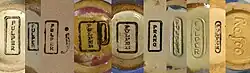
The earliest Vasekraft wares (c. 1909–1917) are most commonly associated with rectangular ink marks bearing the Fulper name, several variations were used. During this period the company also employed the Vasekraft trademark, featuring the "Potter and His Wheel" emblem, particularly on lamps and selected specialty forms. Other early markings included private-label marks, such as those used for pottery marketed through the Prang Company.[16]
In 1917 Fulper discontinued the Vasekraft trademark and adopted a new group of oval marks that remained in use throughout much of the company's later production. These included impressed, raised, and inked variants that appeared on different forms and product lines. The shift from Vasekraft markings to oval Fulper logos reflects a broader reorganization of the company's branding during its years of peak production.[16]


Transition to Stangl glazes and shapes
Beginning in 1924, under newly appointed vice president J. Martin Stangl, Fulper introduced new product lines, including Fulper Fayence, finished in solid-color glazes that were distinct from the mirrored, flambé, and crystalline glazes used on the company's art pottery.[11][14] This new line was produced alongside Fulper's existing art pottery line. Stangl acquired the company in 1930, and the art pottery line continued in production for several more years before being discontinued in 1934, at which point production continued solely under the Stangl Pottery label.[35] Solid-color dinnerware production continued and expanded under Stangl's direction, and by the 1940s the company had introduced hand-carved, hand-painted dinnerware patterns that became its best-known and most enduring product line.[14]
Collecting and legacy
Fulper pottery has developed a dedicated collector base, drawn to the range of forms and glazes produced across the company's history. The First Fifteen and other early forms, many discontinued after only a few years, are now especially scarce.[15] At a February 2023 auction, a rare, gourd-shaped, crystalline-glazed vase dating to about 1910 sold for $20,160 against an estimate of $1,000–1,500.[36] These early pieces also reflect the company's period of greatest technical innovation, including the patented Vasekraft lamps and their extensive early glaze experimentation.[25]
Fulper's Later work has also remained collectible and at a September 2023 auction, a Cattail vase dating to the period between 1917 and 1927, the example illustrated on the cover of The Fulper Book, sold for $22,680 against a pre-auction estimate of $5,000–7,000.[37][38]
Museum collections
Fulper's Vasekraft pottery and later artware are held in major American museum collections including Metropolitan Museum of Art,[39] Smithsonian Institution,[40] Los Angeles County Museum of Art,[41] and the Art Institute of Chicago.[42]
In 2018, the Metropolitan Museum of Art accessioned a major group of American art pottery from the collection of Robert A. Ellison Jr., one of the most significant private collectors in the field. The gift included several Fulper works, among them a likely unique stoneware Ewer (Met 2018.294.92).[43][24] The Met's accompanying publication, American Art Pottery: The Robert A. Ellison Jr. Collection (2018), features a dedicated chapter titled "Fulper: An Art Pottery Manufactory," underscoring the pottery's importance within Ellison's holdings.[44]
Gallery




References
- ↑ "Vase". The Metropolitan Museum of Art. The Met. Retrieved 2026-08-16.
- 1 2 3 4 5 Frelinghuysen, Eidelberg & Spinozzi 2018, p. 306.
- 1 2 Kornacki 2013, p. 14.
- 1 2 3 4 Frelinghuysen, Eidelberg & Spinozzi 2018, p. 307.
- 1 2 3 Kornacki 2013, p. 15.
- 1 2 3 Frelinghuysen, Eidelberg & Spinozzi 2018, p. 313.
- 1 2 3 4 5 Frelinghuysen, Eidelberg & Spinozzi 2018, p. 308.
- 1 2 3 4 5 Blasberg 1979.
- 1 2 3 "About Fulper Pottery". Rago Arts. Retrieved 2026-08-09.
- 1 2 Kornacki 2017, p. 8.
- 1 2 3 4 5 6 7 8 Kornacki 2017, p. 9.
- 1 2 Blasberg 1979, p. 75.
- ↑ Kornacki 2017, p. 10.
- 1 2 3 "A Brief Stangl Pottery History". Stangl Pottery Historical Society. Retrieved 2026-08-16.
- 1 2 3 4 5 6 7 8 9 10 11 12 Kornacki 2013.
- 1 2 3 4 5 6 7 8 9 10 11 12 13 14 15 16 17 18 19 20 21 Kornacki 2017.
- 1 2 3 4 5 6 7 8 9 10 11 12 13 14 15 16 17 18 19 20 21 22 23 24 25 Hibel, Hibel & DeFalco 1992.
- 1 2 Brussel & Chappell 2019.
- 1 2 3 4 5 6 Frelinghuysen, Eidelberg & Spinozzi 2018, p. 312.
- ↑ "Cattails Vase". Cooper Hewitt, Smithsonian Design Museum. Retrieved 2026-08-16.
- ↑ Hibel, Hibel & DeFalco 1992, p. 56.
- 1 2 3 Frelinghuysen, Eidelberg & Spinozzi 2018, p. 310.
- ↑ Frelinghuysen, Eidelberg & Spinozzi 2018, p. 310-312.
- 1 2 Frelinghuysen, Eidelberg & Spinozzi 2018, p. 309.
- 1 2 3 4 5 Kornacki 2012.
- ↑ Frelinghuysen, Eidelberg & Spinozzi 2018, p. 315.
- ↑ Stuart, Evelyn Marie (1914). Vasekraft.
The glaze 'steals' from the body in firing, particles of mineral in the body producing variations in color or crystalline effects in the glaze.
- ↑ Hibel, Hibel & DeFalco 1992, p. 30.
- 1 2 Hibel, John; Carole Goldman Hibel; Robert DeFalco (1992). The Fulper Book. Self-published. pp. 30–31.
Reprints the Vasekraft catalog page listing the six principal glaze classes.
- ↑ "Table Lamp". The Metropolitan Museum of Art. The Met. Retrieved 2026-08-16.
- ↑ "221: Fulper Pottery, Rare Vasekraft table lamp". Rago Arts and Auction Center. Retrieved 2026-08-10.
- ↑ "152: Fulper Pottery, Rare Vasekraft table lamp". Rago Arts and Auction Center. Retrieved 2026-08-10.
- 1 2 3 4 Kornacki 2019.
- ↑ Kornacki 2017, p. 6.
- ↑ Kornacki 2017, p. 9-10.
- ↑ "151: Fulper Pottery, Vase". Rago Arts and Auction Center. Retrieved 2026-08-10.
- ↑ "126: Fulper Pottery, Rare Cattail vase". Rago Arts and Auction Center. Retrieved 2026-08-10.
- ↑ "Early 20th-Century and Modern Design". Maine Antique Digest. Retrieved 2026-08-10.
- ↑ "Vase by Fulper Pottery Company". The Metropolitan Museum of Art. The Met. Retrieved 2026-08-03.
Fulper Pottery Company, Vase, American, 1917–26.
- ↑ "Fulper Pottery Vase". Smithsonian Institution. National Museum of American History. Retrieved 2026-08-03.
Fulper Pottery Vase, Arts and Crafts Movement, ca. 1909.
- ↑ "Vase, circa 1915–1920". Los Angeles County Museum of Art. LACMA Collections. Retrieved 2026-08-03.
Fulper Pottery Company, Vase, circa 1915–1920, earthenware with glaze.
- ↑ "Fulper Pottery Company". Art Institute of Chicago. Art Institute of Chicago. Retrieved 2026-08-03.
- ↑ "Vase". The Metropolitan Museum of Art. The Met. Retrieved 9 August 2026.
- ↑ "American Art Pottery: The Robert A. Ellison Jr. Collection". The Metropolitan Museum of Art. The Met. 2018. Retrieved 9 August 2026.
Bibliography
- Kornacki, Jon A. (2017). "Fulper's Marking System". Journal of the American Art Pottery Association. 33 (1): 6–15.
- Kornacki, Jon A. (2013). "Fulper's First Fifteen". Journal of the American Art Pottery Association. 29 (2): 14–21.
- Kornacki, Jon A. (2019). "Fulper's Gift Box Pottery". Journal of the American Art Pottery Association. 35 (4): 4–8.
- Kornacki, Jon A. (2012). "Fulper's Vasekraft Lamps". Journal of the American Art Pottery Association. 28 (2): 8–15.
- Hibel, John; Hibel, Carole Goldman; DeFalco, Robert (1992). The Fulper Book. David Rago (text). Self-published.
- Blasberg, Robert (1979). Fulper Art Pottery: An Aesthetic Appreciation 1909–1929. Jordan Volpe Gallery.
- Brussel, Michael; Chappell, Steffi (January 23, 2019). "Object of the Week: Handled Vase by Fulper Pottery Company". Everson Museum of Art. Retrieved 2026-08-09.
- Frelinghuysen, Alice Cooney; Eidelberg, Martin; Spinozzi, Adrienne (2018). American Art Pottery: The Robert A. Ellison Jr. Collection. New York: The Metropolitan Museum of Art.