Francis Penty
Francis Penty | |
|---|---|
 | |
| Born | 1841 Naburn, Yorkshire, England |
| Died | 1919 (aged 77–78) Island Bay, Wellington, New Zealand |
| Occupation | Architect |
| Years active | 1887–1919 |
| Partner(s) | Leonard Joseph Forde, Edward Blake, Charles Lawrence |
| Buildings | Hunter Building, Carrigafoyle |
| Design | 'York' |
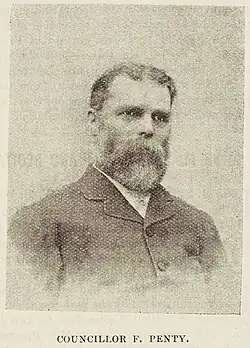
Francis Penty (1841–1919) was an English and New Zealand architect. Penty initially worked in Yorkshire and elsewhere in England before immigrating to New Zealand. In New Zealand Penty formed several partnerships and designed over 200 buildings during his career, primarily in Wellington. Penty's most notable works are the Hunter Building and Carrigafoyle. Several of his buildings have registration with Heritage New Zealand and many are scheduled with the Wellington City Council.
Early life
Francis Penty was born in 1841 in the village of Naburn, Yorkshire, England. Penty attended school in York and articled to an architect active in York and Halifax. Penty later worked as a draughtsman with Thomas Worthington.[1]
Architectural career
Scant information is available on Penty's English career but Penty is known to have worked as an architect for the Royal Engineers and later worked for the London & Northwestern Railway Company for 12 years.[1]
In 1887 Penty came to New Zealand aboard the Kaikoura. Penty set up a private practice in Wellington and by 1905 had designed around 200 homes. Penty's first partnership was with Leonard Joseph Forde, lasting from 1893 to 1898, when Forde left New Zealand. Forde handled the Masterton branch focusing on the Wairarapa whilst Penty focused on Wellington. Penty entered a competition to design the Wellington Public Library but came in third place. Penty was suspended from the Wellington Association of Architects after criticising the prices of fellow members.[1]
Penty formed a partnership with Edward Blake in July 1903. Penty and Blake's partnership produced over a hundred buildings. The pair also won the design for Victoria College (now Victoria University of Wellington),[1] the Hunter Building, as it is now known, is registered as a category 1 building with Heritage New Zealand.[2] Penty's partnership with Blake ended in 1909. Following the end of this partnership he entered one with Charles Lawrence. He remained in this partnership until his death in 1919.[1]
Penty was a founding member of the New Zealand Institute of Architects but left in 1911 over a dispute on policies around pricing. Penty rejoined in 1913 after a solution had been agreed upon.[1]
Political Career
Penty served as a Wellington City Councillor from 1892 to 1895. Penty advocated for improving sanitation in the city during his time on the council owing to his background as a sanitation engineer.[1]
Personal life
Penty is believed to have arrived in New Zealand as a widower. In 1904 he married his second wife. Penty lived in Island Bay with his wife, in a house of his own design. Penty was president of the Victoria Bowling Club, member of the Yorkshire Society of New Zealand, and honorary member of the Wellington Rowing Club. Penty was a philanthropist with a notable donation being that of a contribution towards purchasing a lioness for the Newtown Park Zoo.[1]
List of works
| Name | Date | Image | Note | Ref |
|---|---|---|---|---|
| 24-26 Courtenay Place | 1895 | Scheduled with the Wellington City Council | [3] | |
| 244 The Terrace | 1898 |  | Registered as a category 2 building with Heritage New Zealand | [4] |
| Duke of Edinburgh Hotel | 1898 |  | Demolished in 1975 | [1]: 117 [5] |
| 89 Brougham Street | 1890 | 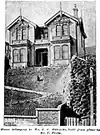 | [6] | |
| 234 Oriental Parade | 1900 | Scheduled with the Wellington City Council | [7] | |
| 34–42 Willis Street | 1900 | Demolished in 2011 | [8] | |
| Preston's Building | 1902 |  | Registered as a category 2 building with Heritage New Zealand | [9] |
| Hunter Building | 1903 | 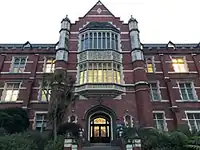 | Registered as a category 1 building with Heritage New Zealand | [2] |
| Carrigafoyle | 1903 |  | Registered as a category 1 building with Heritage New Zealand | [10] |
| Shanghai Restaurant | 1904 |  | Registered as a category 2 building with Heritage New Zealand | [11] |
| Townsend and Paul warehouse | 1905 | Scheduled with the Wellington City Council. Architect unknown but presumed to be Penty & Blake. | [12] | |
| 8 Patrick Street ('Spiro') | 1906 | Registered as a category 2 building with Heritage New Zealand | [13] | |
| 18 Patrick Street ('York') | 1906 | Registered as a category 2 building with Heritage New Zealand | [14] | |
| 43 Adelaide Street ('Suburban') | 1906 | Registered as a category 2 building with Heritage New Zealand | [15] | |
| Wellington Bowling Club Pavillion | 1906 |  | Demolished | [1] |
| Thistle Hall | 1907 | Registered with Heritage New Zealand as part of the Cuba Street Historic Area | [16] | |
| Murray, Roberts & Co. Building | 1907 | Scheduled with the Wellington City Council | [17] | |
| Pan Hellenic Association Building | 1907 | Scheduled with the Wellington City Council | [18] | |
| James Smith Building | 1907 |  | Building was substantially altered in 1932 to have an Art Deco facade. Registered as a category 2 building with Heritage New Zealand | [19] |
| ANZ Bank building, Palmerston North | 1912 | 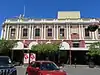 | [20] | |
| ANZ Bank building, Wairoa | 1915 | [21] | ||
| Circa Theatre | 1916 |  | Scheduled with the Wellington City Council | [22] |
References
- 1 2 3 4 5 6 7 8 9 10 Mew, G.; Humphris, Adrian (October 2014). Raupo to Deco. pp. 89–91. ISBN 978-1-927242-56-8.
- 1 2 "221". New Zealand Heritage List/Rārangi Kōrero. Heritage New Zealand.
- ↑ "Commercial Building". Wellington City Heritage.
- ↑ Morrell, Vivienne (16 November 2012). House (Report). Heritage New Zealand.
- ↑ "Duke of Edinburgh Hotel (Wellington, N.Z.)". National Library of New Zealand.
- ↑ "The Cyclopedia and Beethoven" (PDF). Mt Victoria Historical News Society. No. 92. Mount Victoria Historical Society. April 2020.
- ↑ "House". Wellington City Heritage.
- ↑ Jones, Kevin (14 January 2011). Monitoring of the Nineteenth-Century Commercial Premises, 34-42 Willis Street, Wellington, for Grand Complex Properties Ltd under Historic Places Act Authority 2011/101 (Report).
- ↑ "Preston's Building". Wellington City Heritage.
- ↑ "1345". New Zealand Heritage List/Rārangi Kōrero. Heritage New Zealand.
- ↑ "Commercial Building". Wellington City Heritage.
- ↑ "Townsend And Paul Warehouse (Former)". Wellington City Heritage.
- ↑ McCracken, Helen (16 August 2001). House (Report). Heritage New Zealand.
- ↑ McCracken, Helen (16 August 2001). House (Report). Heritage New Zealand.
- ↑ McCracken, Helen (16 August 2001). House (Report). Heritage New Zealand.
- ↑ "Thistle Hall". Wellington City Heritage.
- ↑ "Murray, Roberts & Co. Building (Former)". Wellington City Heritage.
- ↑ "Warehouse (Former)". Wellington City Heritage.
- ↑ "James Smith Ltd Department Store (former)". Wellington City Heritage.
- ↑ "Former ANZ Bank Chambers". Manawatu Heritage.
- ↑ Barrie, Andrew; Cheng, Terry. "A Guide to East Coast Architecture" (PDF).
- ↑ "Circa Theatre". Wellington City Heritage.