Fornaci–Treviglio–Caravaggio Tramway
| Fornaci–Treviglio–Caravaggio tramway | |||
|---|---|---|---|
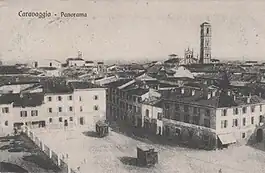 Two trams at the Caravaggio terminus in 1917 | |||
| Overview | |||
| Termini |
| ||
| Service | |||
| Type | Interurban tram | ||
| Operator(s) | ATM (1939–1972) Pistorius (1880–1882) TIP (1882–1926) STEL (1926–1939) | ||
| Rolling stock | Steam trams (until 1931) Electric trams | ||
| History | |||
| Opened | 1880 (Fornaci–Treviglio) 1883 (Treviglio–Caravaggio) | ||
| Closed | 1917 (Treviglio–Caravaggio) 1931 (Cassano–Treviglio) 1972 (Fornaci–Cassano) | ||
| Technical | |||
| Line length | 16.55 km (10.28 mi) | ||
| Track gauge | 1,445 mm (4 ft 8+7⁄8 in) (Italian tram gauge) | ||
| Electrification | 600 V DC | ||
| |||
The Fornaci–Treviglio–Caravaggio tramway was an interurban tramway that connected the hamlet of Villa Fornaci in Gessate to the towns of Treviglio and Caravaggio between the 1880s and the 1920s.
Born as a connecting line between two interurban tramways, the Lodi–Bergamo and the Milan–Vaprio lines, it was upgraded in 1931 and became a branch of the latter. It was closed in 1972.[1][2]
History

In the fervour of tramway construction that had characterised the province of Milan at the end of the 1870s, the Milan–Vaprio line had been built and opened, reaching the banks of the Adda.[3]
The need to find a way to cross the river—since Vaprio at the time had no bridge—and to create a tramway link between the province of Milan and the province of Bergamo, prompted Cavalier Ferdinando Pistorius to apply for the concession of an interurban line that would branch off from the first tramway at Fornaci (later Villa Fornaci) and head to Treviglio, crossing the Adda via the bridge at Cassano. At Treviglio, the line would then connect with another planned tramway, the Lodi–Bergamo line, whose concession had also been granted to Pistorius.[1]
Pistorius obtained the concession on 17 March 1880. The works mainly involved refurbishing the Cassano bridge, which had to be reinforced in its pylons and beams and have its gradient reduced to accommodate the heavy steam locomotives. The line opened on 15 August of the same year.[4]
Two years later, the line was incorporated into the network of the Tramways a Vapore Interprovinciali di Milano, Bergamo e Cremona (TIP). On 18 August 1882, the provincial administration of Bergamo granted TIP the construction and operation of the Treviglio–Caravaggio extension, which was activated on 11 May of the following year.[5][6] In later years, TIP organised special tram services to Caravaggio and its Sanctuary on the days of the Assumption.[7]
The Treviglio–Caravaggio section was the first to be closed. On 17 December 1917, both passenger and freight services were suspended, and on 2 September of the following year, the track was ordered to be dismantled. Two years later, the Cassano d'Adda–Treviglio service was also suspended, concurrently with the Lodi–Bergamo line. However, following protests from the population, it was reopened on 15 February 1925.[8]
This was the period of the acquisition by the Società Trazione Elettrica Lombarda (STEL) of numerous interurban lines in the Milan area. With Royal Decree No. 1565 of 29 July 1926, the Italian Government approved the agreement by which the Edison group company obtained the operation of several TIP tram lines, including Villa Fornaci–Treviglio.[9]

The line's upgrade included electrification with direct current at 1200 volts, relocation of the track to a reserved lane, and the creation of a bypass around the built-up area of Inzago. However, STEL also ordered the closure of the section beyond Cassano d'Adda, building a new terminus outside the town to facilitate interchange with replacement bus services.[10] The new alignment opened on 20 October 1931.[11]
The transfer of management to the Milanese ATM (1939) did not change the line's infrastructure until the 1960s, when it became involved in the Adda fast tramway project. With the opening of the first section between piazzale Sire Raul and Gorgonzola (1968), the bloccati trains specially built by the municipal company for the interurban service reached Cassano d'Adda, using the new line as far as the Gorgonzola depot and using the tramway for the remainder of the route.[12]
On 4 December 1972, with the metropolitanisation of the fast lines—i.e. their integration into Line 2 of the Milan Metro—ATM decided to discontinue the tram service between Gorgonzola and Cassano, replacing it with bus services. The tramway was dismantled the following spring.[13]
Characteristics
Route map | ||||||||||||||||||||||||||||||||||||||||||||||||||||||||||||||||||||||||||||||||||||||||||||||||||
|---|---|---|---|---|---|---|---|---|---|---|---|---|---|---|---|---|---|---|---|---|---|---|---|---|---|---|---|---|---|---|---|---|---|---|---|---|---|---|---|---|---|---|---|---|---|---|---|---|---|---|---|---|---|---|---|---|---|---|---|---|---|---|---|---|---|---|---|---|---|---|---|---|---|---|---|---|---|---|---|---|---|---|---|---|---|---|---|---|---|---|---|---|---|---|---|---|---|---|
| ||||||||||||||||||||||||||||||||||||||||||||||||||||||||||||||||||||||||||||||||||||||||||||||||||


The line was an interurban tramway with a single track at the standard Italian tram gauge of 1445 mm.[1][2]
Traction was steam from the line's opening until 20 October 1931, when electric traction at 1200 volts direct current was activated. The line's power supply was provided by the electrical substation at the Gorgonzola Depot, equipped with two rotary converter groups, each with a power of 600 kW. The contact wire had a cross-section of 100 mm², while the messenger wire had a cross-section of 60 mm².[14]
As for the track, the Pistorius group laid Vignoles rails weighing 18 kg/m. In built-up areas, the system of placing another Vignoles rail with spacers alongside the main rail was adopted.[15]
Following the upgrade of the line by STEL, Vignoles rails of 28.3 kg/m were used in extra-urban sections and Phoenix rails of 48.75 kg/m in urban sections.[16]
Route
The tramway shared a section of about 550 metres with the Milan–Vaprio line, from the double track at Villa Fornaci to the junction of the current Padana Superiore (SS 11) with the Brembo road (former SS 525).[2][17]
The tramway then ran in mixed traffic along the Padana Superiore; the passage through Inzago followed the route of the Postale Veneta road, which later became Via Cavour, continuing along Via Roma and diagonally crossing the central Piazza Vittorio Emanuele; a second station stood at Cassano d'Adda. After crossing the Adda via the Cassano bridge, the tramway entered the province of Bergamo. Continuing along the state road 11, the line reached Treviglio, where it connected with the Lodi–Bergamo line.[2][17]
The line then ran along what is now Via Caravaggio to reach Piazza Locatelli in the town of the same name.[18]
With the restructuring carried out by STEL (1931), the section between Cassano d'Adda and Caravaggio was closed. The terminal at the entrance to Caravaggio was relocated, and the crossing of the built-up area of Inzago was also bypassed by building a new alignment outside the town, alongside the current Padana Superiore state road. The remaining alignment was moved from mixed traffic to a reserved lane alongside the road.[10]
See also
References
- 1 2 3 Cornolò 1980, p. 38.
- 1 2 3 4 Bianchi 1883, p. 167.
- ↑ Cornolò 1980, p. 30.
- ↑ Cornolò 1980, pp. 38–39.
- ↑ Cornolò 1980, p. 341.
- ↑ Albertini & Cerioli 1994, p. 93.
- ↑ Zanin 2009, p. 37.
- ↑ Albertini & Cerioli 1994, p. 94.
- ↑ Cornolò 1980, p. 156.
- 1 2 Cornolò 1980, pp. 156–159.
- ↑ Cornolò 1980, p. 340.
- ↑ Cornolò 1980, p. 311.
- ↑ Cornolò 1980, pp. 321–322.
- ↑ Cornolò 1980, pp. 158–159.
- ↑ Cornolò 1980, p. 48.
- ↑ Cornolò 1980, p. 158.
- 1 2 Gallozzi & Morosini 2017, p. 17.
- ↑ Zanin 2016, p. 77.
Bibliography
- Albertini, Mario; Cerioli, Claudio (1994). Trasporti nella Provincia di Cremona – 100 anni di storia [Transport in the Province of Cremona – 100 years of history] (2nd ed.). Cremona: Editrice Turris. ISBN 88-85635-89-X.
- Bianchi, Giuseppe (1883). L'impianto e l'esercizio dei tramways nella provincia di Milano [The construction and operation of tramways in the province of Milan]. Milan: Hoepli.
- Cornolò, Giovanni (1980). Fuori porta in tram. Le Tranvie extraurbane milanesi 1876-1980 [Beyond the gates by tram. The Milanese interurban tramways 1876–1980]. Parma: Ermanno Albertelli Editore.
- Gallozzi, Claudio; Morosini, Nicoletta (2017). In viaggio sul tram a vapore. Percorso visivo d'epoca delle tranvie a vapore della Regione [Travelling on the steam tram. A period visual itinerary of the region's steam tramways]. Milan: Libraccio editore. ISBN 978-88-97748-40-3.
- Zanin, Paolo (2009). Monza e i suoi tram. Storia dei collegamenti tranviari da Monza a Milano e alla Brianza [Monza and its trams. History of tram connections from Monza to Milan and Brianza] (2nd ed.). Florence: Phasar Edizioni. ISBN 978-88-6358-028-0.
- Zanin, Paolo (2016). A Lodi in tram dalle province di Milano, Bergamo e Cremona [To Lodi by tram from the provinces of Milan, Bergamo and Cremona]. Salò: ETR. ISBN 978-88-85068-45-2.