Forest swastika
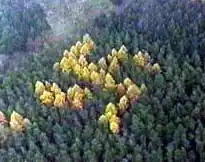
The forest swastika was a patch of 100 larch trees in a pine forest located near Zernikow, Uckermark district, Brandenburg, northeastern Germany. The trees were arranged with their light colors to look like a swastika, and it covered a 0.36 ha (0.89 acres) area. It was removed by the German government in 2000.
History
Reports say the larches were planted in 1938. It is unclear how the trees came to be planted and arranged in such a fashion. They may have been planted in commemoration of Adolf Hitler's 50th birthday, either by local Hitler Youth members[1] or by a warden.[2]
For a few weeks every year in the autumn and in the spring, the colour of the larch leaves would change, contrasting with the deep green of the pine forest.[2] The short duration of the effect, combined with the fact that the image could only be seen from the air, and the relative scarcity of privately owned airplanes in the area, meant that the swastika went largely unnoticed after the fall of Nazi Germany. During the subsequent communist period, Soviet authorities reportedly knew of its existence, but made no effort to remove it.[3]
In 1992, an analyst examining aerial photographs of the area noticed the design; the decisive image had been taken in autumn, when the larches' yellow-brown needles contrasted with the surrounding pines.[4]
Removal
The Brandenburg state authorities, concerned about damage to the region's image and the possibility that the area would become a pilgrimage site for Nazi supporters, attempted to destroy it by removing 43 of the 100 larch trees in 1995. The swastika remained visible, and some trees had regrown; in 2000, German tabloids published aerial photographs showing its prominence. By this time, ownership of around half the land on which the trees sat had been sold into private hands, but on 4 December 2000, a further 25 trees on the government-owned area were felled, and the image was largely obscured.[2][5]
Similar incidents
In the late 1970s, American troops discovered a swastika along with the numbers "1933" planted in a similar style in Hesse.[6] Who planted the trees is unknown.
In September 2006, The New York Times reported on a reversed forest swastika made of fir trees in Eki Naryn, Kyrgyzstan, on the edge of the Tian Shan Mountains. It is about 200 metres (660 feet) across. Myths and legends abound about how and when the swastika came to be planted in Soviet territory.[7]
See also
- Olympic oaks, arboreal relics of 1930s Germany
- List of individual trees
References
- ↑ Cleaver, Hannah (30 November 2000). "Berlin forest swastika to go but its image may remain". The Daily Telegraph. Archived from the original on 11 March 2007. Retrieved 9 March 2006.
- 1 2 3 Askin, Jennifer (4 December 2000). "Germany Destroys Forest Swastika". ABC News. Retrieved 19 September 2009.
- ↑ "German forest loses swastika". BBC News. 4 December 2000. Retrieved 9 March 2006.
- ↑ Steyer, Claus-Dieter (4 December 2000). ""Hakenkreuzwald": Holzfäller im Forst bei Zernikow" ["Swastika forest": Loggers in the forest near Zernikow]. Der Tagesspiegel (in German).
Tatsächlich stieß 1992 ein Auswerter von Luftbildaufnahmen auf das Hakenkreuz im Wald. Das entscheidende Foto war im Herbst entstanden, wo die Lärchen ihre Nadeln gelb-braun färben und sich so von den Kiefern absetzen.
- ↑ "Der Hakenkreuz-Wald bei Zernikow kam unter die Säge" [The swastika forest near Zernikow came under the saw]. Berliner Zeitung (in German). 5 December 2000.
Es ist Montag, kurz nach acht Uhr. Braun hat den ersten Baum des "Hakenkreuz-Waldes" von Zernikow (Uckermark) gefällt. 24 weitere folgen.
- ↑ Alex Moore (9 July 2013). "Germany's insane 'Swastika Forests' are still an unsolved mystery". deathandtaxesmag.com.
- ↑ C. J. Chivers (16 September 2006). "Secrets and Lies Shroud Origins of Giant Swastika". The New York Times. Retrieved 9 April 2009.
External links
- "Swastika made of living trees cut down in German forest" CNN, 4 December 2000, retrieved 9 March 2006
- "Berlin forest swastika to go but its image may remain" from the Daily Telegraph
- (in German) "Der Hakenkreuz-Wald bei Zernikow kam unter die Säge", Berliner Zeitung from 5 December 2000. Accessed through Internet Archive.
- (in German) "Das Kreuz im Wald", Die Zeit, 12 August 2004. URL last accessed 14 March 2006.