Fissidens fontanus

| Fissidens fontanus | |
|---|---|
Scientific classification  | |
| Kingdom: | Plantae |
| Division: | Bryophyta |
| Class: | Bryopsida |
| Subclass: | Dicranidae |
| Order: | Dicranales |
| Family: | Fissidentaceae |
| Genus: | Fissidens |
| Species: | F. fontanus |
| Binomial name | |
| Fissidens fontanus (Bach.Pyl.) Steud. | |
| Synonyms | |
| |
Fissidens fontanus, commonly known as limp pocket moss or phoenix moss, is a species of aquatic moss belonging to the family Fissidentaceae.
Morphology
Leaf and Growth Morphology
Fissidens fontanus is a pleurocarpic moss that has lance-like leaves with a conspicuous midrib that are around 2-7mm in length.[1] At the base of each leaf, a small folded over lobe is formed resembling a pocket.[1] Leaves have an alternating orientation on the stem, ending in a small tuft of gathered leaves.[1] F. fontanus is intolerant to desiccation, quickly drying out of not in water or areas of high humidity.[2] When dried, the leaves curl in and become wavy in appearance[2] This species is simple to identify in the Fissidens genus, as it is the only member to have spaced apart leaves on the stem[2]

Sporophyte Morphology
Sporophytes are located on the stem of F. fontanus, often located in the leaf base.[1] The capsules are short, under around 1mm, and erectly point away from the stem.[1]

Range
Fissidens fontanus has a wide distribution, and has been found across Europe, the Mediterranean, North America, Mexico, Chile, Australia, Zambia, and the Arabian Peninsula.[3][4][5]
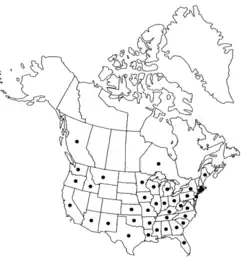
Within North America, it is most commonly found in the eastern United States, particularly in the midwest, south, and Northeast.[6] It is not found in New Hampshire, Vermont, Maryland, and Delaware.[6] It is less common in Western United States, being found in states like California, Oregon, Washington, Arizona, New Mexico and Texas.[6]F. fontanus is sparse in Canada, being present in British Columbia and Ontario.[6]
Habitat
F. fontanus forms thick mattes of vegetative material on various material such as flat bedrock, cobbles, roots masses or logs.[1]F. fontanus tolerates water pH of 6.0 to 8.0.[2]F. fontanus is typically found in slow-moving or still water. While this moss is considered to be an aquatic species, it can be found growing emerged in areas where the water levels vary seasonally.[3][5]F. fontanus can be found in both natural and man-made aquatic environments, and seems to be somewhat tolerant of pollutants.
Ecology
Fissidens fontanus is predated upon by multiple organisms including aquatic mollusks and Trumpeter Swans [7][8]
References
- 1 2 3 4 5 6 "Collecting Mosses", Common Mosses of the Northeast and Appalachians, Princeton: Princeton University Press, 2013, doi:10.1515/9781400845880.20, ISBN 978-1-4008-4588-0, retrieved 2026-03-13
- 1 2 3 4 "Water Pocket Moss (Fissidens fontanus)". www.illinoiswildflowers.info. Retrieved 2026-04-12.
- 1 2 Sérgio, C; Vieira, C; Silva, I; Brugués, M; Cros, R; Stow, S (May 2010). "Update on the distribution,ecology and conservation of Fissidens fontanus in Portugal". Field Bryology (101): 8–11.
- ↑ Hugonnot, Vincent; Pépin, Florine (2025). "Fissidens fontanus (Bach.Pyl.) Steud. and allies: aquatic bryophytes of the Asir granite highlands (Arabian Peninsula)". Thaiszia Journal of Botany (35): 104–113.
- 1 2 Anđić, Branko; Dragićević, Snežana; Stešević, Danijela; Papp, Beáta (January 2018). "Fissidens fontanus, a new species to Montenegro". Lindbergia. 41 (1): 01094. doi:10.25227/linbg.01094. ISSN 0105-0761.
- 1 2 3 4 5 Flora of United States. Vol. 27. New York: Oxford Press. 2007. p. 343. ISBN 978-0-19-531823-4.
- ↑ "Chapter 4-6 Invertebrates: Mollusks" (PDF). April 12, 2026.
- ↑ Schorger, A. W. (1964). "The Trumpeter Swan as a Breeding Bird in Minnesota, Wisconsin, Illinois, and Indiana". The Trumpeter Swan as a Breeding Bird in Minnesota, Wisconsin, Illinois, and Indiana. 76 (4).