Fire service vehicles in Germany

Fire vehicles in Germany are subject to many special requirements; they must be as multifunctional as possible, and must be usable in all kinds of terrain such as cities, forests, fields, and mountains. To ensure simple and straightforward use even across regions, the German Institute for Standardisation (DIN) has standardized many emergency vehicles.[1]
Classification
In Germany, there are two criteria for classification of fire vehicles: crew size and standardization.
Crew size
German fire vehicles can be classified according to the tactical unit that occupies them. This is particularly important for operations requiring a large number of personnel to ensure transport of all first responders to the scene. This classification divides fire vehicles into 3 groups.
German fire vehicle seating is typically described using 4 numbers (for example, (0/1/2/3). The first number represents the number of platoon leaders (Zugführer). This is mainly used when referring to groups of vehicles (such as the Rüstzug), and is thus often left out when describing individual vehicles. The second describes the number of unit leaders, either squad leaders (Staffelführer) or group leaders (Gruppenführer). The third number describes the amount of standard crew members. This includes engineers (Maschinisten), troop leaders (Truppführer) (aside from when counting Truppfahrzeuge), and troop men (Truppmänner). The final number, which is sometimes underlined, is the total amount of people of any classification.[2]
- ATruppfahrzeug (0/1/2/3) has 3 crew members: A troop leader (Truppführer), a crew member (Truppmann) and an engineer (Maschinist). Examples of Truppfahrzeuge are aerial rescue vehicles (Hubrettungsfahrzeuge), water tender engines (TLFs), hose vehicles (Schlauchwagen), Rüstwagen (RWs), and Gerätewagen (GWs).[2][1][3][4]
- A Staffelfahrzeug (0/1/5/6) has 6 crew members: A squad leader (Staffelführer), an engineer (Maschinist) and two troops (each having a troop leader (Truppführer) and a crew member (Truppmann), respectively). Examples of Staffelfahrzeugen are portable pump vehicles (TSFs), some water tender engines (TLFs), and small fire engines (KLFs).[2][1][3][4]
- A Gruppenfahrzeug (0/1/8/9 or 1/0/8/9) has 9 crew members: A group leader (Gruppenführer), an engineer (Maschinist), a Melder, and three troops (each having a troop leader (Truppführer) and a crew member (Truppmann), respectively). Examples of Gruppenfahrzeugen are Löschgruppenfahrzeuge (LFs), Hilfeleistungslöschgruppenfahrzeuge (HLFs), Mannschaftstransportfahrzeuge (MTFs/MTWs), and often Mehrzweckfahrzeuge (MZFs).[2][1][3][4]
Standardization
Most German fire vehicles are standardized in accordance with DIN. DIN 14500 through 14599, as well as DIN 14700 to 14709 are used for this purpose.
List of standardized German fire engine types
| Vehicle name (German) | Abbreviation | Pump | Main task(s) | Gross vehicle weight (metric tons) | Crew size | Minimum tank volume |
|---|---|---|---|---|---|---|
| Tragkraftspritzenfahrzeug | TSF | PFPN 10-1000 | Firefighting | 4,75 t | Staffel (0/1/5/6) | – |
| Tragkraftspritzenfahrzeug mit Wasser | TSF-W | PFPN 10-1000 | Firefighting | 7,5 t | Staffel (0/1/5/6) | 500 to 750 l |
| Kleinlöschfahrzeug | KLF | PFPN 10-1000 | Firefighting | 4,75 t | Staffel (0/1/5/6) | 500 l |
| Mittleres Löschfahrzeug | MLF | FPN 10-1000 | Firefighting | 9 t | Staffel (0/1/5/6) | 600 to 1000 l |
| Löschgruppenfahrzeug 10 | LF 10 | FPN 10-1000 | Firefighting / technical assistance | 14 t | Gruppe (0/1/8/9) | 1200 l |
| Hilfeleistungslöschgruppenfahrzeug 10 | HLF 10 | FPN 10-1000 | Firefighting / technical assistance | 14 t | Gruppe (0/1/8/9) | 1000 l |
| Löschgruppenfahrzeug 20 | LF 20 | FPN 10-2000 | Firefighting / technical assistance | 16 t | Gruppe (0/1/8/9) | 2000 l |
| Hilfeleistungslöschgruppenfahrzeug 20 | HLF 20 | FPN 10-2000 | Firefighting / technical assistance | 16 t | Gruppe (0/1/8/9) | 1600 l |
| Löschgruppenfahrzeug 20 für den Katastrophenschutz | LF 20 KatS | FPN 10-2000 | Firefighting / technical assistance | 16 t | Gruppe (0/1/8/9) | 1000 l |
| Tanklöschfahrzeug 2000 | TLF 2000 | FPN 10-1000 | Firefighting | 14 t | Trupp (0/1/2/3) | 2000 l (1800 l) |
| Tanklöschfahrzeug 3000 | TLF 3000 | FPN 10-2000 | Firefighting | 14 t | Trupp (0/1/2/3) | 3000 l |
| Tanklöschfahrzeug 4000 | TLF 4000 | FPN 10-2000 | Firefighting | >16 t | Trupp (0/1/2/3) | 4000 l + 500 l foam |
| Drehleiter 12/9 | DLK 12 (DLAK 12/9) | – | Rescue | 13 t | Trupp (0/1/2/3) | – |
| Drehleiter 18/12 | DLK 18 (DLAK 18/12) | – | Rescue | 14 t | Trupp (0/1/2/3) | – |
| Drehleiter 23/12 | DLK 23 (DLAK 23/12) | – | Rescue | 16 t | Trupp (0/1/2/3) | – |
| Teleskopgelenkmast 18/12 | TGM 18/12 | – | Firefighting / technical assistance / rescue | 16 t | Trupp (0/1/1/2) | – |
| Teleskopgelenkmast 23/12 | TGM 23/12 | – | Firefighting / technical assistance / rescue | 16 t | Trupp (0/1/1/2) | – |
| Wechselladerfahrzeug | WLF | – | Logistics | >16 t | Trupp (0/1/1/2) | – |
| Rüstwagen | RW | – | Technical assistance | 16 t | Trupp (0/1/2/3) | – |
| Gerätewagen Gefahrgut | GW-G | – | Hazardous material incidents | 16 t | Trupp (0/1/1/2 oder 0/1/2/3) | – |
| Gerätewagen Logistik 1 | GW-L1 | – | Logistics | 7,5 t (16 t) | Trupp (0/1/2/3) or Staffel (0/1/5/6) | – |
| Gerätewagen Logistik 2 | GW-L2 | – | Logistics | 16 t | Staffel (0/1/5/6) | – |
| Kommandowagen | KdoW | – | Command | 3,5 t | (0/1/2/3) | – |
| Einsatzleitwagen 1 | ELW 1 | – | Command | 4,75 t | (0/1/2/3) | – |
| Einsatzleitwagen 2 | ELW 2 | – | Command | 16 t (>16 t) | Trupp (0/1/2/3) | – |
Sources: Deutsches Institut für Normung – Feuerwehrfahrzeug-Typenliste der gängigsten Fahrzeuge,[1] Landesfeuerwehrschule Schleswig-Holstein – Fahrzeug- und Gerätekunde - Lehrgang Gruppenführung[5], Kreisjugendfeuerwehr Nordhausen – Übersicht: Kurzzeichen im Feuerwehrwesen nach DIN 14033[6]
Command vehicles

The Einsatzleitwagen (ELW) transports the incident commander (Einsatzleiter) to the scene and helps them coordinate operations. For this reason, they transport various maps, radios, reference materials, and other command resources. Currently, 3 Einsatzleitwagen are standardized: KdoW; ELW 1; and ELW 2.[7][8][9][10][5]
ELW 1
The ELW 1 is primarily used by incident command for traveling to and surveying incidents, as an aid for leading tactical units, and as an aid for commanding formations. However, it lacks staff-style command operations. It is standardized according to DIN 14507-2.[9][11][5]
ELW 2

The ELW 2 is used in larger scenarios where significant coordination is required. The ELW 2 not only has radio work stations, but also a meeting room; in total, it must have 3 separate rooms/compartments. The ELW 2 is standardized according to DIN 14507-3.[9][10][12][5]
KdoW
The Kommandowagen (KdoW) is used by the incident command for traveling to and surveying incident sites. Depending on the department, it can be the official vehicle of the full-time fire chief (Kommandant). The KdoW is standardized according to DIN 14507-5.[10][13][5]
Fire engines (Löschfahrzeuge)
Fire engines (Löschfahrzeuge) carry equipment for fighting fires. This includes pumps, hoses, nozzles, and typically a water tank, in addition to other technical equipment. Their primary task is firefighting.

Portable pump vehicles (Tragkraftspritzenfahrzeuge/TLF)
Tragkraftspritzenfahrzeuge (TSFs) are small fire engines equipped with firefighting equipment. They seat a squad (Staffel) and have a maximum vehicle weight of 4,75 t (4,5 t without SCBA equipment). They are light vehicles, primarily used by volunteer fire departments covering smaller areas. They do not have a permanent pump, rather they carry a portable fire pump (PFPN 10 / 1000) mounted on a sled in the rear of the vehicle. The TSF seats only a squad (Staffel), but still has the complete equipment for a group (Gruppe) on board, including 4 SCBA units and a 4-part sectional ladder.[7][14][5][15][16][17]

Currently, 3 Tragkraftspritzenfahrzeuge are standardized: TSF; TSF-W; TSF-L
Small fire engine (Kleinlöschfahrzeug/KLF)
The Kleinlöschfahrzeug (KLF) is a fire engine equipped with at least one portable pump PFPN 10-1000 standardized in DIN 14530-24, equipment for quick water access, a water tank with a minimum usable volume of 500 L (130 US gal), and firefighting equipment for a Gruppe (group) (0/1/8/9). The vehicle sits a Staffel (squad) (0/1/5/6). The vehicle is mainly used for firefighting and along with its crew, forms an independent tactual unit.[18][19][20]
The maximum allowed length is 6 m (20 ft), the maximum allowed width is 2.3 m (7.5 ft), and the maximum allowed height is 2.6 m (8.5 ft). The allowed weight is limited to 4,750 kg (10,470 lb).[7][20]

Aside from the standardized KLF, there are also non-standardized, custom vehicles used by departments that carry the same name.[21]
Medium fire engine (Mittleres Löschfahrzeug/MLF)
Mittlere Löschfahrzeuge (MLFs), formerly known as „Staffellöschfahrzeug“ (StLF) in the old DIN standard, are medium-sized fire engines that fall between the LF 10 and the TSF-W. They are standardized by DIN 14530-25, and fill the gap from small and medium-sized fire departments needing a small, standardized, multi-purpose vehicle. A vehicle sits a Staffel (squad), and has a maximum weight of 9,000 kg (20,000 lb). It must have a usable water supply of at least 600 L (160 US gal), extensive firefighting equipment, and a limited amount of technical assistance equipment.[22][5][23]
Löschgruppenfahrzeuge (LF)

Löschgruppenfahrzeuge (LFs) are the backbone of nearly every firefighting operation. They carry the majority of the firefighting equipment and a significant portion of the crew (a Gruppe), as well as one or two centrifugal fire pumps. Thanks to the built in tanks and quick-attack system (Schellangriffseinrichtung), initial firefighting operations can begin, even without a water source.[5][24][25]
Currently, 3 LFs are standardized: the LF 10, the LF 20, and the Löschgruppenfahrzeug 20 KatS.
LFs built to the old standards are still very common. Example of this are: LF 8, LF 8/6, LF 10/6; LF 16, LF 16/12, LF 20/16; and LF 24. There also exists the LF 16-TS, which carries a portable pump and is primarily used for disaster relief. Its equipment involves, among other things, 600 m (2,000 ft) of B hoses. The successor of the LF 16-TS is the LF 20 KatS, set by the new standards. According to the old naming standard, LF stood for Löschgruppenfahrzeug and the number before the slash indicated the output of the centrifugal pump (20 for a nominal output of at least 2,000 L (530 U.S. gal) per minute at a pressure of 10 bar (150 psi). The following number stood for the tank volume in units of 100 liters (26 U.S. gal).[7][24]

Hilfeleistungslöschgruppenfahrzeug (HLF)
Hilfeleistungslöschgruppenfahrzeuge (HLFs) are common in larger fire brigades and are characterized by their wide assortment of technical assistance equipment supplementing the firefighting equipment. The vehicle is designed to fit 9 people. Currently, only the HLF 10 (formerly HLF 10/6) and the HLF 20 (formerly HLF 20/16) are standardized.[7][5][26]
Water tender engines (Tanklöschfahrzeuge/TLF)

Tanklöschfahrzeuge (TLFs) are vehicles that mainly serve to supply water and other extinguishing agents over extended periods of time, sometimes in a shuttle service if necessary. They are often necessary, particularly when it comes to dealing with wildfires.[5][27]
In addition to extinguishing agents, TLFs transport part of the necessary equipment to deal with fires. Newer vehicles are crewed with Truppbesatzung (0/1/2/3), but older standards also allowed TLFs with Staffelbesatzung (0/1/5/6). TLFs can typically respond to smaller emergencies, such as burning garbage cans, etc., on their own.[5]
Currently, 3 types of TLF are standardized: the TLF 2000, the TLF 3000, and the TLF 4000, with the number signifying the water tank volume in liters.[7][28]
In the past, the TLF 24/50, the TLF 16/24-Tr, the TLF 20/40, and the TLF 20/40-SL were all standardized. Some vehicles built to older standards such as the TLF 8/8, the TLF 8/18, and the TLF 16/25, as well as those mentioned before are still common to this day.[29][30][31][32][33]
In addition, there are also large tank fire engines such as the Großtanklöschfahrzeug (GTLF), a larger variant of the TLF. In Brandenburg, the TLF 16/45 was designed specifically to fight forest fires. The Lower Saxon wildfire vehicle was the TLF 8 W.[34][35][36][37][38]
Turntable ladders (Drehleitern/DL/DLK)
Turntable ladders (Drehleitern, DL/DLK) are the best-known and most widespread aerial rescue vehicles in Germany. They allow access to higher stories via an extendable ladder. The abbreviation DL stands for „Drehleiter“, meaning "turntable ladder", and the abbreviation DLK stands for „Drehleiter mit Rettungskorb“, or "turntable ladder with rescue basket". The first number following either DL or DLK is the maximum rescue height in meters.[39][7][5]
The new abbreviations, DLA(K) and DLS(K), stand for "automatic turntable ladder (with basket)" ("Drehleiter Automatik (mit Korb)") and "sequential or half-automatic turntable ladder" ("Drehleiter Sequentiell bzw. Halbautomatik"). DLA turntable ladders can perform multiple lifting movements at the same time, whereas DLS ladders can only do one at a time. Because of this, DLS ladders cannot meet the requirements for setup time and are no longer procured in Germany.[7]

Currently, 3 turntable ladders are standardized in Germany as aerial rescue vehicles:[7]
- DLA/DLS (K) 12-9
- DLA/DLS (K) 18-12
- DLA/DLS (K) 23-12
The hand-operated DL 16-4 was standardized up until 2011.[40][41]
Additionally, there are several types of turntable ladder that are versions of the DLK 23-12, but have a longer ladder assembly and are therefore not standardized such as the DLK 37 and the DLK 44.[42][43]
Rescue and equipment vehicles
Rescue and equipment vehicles bring special materials and equipment for technical assistance (such as for vehicle and chemical accidents). They usually only have a small crew.
Rescue vehicle (Rüstwagen/RW)

Rüstwagen (RW) are fire vehicles used for large-scale technical assistance. They are commonly used for severe vehicle accidents, rescue situations, electricity supply, severe weather situations, building collapses, oil spills, and much more.[5]
RWs have all-wheel-drive, a winch, a generator, and many types of equipment. They provide the majority of the equipment for a rescue unit (Rüstzug), and have a Truppbesatzung (0/1/2/3). The Rüstwagen does not typically constitute an independent unit, and is typically paired with at least one water-supplying vehicle.[7][44][45][14]
A Rüstzug is made up of a command vehicle (Einsatzleitwagen), a Hilfeleistungslöschfahrzeug, a Rüstwagen, and other vehicles if available.[46]
Currently, there is only one standardized Rüstwagen.[47] However, there are still many older Rüstwagen in the 3 old size categories, RW 1; RW 2; and RW 3. The standard was changed in 2002, although RW 3 had already been removed from the standard earlier.[48]
Equipment vehicle (Gerätewagen/GW)

Gerätewagen (GW) are fire vehicles designed for technical assistance. They can have all-wheel drive and usually carry highly specialized equipment. The vehicles can be assigned to different categories depending on the specialization of their equipment.[44][5]
Currently, three Gerätewagen are DIN-standardized (according to DIN 14555): Gerätewägen Logistik GW-L1 and GW-L2 as well as the Gerätewagen Gefahrgut (GW-G). The former two are used for logistics, and the latter is used for hazardous materials.[49][50][51][48]
The GW-G1, GW-G2, GW-G3; GW-Öl, and the SW 2000-Tr are no longer standardized but still commonly found across Germany. There are also many other forms of Gerätewagen that aren't standardized.[48]
Fire service crane (Feuerwehrkran/FwK)
Fire service cranes (Feuerwehrkräne/FwK) are also not standardized, and are intended for lifting heavy loads (such as humans, animals, vehicles, trees, etc.) and for supporting technical assistance operations, although they can also be used directly for firefighting. They are among the largest and most expensive fire vehicles in Germany.[52][53][54]
Hook-lift vehicles and roll-off containers (Wechselladerfahrzeuge//WLF and Abrollbehältern/AB)
Hook-lift vehicles (Wechselladerfahrzeuge, WLF) are special vehicles used to transport roll-off containers (Abrollbehältern, AB) with specific firefighting gear. They carry a crew of 3 und together with the equipment in the relevant container, typically form an independent tactical unit.[55][48]
Common roll-off containers include: AB Einsatzleitung (operation control), AB Pumpen (pumps), AB Mulde (dump bed), AB Atemschutz (SCBA), AB Gefahrgut (hazardous materials), AB Sonderlöschmittel (special extinguishing agents), and AB Rüstmaterial (rescue equipment).[56][57][5]
Hook-lift vehicles can also be equipped with a crane.
Emergency rescue vehicles
Emergency rescue vehicles are used for emergency rescue and patient transport, and can be operated by a fire department or, commonly, other organizations such as the German Red Cross or the Johanniter.[58]
The patient transport ambulance, emergency ambulance, and the mobile intensive care unit are all standardized in DIN EN 1789 and the emergency physician vehicle is regulated in (DIN 75079).[59][60]
Non-standardized fire service vehicles
Small emergency vehicle (Kleineinsatzfahrzeug/KEF)
Kleineinsatzfahrzeuge (KEF), also known locally as Kleinalarmfahrzeug (KlAF), are equipment vehicles used to handle relatively minor incidents. The crew and equipment can vary significantly. Due to their range of applications, this type of vehicle is very common in urban fire departments.[61][62]
Special fire engines (Sonderlöschfahrzeuge/SLF)

Sonderlöschfahrzeuge (SLF) are fire engines designed for highly specialized firefighting. They are typically used by non-public fire brigades (Werkfeuerwehren) or very large fire departments and are fundamentally different from conventional fire engines. Examples of these vehicles are the airport crash tender (Flugfeldlöschfahrzeuge, FLF), the fire tank (Löschpanzer), foam fire engines (Schaumlöschfahrzeuge), and aerosol fire engines (Aerosollöschfahrzeuge, also known as „Turbolöscher“).[63][64][65]
Disaster response vehicles (KatS)

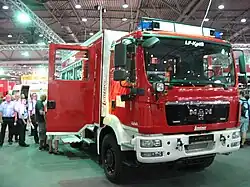
Disaster response and civil protection vehicles form a separate category of fire vehicles, generally with "KatS" (short for "Katastrophenschutz") in the name. They are typically not standardized according to DIN, but rather are described by the Federal Office of Civil Protection and Disaster Assistance (Bundesamt für Bevölkerungsschutz und Katastrophenhilfe) in a procurement request, centrally procured, and subsequently distributed to aid organizations throughout Germany. Thus, the vehicles remain property of the federal government. The procurement requests are typically more specific than typical vehicle standards, since they define specific chassis, bodies, engines, and equipment.[5] Certain states add extra equipment in addition to the federal standards; for example, Lower Saxony has a state-specific disaster relief vehicle, the LF-KatS-NDS, in addition to those following the federal blueprint. It, however, is designed to not overly deviate from the federal standard.[66][67]
Disaster response vehicles are designed for joint use in major incidents, but remain available to their respective fire department for regular operations as well.
Rail vehicles

Rail-bound rescue equipment, typically a train made up of one or several locomotives and wagons, can be deployed in the case of an accident on or near a railway line. However, they are not fire engines in the typical sense. The trains, often referred to as rescue train (Rettungszug), fire and rescue train (Lösch- und Rettungszug) or tunnel assistance train (Tunnelhilfszug), are positioned in central areas and can be staffed by railway personnel, firefighters, and paramedics as needed. They serve as support to the local emergency services, not as replacement.[68]
Additionally, there are vehicles such as the Hilfeleistungslöschfahrzeug 24/14-S that can travel on railroad tracks using a rail wheel set. These vehicles are often primarily intended for tunnels.[69]
Fire service trailers (FwA)
Fire service trailers (FwA) are used to transport equipment to the scene of an incident. They are especially used by fire departments that can't afford the vehicles that would normally come with the equipment. Most fire service trailers are not standardized, with a notable exception being the boat trailer for the multi-purpose boat (MZB) and rescue boat (RTB)[70][71][72]
Fireboats
The following boats are used by fire departments in Germany:[73][74][75]
- Multi-purpose boats/Mehrzweckboote (MZB)
- Extinguishing boats/Feuerlöschboote (FLB)
- Rescue boats/Rettungsboote (RTB1 and RTB2)
The MZBs and RTBs are standardized in accordance with DIN 14961.[73]
Equipment
Pumps

Pumps permanently integrated into vehicles can be categorized either as a front pump or a back pump. Front pumps are used in vehicle types that have a second pump in the back, or in vehicles that drive directly up to water sources (such as the LF16-TS). Newer vehicles typically have the integrated pump in the back, and a second, portable pump on the side.[76][77][78][79]
If only one pump is available, it is typically in the back behind the water tank, as the hose length from water tank to pump is minimized in this configuration. Additionally, the engineer (Maschinist) is generally safer standing by a pump in the back as opposed to by one on the side, particularly by tighter accident sites.
Radio
Fire engines are typically equipped with two-way radio to facilitate communication between tactical units. For this, 2-meter band handheld radios are used for on-site communication, whereas 4-meter band is used for communication between vehicles and disptatch.[80] The switch to digital radio has been planned nationwide, and as of 2018, has been implemented in some places while others are still in the planning stage. This modern system is expected to provide better and more reliable communication, even over district and state borders.[81][82]
History
Fire vehicles before World War I


The first fire vehicles were built by hand and were based on the design of coaches and wagons. Until the end of the 19th century, there were practically only two types of fire vehicle: the pump wagon (Spritzenwagen) and the portable ladder (Schiebeleiter), where were brought either by horses or the crew to the site.[83] They were built of out of wood and were operated by muscle power, meaning they weren't always consistently reliable.
Due to industrialization, fire departments became increasingly mechanized. The history of modern fire vehicles began in 1902, when the Freiburg-based company Grether & Cie built the first fire engine with a combustion engine.[84][85] The next milestone came in 1904, when Magirus (later Magirus-Deutz now Iveco Magirus) built the first motor-powered turntable ladder in the world, which still had to be extended by hand.[86][87] Shortly after came motor pumps, which helped Magirus achieve economic success. Other fire equipment manufacturers also began installing fire truck bodies on truck-chassis at that time.
Fire vehicles after World War I
After World War I, the foundations for modern firefighting were laid. The vehicles got better, more multifunctional, and more modern. Rules and regulations were established that dictated how they could look and how they were to be used. Their development received a large boost, particularly during the Nazi era. On March 1, 1937, it was dictated that all fire service vehicles were to be painted fir green. From November 23, 1938 onwards, fire departments were put under the control of the police.[88][89][90] Professional fire departments were renamed to Feuerschutzpolizei (Fire Protection Police), and volunteer fire departments became technical auxiliary units of the police, although the latter retained their title. Additionally, military fire brigades were formed.[89][91][92]
Uniform building regulations went into effect in 1940. These laid out regulations for several types of fire engines such as the;[93][94][95][96][90]
- Leichtes Löschgruppenfahrzeug (LLG, later LF 8)
- Schweres Löschgruppenfahrzeug (SLG, later LF 15)
Additional regulation allowing more types of vehicles went into effect on February 1 and June 1, 1941.[93]
On August 14, 1942 came orders that all vehicles were to be delivered in matte black-gray (RAL 7021), and on April 7, 1943, the paint scheme was changed to matte yellow-gray (RAL 7028).[93][97]
Fire engines after World War II
West Germany

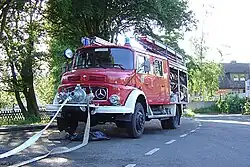
Following World War II, a host of vehicles was designed, many of which are still in use today. This includes most classic fire engines, Tanklöschfahrzeuge, turntable ladders, Rüst- and Gerätewagen, and much more. As time progressed, the vehicles developed.[98][90][99]
Experience fighting forest fires and bush fires led to the development of larger and all-terrain water tenders and hose trucks.[99]
Over time, the demands placed on the vehicles increased, and newer and larger engines were developed, although they also became increasingly similar to each other; for example, Löschgruppenfahrzeuge (LFs) got a quick-attack setup (Schnellangriffseinrichtung) and a tank, and water trucks got hydraulic rescue tools.[100][101] At the same time however, more differences developed, such as with turntable ladders. From 1980 onward, new turntable ladders with low-entry cabs were introduced, with the cab positioned ahead of the front axle in order to reduce the overall height of the vehicle. This was particularly helpful for operations in narrow city centers.[102][103]
East Germany

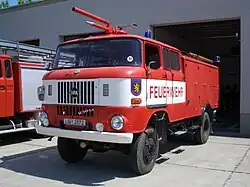
The development of fire vehicles in East Germany began in 1949 with the presentation of various models. Production of fire vehicles in East Germany began in 1951 in the VEB Phänomen Werk in Zittau. The VEB Horch Automobilwerk in Zwickau began production two years later in 1953.[104][105][106]
Following the war, there was no production of turntable ladders in East Germany until the Ministry of the Interior ordered VEB Feuerlöschgerätewerk Luckenwalde to begin production in 1955. Large-scale production of turntable ladders in East Germany began in 1962.[107]
Emergency vehicles in East Germany at the time were subject to strict regulation in accordance with TGL (comparable to DIN).[108][109]
There were three main locations for the production of fire service vehicles in East Germany:
- In Luckenwalde: the successor of the company Koebe, the VEB Feuerlöschgerätewerk Luckenwalde (now Rosenbauer)[110]
- In Görlitz: The VEB Feuerlöschgerätewerk Görlitz, formerly the company G.A. Fischer[111]
- In Jöhstadt: the VEB Feuerlöschgerätewerk Jöhstadt, the successor of the company Flader.[112][113]
Fire engines today

Over time, the variety of both standardized and non-standardized fire vehicles makes it increasingly difficult to assess their operational value. As a result, different size variations of the same vehicle are frequently consolidated into the same classification.[114]
Nowadays, the largest manufacturers of fire engines and fire service vehicles in Germany are Magirus, Metz Aerials, Rosenbauer, Schlingmann and Ziegler. In addition, there are many smaller body manufacturers such as BAI, ITURRI Feuerwehr- und Umwelttechnik, and Lentner.
See also
Literature
- Feuerwehrfahrzeuge Teil I. Die Roten Hefte (11 ed.). Kohlhammer. 1996. ISBN 978-3-17-013954-1.
- Feuerwehrfahrzeuge Teil II. Die Roten Hefte (11 ed.). Kohlhammer. 1996. ISBN 978-3-17-014285-5.
- Wolfgang Jendsch: Feuerwehrfahrzeuge in Europa. Haus Verlag, 1991, ISBN 978-3-88776-048-9.
- Wolfgang Jendsch: BRAND – Die Feuerwehren der Welt. Weltrundschau Verlag, diverse Beiträge über Feuerwehrfahrzeuge aus aller Welt in den einzelnen Buchausgaben.
- Wolfgang Jendsch: Feuerwehren – Spezialfahrzeuge aus aller Welt. Motorbuch Verlag, 2006, ISBN 978-3-613-02601-8.
- Wolfgang Jendsch: Moderne Feuerwehrfahrzeuge aus aller Welt. Motorbuch Verlag, 2009, ISBN 978-3-613-02601-8.
- Wolfgang Jendsch: Feuerwehr-Einsatzfahrzeuge – Waldbrandbekämpfung. Motorbuch Verlag, 2009, ISBN 978-3-613-03033-6.
- Walter Hamilton, Ulrich Kortt, Rolf Schmid: Handbuch für den Feuerwehrmann. 20. Auflage. Boorberg Verlag, 2004, ISBN 978-3-415-03176-0.
- Hans Kemper: Fahrzeugkunde. Ecomed Verlag, ISBN 978-3-609-62105-0.
- Landesfeuerwehrschule Baden-Württemberg: Maschinist für Löschfahrzeuge. Neckar-Verlag, 2002, ISBN 978-3-7883-1966-3.
- Axel Johanßen: Buchreihe Fahrzeuge der Feuerwehr (2008/2009 aktuell: Band 11, ISBN 978-3-939673-04-0, FdFw-Verlag, Köln).
- Axel Johanßen: Deutsche Feuerwehrfahrzeuge von 1990 bis heute. Bassermann-Verlag, 2007, ISBN 978-3-8094-2175-7.
- Udo Paulitz: Buchreihe Alte Feuerwehren. Franckh-Kosmos, Stuttgart.
- Manfred Gihl: Geschichte des deutschen Feuerwehrfahrzeugbaus, Band 1, Von den Anfängen bis 1940: Wie die Feuerwehren mobil wurden. Kohlhammer Verlag, Stuttgart 1996, ISBN 978-3-17-014289-3.
- Manfred Gihl: Geschichte des deutschen Feuerwehrfahrzeugbaus, Band 2, Von 1940 bis heute: Wie die Feuerwehren mobil sind. Kohlhammer Verlag, Stuttgart 2000, ISBN 978-3-17-014290-9.
References
- 1 2 3 4 5 Deutsches Institut für Normung (8 April 2026). "Feuerwehrfahrzeug-Typenliste der gängigsten genormten Fahrzeuge; 26. überarbeitete Fassung vom 08. April 2026" [Fire service vehicle type list of the most common standardized vehicles; 26th revised edition from April 8, 2026] (PDF). DIN (in German) (26 ed.). Archived (PDF) from the original on 10 June 2026. Retrieved 10 June 2026.
- 1 2 3 4 Ausschuss Feuerwehrangelegenheiten, Katastrophenschutz und zivile Verteidigung (AFKzV) (21 February 2008). "FwDV 3 / Feuerwehr Dienstvorschrift 3: Einheiten im Lösch - und Hilfeleistungseinsatz" (PDF). Institut für Brand- und Katastrophenschutz Heyrothsberge (in German) (2008 ed.). Ministerium des Inneren Sachsen-Anhalt. pp. 6–9. Archived (PDF) from the original on 10 November 2025.
- 1 2 3 "Einheiten bei der hessischen Feuerwehr". Freiwillige Feuerwehr Stadt Amöneburg (in German). Retrieved 17 June 2026.
- 1 2 3 "Trupp, Staffel, Gruppe und Zug". Freiwillige Feuerwehr Trogen (in German). Retrieved 2026-06-17.
- 1 2 3 4 5 6 7 8 9 10 11 12 13 14 15 16 Landesfeuerwehrschule Schleswig-Holstein (January 2017). "Fahrzeug- und Gerätekunde - Lehrgang Gruppenführung" [Vehicle and Equipment Knowledge - Group Leader Training Course] (PDF). Kreisfeuerwehrverband Schleswig-Flensburg (in German). pp. 8–18. Archived from the original on 10 June 2026. Retrieved 10 June 2026.
- ↑ "ÜBERSICHT: Kurzzeichen im Feuerwehrwesen nach DIN 14033" (in German). Retrieved 2026-06-17.
- 1 2 3 4 5 6 7 8 9 10 Thüringer Landesfeuerwehr- und Katastrophenschutzschule (August 2020). "Einsatzfahrzeuge der Feuerwehren, der Hilfsorganisationen und des Zivil- und Katastrophenschutzes des Freistaats Thüringen" [Emergency vehicles of the fire brigades, aid organizations, and civil protection and disaster management services of the Free State of Thuringia] (PDF). Thüringer Landesfeuerwehr- und Katastrophenschutzschule (TLFKS) (in German). Archived (PDF) from the original on 20 May 2026. Retrieved 20 May 2026.
- ↑ "Einsatzleitfahrzeuge" [Command vehicles]. GSF Sonderfahrzeugbau Twist (in German). 2022-07-18. Retrieved 2026-05-20.
- 1 2 3 Trier, Amt für Brand-, Zivilschutz und Rettungsdienst- Stadt. "Einsatzleitwagen". Amt für Brand-, Zivilschutz und Rettungsdienst - Stadt Trier (in German). Retrieved 2026-06-06.
{{cite web}}: CS1 maint: multiple names: authors list (link) - 1 2 3 "Führungsfahrzeuge" [Command vehicles]. www.feuerwehr-ueberlingen.de (in German). Retrieved 2026-06-06.
- ↑ Deutsches Institut für Normung (April 2014). "DIN SPEC 14507-2 - Einsatzleitfahrzeuge - Teil 2: Einsatzleitwagen ELW 1". dinmedia (in German). Retrieved 2026-06-10.
- ↑ Deutsches Institut für Normung. "DIN SPEC 14507-3 - Einsatzleitfahrzeuge - Teil 3: Einsatzleitwagen ELW 2". dinmedia (in German). Retrieved 2026-06-10.
- ↑ Deutsches Institut für Normung (June 2014). "DIN 14507-5 - Einsatzleitfahrzeuge - Teil 5: Kommandowagen KdoW". dinmedia (in German). Retrieved 2026-06-10.
- 1 2 "DIN 14530-16 - Löschfahrzeuge - Teil 16: Tragkraftspritzenfahrzeug TSF". din (in German). November 2019. Retrieved 2026-05-20.
- ↑ Feuerwehr Mengen. "Tragkraftspritzenfahrzeug". www.mengen.de (in German). Retrieved 2026-06-10.
- ↑ Magirus. "Magirus TSF-W - Tragkraftspritzenfahrzeug". www.magirusgroup.com (in German). Retrieved 2026-06-10.
- ↑ Ziegler. "TSF-W". Ziegler Feuerwehrfahrzeuge (in German). Retrieved 2026-06-10.
- ↑ "KLF Kleinlöschfahrzeug kaufen | Schmitz Feuerwehrtechnik". www.schmitz-feuerwehr.de (in German). Retrieved 2026-06-10.
- ↑ "Feuerwehr Kapsweyer – Kleinlöschfahrzeug". www.feuerwehr-kapsweyer.de (in German). Retrieved 2026-06-10.
- 1 2 Deutsches Institut für Normung. "DIN 14530-24 - Löschfahrzeuge - Teil 24: Kleinlöschfahrzeug KLF". dinmedia (in German). Retrieved 2026-06-10.
- ↑ Schule Schloss Salem (28 April 2022). "75 Jahre Feuerwehrdienst - Spendenaktion neues Fahrzeug für die Feuerwehr" [75 Years of Fire Service - Fundraising for a new fire vehicle] (PDF). Schule Schloss Salem (in German). pp. 6, 9. Archived (PDF) from the original on 10 June 2026. Retrieved 10 June 2026.
- ↑ "DIN 14530-25 - Löschfahrzeuge - Teil 25: Mittleres Löschfahrzeug MLF". din (in German). Retrieved 2026-05-20.
- ↑ Feuerwehr-Magazin Redaktion (2022-09-19). "12 Fakten zum MLF" [12 facts about the MLF]. Feuerwehr-Magazin (in German). Retrieved 2026-06-10.
- 1 2 "Löschgruppenfahrzeug LF 16/12". Freiwillige Feuerwehr Schöneiche bei Berlin (in German). Archived from the original on 11 June 2026. Retrieved 2026-06-11.
- ↑ "Löschgruppenfahrzeug LF 16/12". Feuerwehr Landstuhl (in German). Retrieved 2026-06-11.
- ↑ "Löschgruppenfahrzeug – Feuerwehr Leingarten" (in German). 2024-07-04. Retrieved 2026-06-11.
- ↑ "Tanklöschfahrzeug - Einfach erklärt". www.ff-welle.de (in German). Archived from the original on 2023-02-07. Retrieved 2026-06-11.
- ↑ e.V, Landesfeuerwehrverband Bayern. "Feuerwehr Lernbar". feuerwehr-lernbar.de (in German). Retrieved 2026-06-11.
- ↑ Innenministerium Baden-Württemberg (14 December 2007). "Verwaltungsvorschrift zur Änderung der VwV Zuwendungen Feuerwehrwesen" (PDF). Kreisfeuerwehrverband Heilbronn (in German) (published 30 January 2008). Archived from the original on 11 June 2026.
- ↑ "Tanklöschfahrzeug TLF 24/50". Freiwillige Feuerwehr Goslar (in German). Retrieved 2026-06-11.
- ↑ Deutsches Institut für Normung (September 1989). "TLF 24/50, DIN 14530, Teil 21". Yumpu (in German). Archived from the original on 11 June 2026. Retrieved 2026-06-11.
- ↑ "Einsatzfahrzeug: Florian Berlin TLF 16/24-Tr B-2197 (a.D.)". bos-fahrzeuge.info (in German). Retrieved 2026-06-11.
- ↑ "Freiwillige Feuerwehr Saarlouis: TLF 20/40-SL (2/24)". www.feuerwehr.saarlouis.de (in German). Retrieved 2026-06-11.
- ↑ Huisinga, Mareike (23 March 2026). "Pirnas Feuerwehr erhält besonderes Einsatzfahrzeug" [Pirnas fire department receives a special emergency vehicle]. Sächsische.de (in German). Archived from the original on 11 June 2026.
- ↑ Rüffer, von Michael (2022-06-09). "5 Besonderheiten der TLF-Waldbrand Typ Brandenburg". Feuerwehr-Magazin (in German). Retrieved 2026-06-11.
- ↑ "Tanklöschfahrzeug TLF 16/45". Freiwillige Feuerwehr Potsdam Bornim (in German). Archived from the original on 15 July 2024. Retrieved 2026-06-11.
- ↑ "TLF 8/18". Freiwillige Feuerwehr Schöndorf (in German). Retrieved 2026-06-11.
- ↑ "TLF 8-W". Ortsfeuerwehr Sibbessee (in German). Retrieved 2026-06-11.
- ↑ "Merkblatt für die Feuerwehren Bayerns" [Information sheet for fire brigades of Bavaria]. Staatliche Feuerwehrschule Würzburg (in German) (24th ed.). Würzburg: Staatliche Feuerwehrschule Würzburg. September 2012. p. 14. Archived from the original on 24 April 2016.
- ↑ Deutsches Institut für Normung (April 1985). "DIN 14702 - Drehleiter DL 16-4, mit Handantrieb". dinmedia (in German). Retrieved 2026-06-11.
- ↑ "DIN 14702 – DL 16-4 ersatzlos zurückgezogen". Drehleiter.info (in German). 2026. Retrieved 2026-06-11.
- ↑ "Einsatzfahrzeug: Innsbruck - BF - DLK 37 (a.D.)". bos-fahrzeuge.info (in German). Retrieved 2026-06-11.
- ↑ "Hoyerswerda: Größte deutsche Drehleiter wird ersetzt". drehleiter.info (in German). Retrieved 2026-06-11.
- 1 2 "Geräte- und Rüstfahrzeuge". www.feuerwehr-ueberlingen.de (in German). Retrieved 2026-06-06.
- ↑ Trier, Amt für Brand-, Zivilschutz und Rettungsdienst- Stadt. "Rüst- und Gerätewagen". Amt für Brand-, Zivilschutz und Rettungsdienst - Stadt Trier (in German). Retrieved 2026-06-06.
{{cite web}}: CS1 maint: multiple names: authors list (link) - ↑ "Taktische Züge". Feuerwehr Neuburg an der Donau (in German). Retrieved 2026-05-20.
- ↑ "DIN 14555-3 - Rüstwagen und Gerätewagen - Teil 3: Rüstwagen RW". din (in German). Retrieved 2026-05-20.
- 1 2 3 4 FEUERWEHRLEBEN (2023-01-29). "Alle Rüstwagen, Gerätewagen und Wechselladerfahrzeug auf einem Blick". Feuerwehrleben (in German). Retrieved 2026-06-11.
- ↑ "Feuerwehrfahrzeuge in Deutschland" [Fire service vehicles in Germany]. Feuerwehr, THW, Rettungsdienst - Wir sind nur Menschen, keine Helden. (in German). 2016-12-17. Retrieved 2026-06-10.
- ↑ Deutsches Institut für Normung (March 2023). "DIN 14555-12 - Rüstwagen und Gerätewagen - Teil 12: Gerätewagen Gefahrgut GW-G". dinmedia (in German). Retrieved 2026-06-10.
- ↑ "Geräte- & Rüstwagen: GW-L & RW | Schmitz Feuerwehr". www.schmitz-feuerwehr.de (in German). Retrieved 2026-06-10.
- ↑ "FwK 30". Feuerwehr Frankfurt am Main (in German). Retrieved 2026-06-10.
- ↑ "Feuerwehrkran" [Fire service crane]. www.feuerwehr.hamburg (in German). Retrieved 2026-06-10.
- ↑ "Feuerwehrkrane" [Fire service cranes]. Liebherr (in German). Retrieved 2026-06-10.
- ↑ "Wechselladerfahrzeuge". www.feuerwehr-ueberlingen.de (in German). Retrieved 2026-06-06.
- ↑ Trier, Amt für Brand-, Zivilschutz und Rettungsdienst- Stadt. "Abrollbehälter". Amt für Brand-, Zivilschutz und Rettungsdienst - Stadt Trier (in German). Retrieved 2026-06-06.
{{cite web}}: CS1 maint: multiple names: authors list (link) - ↑ "Abrollbehälter". www.feuerwehr-ueberlingen.de (in German). Retrieved 2026-06-06.
- ↑ "EMS Around the World: Germany Brings the Doctors to the Action". HMP Global Learning Network. 2020-08-28. Retrieved 2026-06-11.
- ↑ Deutsches Institut für Normung (July 2024). "DIN EN 1789 - Rettungsdienstfahrzeuge und deren Ausrüstung - Krankenkraftwagen; Deutsche Fassung EN 1789:2020+A1:2023". dinmedia (in German). Retrieved 2026-06-11.
- ↑ Deutsches Institut für Normung (April 2026). "DIN 75079 - Notarzt-Einsatzfahrzeuge (NEF) - Begriffe, Anforderungen, Prüfung". dinmedia (in German). Retrieved 2026-06-11.
- ↑ Heidelberg, Stadt. "Feuerwehr Heidelberg - Kleineinsatzfahrzeug". www.heidelberg.de (in German). Archived from the original on 2025-12-09. Retrieved 2026-06-11.
- ↑ "Sonderfahrzeuge". www.feuerwehr-ueberlingen.de (in German). Retrieved 2026-06-11.
- ↑ "Sonderlöschfahrzeuge". WISS Feuerwehrfahrzeuge (in German). Archived from the original on 9 September 2025. Retrieved 2026-06-11.
- ↑ "Sonderlöschfahrzeuge". ITURRI Feuerwehr-und Umwelttechnik GmbH (in German). Retrieved 2026-06-11.
- ↑ MAGIRUS. "Industrielöschfahrzeuge und Sonderlöschfahrzeuge von Magirus". www.magirusgroup.com (in German). Retrieved 2026-06-11.
- ↑ Niedersächsisches Landesamt für Brand- und Katastrophenschutz. "Löschgruppenfahrzeug für den Katastrophenschutz - LF-KatS". Niedersächsisches Landesamt für Brand- und Katastrophenschutz (in German). Retrieved 10 June 2026.
- ↑ Niedersächsisches Ministerium für Inneres und Sport (18 July 2023). "Beladungskonzept Löschgruppenfahrzeug für den Einsatz im Katastrophenschutz – Ausführung Niedersachsen. (LF-KatS-NDS)" [Loading concept for a fire engine for use in disaster control – Lower Saxony version. (LF-KatS-NDS)]. Niedersächsisches Landesamt für Brand- und Katastrophenschutz (in German). Prepared by Andreas Groß. Hannover. Archived from the original on 10 June 2026. Retrieved 10 June 2026.
- ↑ Bundesregierung Deutschland (12 March 2009). "Sicherheit in Eisenbahntunneln" [Safety in rail tunnels] (PDF). Deutscher Bundestag (Response to written parliamentary question) (in German). p. 7. ISSN 0722-8333. Drucksache 16/11791.
- ↑ Heidelberg, Stadt. "HLF 24/14 Schiene". Berufsfeuerwehr Heidelberg (in German). Archived from the original on 2025-07-09. Retrieved 2026-06-11.
- ↑ "Anhänger". www.feuerwehr-ueberlingen.de (in German). Retrieved 2026-06-11.
- ↑ "DIN 14962 - Feuerwehrwesen - Bootsanhänger". din (in German). Retrieved 2026-06-10.
- ↑ "Absenkbare Logistikanhänger". FEIG GmbH (in German). Retrieved 2026-06-11.
- 1 2 "Boote für die Feuerwehr" (PDF). Feuerwehr-Unfallkasse Niedersachsen (in German). Archived from the original (PDF) on 1 May 2025. Retrieved 11 June 2026.
- ↑ "Öl- und Schadenwehr Bodensee". Feuerwehr Friedrichshafen (in German). Retrieved 2026-06-11.
- ↑ "Boote". www.feuerwehr-ueberlingen.de (in German). Retrieved 2026-06-11.
- ↑ "Feuerlöschkreiselpumpe Präsentation - Ausbilderleitfaden für die Freiwilligen Feuerwehren Bayerns – Maschinist für Tragkraftspritzen und Löschfahrzeuge" (PDF). Feuerwehr Lernbar (in German). May 2020. Retrieved 18 June 2026.
- ↑ "Löschgruppenfahrzeug LF 16 - TS :: Freiwillige Feuerwehr Tanna". www.feuerwehr-tanna.de (in German). Retrieved 2026-06-17.
- ↑ "Florian Tübingen 1/45". Feuerwehr Tübingen (in German). Retrieved 2026-06-17.
- ↑ "Löschgruppenfahrzeug mit Tragkraftspritze (intern LF16/TS-9)". Freiwillige Feuerwehr Berghofen (in German). Retrieved 2026-06-17.
- ↑ "Sprechfunk". Freiwillige Feuerwehr Appen (in German). Retrieved 2026-06-17.
- ↑ Peter (2023-07-09). "Behördenfunk in Deutschland: Anspruch und Wirklichkeit". AG KRITIS (in German). Retrieved 2026-06-17.
- ↑ "Feuerwehr - Funkverkehrskreise in 16 Bundesländer 2026 / 2027". www.funkfrequenzen01.de (in German). 1 January 2026. Archived from the original on 5 March 2026. Retrieved 2026-06-17.
- ↑ Die Gründerjahre der Freiwilligen Feuerwehr Obertiefenbach (in German). Der Kreisausschuss des Landkreises Limburg-Weilburg. 1994. pp. 170–171.
- ↑ "Grether & Cie. Freiburg". www.alemannische-seiten.de (in German). Retrieved 2026-06-11.
- ↑ Kaufholz, Bernd. "Mit Tatütata durch die Geschichte". www.volksstimme.de (in German). Retrieved 2026-06-11.
- ↑ "C.D. Magirus". Magirus-Sammlung Roleff (in German). Retrieved 2026-06-11.
- ↑ Museum of Fire Heritage Team (2022-09-01). "How the tables have turned: A brief history on turntable ladders". Museum of Fire. Retrieved 2026-06-11.
- ↑ "Sonstige Dokumente - Vfdb". www.vfdb.de (in German). Retrieved 2026-06-11.
- 1 2 "Die Feuerwehren und ihre Verbände in der nationalsozialistischen Diktatur". Feuerwehr-Museum Heidekreis (in German). Retrieved 2026-06-11.
- 1 2 3 Miller, Carl F. (June 1971). "Fire Fighting Operations in Hamburg, Germany during World War II" (PDF). Defense Technical Information Center. San Mateo, California: URS Research Company. Archived (PDF) from the original on 6 December 2025. Retrieved 17 June 2026.
- ↑ "The Feuerschutzpolizei: Nazi Germany's firefighters". www.talesfromhistory.com. Retrieved 2026-06-17.
- ↑ "German Fire Police | World War II | Stronghold Nation". www.stronghold-nation.com. Retrieved 2026-06-17.
- 1 2 3 Rodehau, Erwin (31 May 2016). "Das Kraftfahrwesen des Feuerlöschdienstes im Deutschen Reich 1933 - 1945" (PDF). Feuerwehrchronik (in German) (3rd ed.). pp. 62–70.
- ↑ "Berliner Feuerwehr: Fahrzeuge von 1923 bis 1942" [Berlin Fire Brigade: Vehicles from 1923 to 1942]. www.berliner-feuerwehr.de (in German). Retrieved 2026-06-17.
- ↑ "Leichtes Löschgruppenfahrzeug | Freiwillige Feuerwehr Kiel | Kiel". Stadtfeuerwehrverband Kiel (in German). Retrieved 2026-06-17.
- ↑ "SLG / LF 15 (Reich)". Freiwillige Feuerwehr Saarlouis (in German). Retrieved 2026-06-17.
- ↑ "LF 15". Freiwillige Feuerwehr - Stadt Brilon (in German). 2008-12-13. Retrieved 2026-06-17.
- ↑ "West German Trucks & military vehicles (1947-90)". truck-encyclopedia.com. Retrieved 2026-06-17.
- 1 2 Gihl, Manfred (2017). "Vom Löschgruppenfahrzeug LF 15 zum Hamburger Löschfahrzeug HLF 20" (PDF). Feuerwehr Hamburg (in German). Hamburg. Retrieved 17 June 2026.
- ↑ "Löschgruppenfahrzeug - LF 10/6". Freiwillige Feuerwehr Flintsbach a.Inn (in German). Retrieved 2026-06-17.
- ↑ "Tanklöschfahrzeug - TLF 16/25". Feuerwehr Garmisch (in German). Retrieved 2026-06-17.
- ↑ "Drehleitern - von 1903 bis heute". Feuerwehr Offenbach (in German). Retrieved 2026-06-17.
- ↑ "Drehleitern BF München". Magirus (in German). 2017-08-01. Retrieved 2026-06-17.
- ↑ "Berliner Feuerwehr: Fahrzeuge von 1951 bis 1995". www.berliner-feuerwehr.de (in German). Retrieved 2026-06-17.
- ↑ "VEB HORCH Kraftfahrzeug- und Motorenwerke Zwickau". motorostalgie (in German). Retrieved 2026-06-17.
- ↑ "Horch H3A Löschfahrzeug LF 15". www.feuerwehrverein-bad-doberan.de (in German). Retrieved 2026-06-17.
- ↑ Nase, Detlef (1999). "DDR-Drehleitern". Yumpu. 2/1999 (in German). Deutsche Feuerwehr-Zeitung. Retrieved 2026-06-17.
- ↑ "TGL und DIN". www.sicher24.de (in German). Retrieved 2026-06-17.
- ↑ "Restauration und Erhalt der Feuerwehrtechnik der DDR - Die Löschtechnik der Feuerwehr der DDR". drk-ddr.de (in German). Retrieved 2026-06-17.
- ↑ "Koebe-Fabrik vor 140 Jahren gegründet". Märkische Allgemeine Zeitung (in German). Archived from the original on 2025-06-03. Retrieved 2026-06-17.
- ↑ "Feuerlöschgerätewerk Görlitz". bos-fahrzeuge.info (in German). Retrieved 2026-06-17.
- ↑ "Preßnitztalbahn". www.stillgelegt.de (in German). Retrieved 2026-06-17.
- ↑ "Requsiten Sammlung". Feuerwehr Sonthofen (in German). Retrieved 2026-06-17.
- ↑ "Fachempfehlung des Fachausschusses Technik der deutschen Feuerwehren - Die Ausschreibung und Beschaffung von Feuerwehrfahrzeugen" (PDF). Deutscher Feuerwehrverband (in German). 19 September 2025. Retrieved 17 June 2026.