Fine Feathers (play)
| Fine Feathers | |
|---|---|
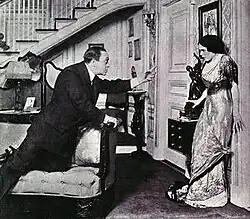 Robert Edeson as Robert Reynolds and Lolita Robertson as Jane Reynolds in the original Chicago production | |
| Original language | English |
| Written by | Eugene Walter |
| Genre | Drama |
| Setting | Staten Island and Long Island, New York |
| Premiere | |
| Date | August 12, 1912 |
| Place | Cort Theatre, Chicago |
Fine Feathers is a 1912 American drama in four acts by Eugene Walter. It concerns an engineer who accepts a bribe to approve inferior cement for a dam, with disastrous consequences. The play premiered at the Cort Theatre in Chicago on August 12, 1912, in a production by H. H. Frazee, and opened on Broadway at the Astor Theatre on January 7, 1913. The Broadway production, directed by Walter, starred Robert Edeson, Wilton Lackaye and Lolita Robertson.
The work developed through several earlier versions and titles, beginning with material by playwright Walter Hackett. Hackett's contribution and the contractual rights to the play became the subjects of several lawsuits. Fine Feathers was later novelized and adapted as a 1915 film and as a second film in 1921.
Development
The play originated in a scenario by Walter Hackett titled C.O.D. Hackett assigned an interest in the work to Frank M. Case, then manager of the Algonquin Hotel, in settlement of an unpaid hotel bill. Eugene Walter subsequently reworked the material for the stage.[1][2]
An early version, titled Fads and Frills, was produced by Charles Dillingham in 1910 but closed after a short run.[2] The Shubert brothers then produced a revised version as Homeward Bound, which was presented at Daly's Theatre in New York and subsequently toured.[3] Another revision, starring Margaret Illington, was announced under the title Who's to Blame? before being staged as Mrs. Maxwell's Mistake.[4][5] After a performance at the Park Theatre in Bridgeport, Connecticut, on April 20, 1911, Mrs. Maxwell's Mistake opened at the Maxine Elliott Theatre in New York on April 24.[6]
Walter later rewrote the comedy as a drama and retitled it Fine Feathers. Producer H. H. Frazee agreed to stage the new version. On June 4, 1912, Case transferred his interest in the work to Walter for $200.[7]
Plot
Bob and Jane Reynolds live modestly in a bungalow on Staten Island, where Bob earns $25 a week. Jane has grown dissatisfied with their limited means and wants the clothes and comforts that they cannot afford. John Brand, a wealthy and unscrupulous former college classmate of Bob's, offers Bob $40,000 to approve the use of inferior cement in the construction of a dam. Bob initially refuses, but Brand persuades Jane to influence her husband, and Bob eventually accepts the bribe.
Five years later, Bob and Jane live in an expensive house on Long Island. Bob has lost money through speculation and has written a $10,000 check against an overdrawn account. Drunk and desperate, he blames Brand for his ruin and threatens to expose the bribery unless Brand helps him. Brand warns that exposing the scheme will also implicate Jane, but he ultimately covers Bob's check.
Bob and Jane decide to abandon their affluent life and begin again. Before they can do so, however, they learn that the dam constructed with the defective cement has collapsed, destroying a community and killing many people. Overcome by guilt, Bob telephones the police and asks that an officer be sent to the house. The lights go out, a gunshot is heard, and Jane realizes that Bob has killed himself.[8]
Productions
Original production
Frazee's production opened at the Cort Theatre in Chicago on August 12, 1912.[9] Walter directed the production. Its principal cast included Robert Edeson as Bob Reynolds, Wilton Lackaye as John Brand and Lolita Robertson as Jane Reynolds. Rose Coghlan, Max Figman, Helen Hilton and Amelia Sumers also appeared in the company.[10]
Broadway and tour
The production opened at the Astor Theatre on January 7, 1913, and ran for 79 performances, closing in March.[10] It subsequently toured the United States. In August 1913, it inaugurated the newly completed Bronx Opera House, where the company played a nine-day engagement.[11]
Authorship and legal disputes
The success of Fine Feathers led to several disputes over its authorship and ownership. Hackett maintained that the finished play remained a joint work based on his original material, while Walter argued that he had substantially rewritten it. Hackett sought an injunction preventing Walter from presenting the play without crediting him as a co-author.[12]
Frank M. Case sued Walter in March 1913 for what he claimed was his unpaid share of the royalties. Days later, Lee Shubert filed a separate suit alleging that Walter had violated the Shuberts' contractual right to produce the work previously known as Homeward Bound.[13][14] Hackett also brought an action asserting joint authorship, and Hackett and Walter later jointly sought to compel Case to transfer any remaining interest in the play.[1]
Other versions
Burlesque and proposed opera
Nine Feathers, a one-act burlesque by Fred Donaghey, was created as a curtain raiser for The Girl at the Gate and was tried out in Detroit in 1912.[15]
In February 1913, Frazee announced that negotiations had been completed for Ruggero Leoncavallo to compose an operatic version of the play. The proposed adaptation was not produced.[16]
Novelizations
Marie Louise Gannon adapted the play as a story for the January 1913 issue of The Green Book Magazine.[17] A second novelization, by Webster Denison, was published in book form by A. C. McClurg & Co. in 1914 and was later serialized in American newspapers.[18]
Films
The first screen adaptation, released in 1915, was directed by Joseph A. Golden for the Cosmos Feature Film Corporation. It starred Janet Beecher as Jane Reynolds, David Powell as Bob Reynolds and Lyster Chambers as John Brand. World Film Corporation distributed the five-reel silent film.[19]
A second silent adaptation was released by Metro Pictures in 1921. Directed by Fred Sittenham from a scenario by Lois Zellner, it starred Eugene Pallette as Bob, Claire Whitney as Jane and Warburton Gamble as Brand.[20]
References
- 1 2 "$3,000 Board Bill Figures in Suit over Play". The Evening Telegram. June 30, 1913.
- 1 2 Decisions of the United States Courts Involving Copyright, 1914–1917. Library of Congress. 1918.
- ↑ "Up and Down Broadway". Billboard. March 4, 1911.
- ↑ "Theatrical Notes". New-York Tribune. March 27, 1911.
- ↑ "Another Title for Homeward Bound". The New York Clipper. April 1, 1911.
- ↑ "Margaret Illington in Mrs. Maxwell's Mistake". The New York Clipper. April 29, 1911.
- ↑ Reports of Selected Cases Decided in Courts of the State of New York Other Than the Court of Appeals and the Appellate Division of the Supreme Court. Vol. 80. J. B. Lyon Company. 1913. p. 340.
- ↑ "Fine Feathers". The New York Dramatic Mirror. January 15, 1913.
- ↑ Thorold, W. J.; Hornblow, Arthur Jr.; Maxwell, Perriton; Beach, Stewart (December 1912). "Chicago Applauds Eugene Walter's New Play". The Theatre.
- 1 2 "Fine Feathers – Broadway Play – Original". Internet Broadway Database. The Broadway League. Retrieved August 18, 2026.
- ↑ "New Bronx Opera House Opens". The New York Times. August 31, 1913.
- ↑ The New York Supplement. Vol. 142. West Publishing Company. 1913. p. 209.
- ↑ "Walter Sued for Shares". The New York Dramatic Mirror. March 12, 1913.
- ↑ "Playwright Twice Sued". New York Herald. March 11, 1913.
- ↑ "Travestying Fine Feathers". Variety. November 6, 1912.
- ↑ "Theatrical Notes". The New York Times. February 26, 1913.
- ↑ Gannon, Marie Louise (January 1913). "Fine Feathers". The Green Book Magazine. p. 148.
- ↑ Denison, Webster (1914). Fine Feathers: Novelized from Eugene Walter's Drama. Chicago: A. C. McClurg & Co.
- ↑ "Fine Feathers (1915)". AFI Catalog of Feature Films. American Film Institute. Retrieved August 18, 2026.
- ↑ "Fine Feathers (1921)". AFI Catalog of Feature Films. American Film Institute. Retrieved August 18, 2026.