Orthetrum villosovittatum
| Fiery skimmer | |
|---|---|
 | |
| A male fiery skimmer, Cairns | |
 | |
| Female | |
Scientific classification  | |
| Kingdom: | Animalia |
| Phylum: | Arthropoda |
| Clade: | Pancrustacea |
| Class: | Insecta |
| Order: | Odonata |
| Infraorder: | Anisoptera |
| Superfamily: | Libelluloidea |
| Family: | Libellulidae |
| Genus: | Orthetrum |
| Species: | O. villosovittatum |
| Binomial name | |
| Orthetrum villosovittatum | |
 | |
| Synonyms[3] | |
| |

Orthetrum villosovittatum, known as the fiery skimmer,[4] is a species of dragonfly in the family Libellulidae.[5][3] Its range is from the Moluccas, New Guinea and neighbouring islands as well as Australia.[6] In Australia it is found in Victoria through eastern New South Wales and Queensland, north inland Queensland, Cape York Peninsula and north Northern Territory.[7] It is a common species through most of its range.
Orthetrum villosovittatum is a medium-sized dragonfly with a wingspan of 60–85 mm.[4] Mature males have dark greyish to greenish-brown thoraxes and red abdomens, with the abdomen constricted at segment four. Young males have an amber and black colouring. Females are ochre-coloured.
Orthetrum villosovittatum inhabits boggy seepages, streams and swamps.[4]
Etymology
The genus name Orthetrum is derived from the Greek ὀρθός (orthos, "straight") and ἦτρον (ētron, "abdomen"), referring to the parallel-sided abdomen of the genus.[8]
The species name villosovittatum is derived from the Latin villosus ("shaggy" or "hairy") and vittatus ("banded" or "striped"), referring to the hairy dark streak on the side of the thorax.[2][8]
Gallery
 Female face on
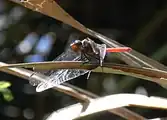 Male face on
 Female
 Male
 Young males are an orange colour
 Female side view
 Male side view
 Young male side view
 Resting with wings held forward
 Female looking to deposit her eggs in a pond
 Male tail
 Mating pair
 Female wings
 Male wings
References
- ↑ Dow, R.A. (2017). "Orthetrum villosovittatum". IUCN Red List of Threatened Species. 2017 e.T83369839A83383913. doi:10.2305/IUCN.UK.2017-1.RLTS.T83369839A83383913.en. Retrieved 19 November 2021.
- 1 2 Brauer, F. (1868). "Neue und wenig bekannte vom Herrn Doct. Semper gesammelte Odonaten". Verhandlungen der Zoologisch-Botanischen Gesellschaft in Wien (in German). 18: 167–188 [167] – via Biodiversity Heritage Library.
- 1 2 Paulson, D.; Schorr, M.; Abbott, J.; Bota-Sierra, C.; Deliry, C.; Dijkstra, K.-D.; Lozano, F. "World Odonata List". OdonataCentral. University of Alabama. Retrieved 13 April 2026.
- 1 2 3 Theischinger, Gunther; Hawking, John (2007). The complete field guide to dragonflies of Australia. Collingwood, Vic.: CSIRO Publishing. ISBN 978-0-643-09073-6.
- ↑ "Species Orthetrum villosovittatum (Brauer, 1868)". Australian Faunal Directory. Australian Biological Resources Study. 2012. Retrieved 1 March 2017.
- ↑ Watson, J.A.L.; Theischinger, G.; Abbey, H.M. (1991). The Australian Dragonflies: A Guide to the Identification, Distributions and Habitats of Australian Odonata. Melbourne: CSIRO. p. 278. ISBN 0-643-05136-8.
- ↑ Theischinger, Gunther; Endersby, Ian (2009). Identification Guide to the Australian Odonata (PDF). Department of Environment, Climate Change and Water NSW. p. 231. ISBN 978-1-74232-475-3.
- 1 2 Endersby, Ian; Fliedner, Heinrich (2015). The Naming of Australia's Dragonflies. Eltham, Victoria, Australia: Busybird Publishing. ISBN 9781925260625.

