Fathom (video game)
| Fathom | |
|---|---|
 | |
| Developers |
|
| Publishers | Imagic
|
| Designer | Rob Fulop |
| Artists | Michael Becker, Wilfredo Aguilar |
| Platforms | Atari 2600, Intellivision, TI-99/4A, ColecoVision, MSX |
| Release | |
| Genre | Action-adventure |
| Mode | Single-player |
Fathom is an action-adventure game designed by Rob Fulop, and published by Imagic in 1983. It is his final design for Imagic,[4] and one of the last games Imagic published before its closure. Fathom was initially released for the Atari 2600 in August 1983. It was later ported to the Intellivision, ColecoVision, and TI 99/4A.[5] The player controls both a dolphin and a seagull to collect the missing pieces of a broken trident and save a mermaid trapped at the bottom of the ocean.
The player assumes the role of a shapeshifter named Proteus, and must navigate distinct underwater and aerial screens. The dolphin gathers seahorses while avoiding octopuses, and the seagull collects pink clouds while avoiding volcanic eruptions. Fulfilling these tasks yields the starfish needed to acquire trident shards.
Development of Fathom was uniquely driven by a single animation of a jumping dolphin created by artist Michael Becker, which inspired Fulop's cartoon-like design. Upon release, contemporary reviewers praised the vibrant visual presentation and animations, though critics were divided on the repetitive nature of the gameplay loops. Retrospective reception has been generally positive, highlighting the game as a technical and artistic achievement for the Atari 2600 hardware.
Gameplay
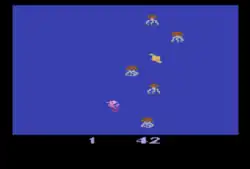
The objective is to free the mermaid Neptina, daughter of Neptune, who has been trapped at the bottom of the sea by the Titans. The player character is a shapeshifter named Proteus who must recover the shattered pieces of Neptune's trident to break Neptina's cage.[6]
The player starts the game in the form of a dolphin and can swim freely between several different ocean screens. The player has a limited amount of time to collect all three shards of the broken trident and return them to the mermaid's cage at the bottom of the map. As a dolphin, the player must collect all the seahorses that appear on a certain screen, while avoiding octopuses and seaweed beds. Once all seahorses are collected, the player can obtain a starfish which will give them one piece of the trident. Collecting enough seahorses will also cause a bird icon to appear at the bottom of the screen. Returning to the top of the screen with this icon will allow the player to start controlling a seagull above the water.[7]
As a seagull, the player must fly around a different set of screens above the water while avoiding black birds and volcanic eruptions. Collecting enough pink clouds will cause more starfish to appear, which grants the player another trident piece. Obtaining all three trident pieces and sufficient clouds will make a fish symbol appear at the bottom of the screen, allowing the player to transform back into a dolphin and swim down to Neptina's cage to finish a loop.[8] Every time one game loop is completed, the number of screens on the map increases and the player must travel further to accomplish their objectives. Once the player completes seven loops, the game is over and a secret ending is revealed.[9]
Development
Fathom was designed by Rob Fulop for Imagic. According to him, early development began when game artist Michael Becker rendered a picture of a dolphin jumping out of the water. The concept and gameplay were then designed around the image.[4] Becker became the game's artist, designing all of its graphics in collaboration with Fulop. Fathom is Fulop's first project where he directly made none of the graphics.[10] Fulop said he wanted players to feel as if they were controlling all the characters in a cartoon. He claimed to have designed it "to look more like a cartoon than any other type of video game". He hoped each time players would play the game, they would learn something new about it.[10]
Fulop later became frustrated with the way control of the dolphin transitioned to the seagull. He had wanted to create a more dramatic transition between the two gameplay states, but this would have cut part of the dolphin jumping animation Becker had designed. This alteration was rejected by fellow game designer Dennis Koble and Imagic CEO Bill Grubb, and Fulop claims this incident caused him to dislike the game following its release.[4]
The game contains an Easter egg. Under the right conditions, the initials of the three developers (Rob Fulop, Michael Becker, and Wilfredo Aguilar) can replace the rocks spewing from the erupting volcano. Fulop said players had responded well to Easter eggs in other games and the 8 KB ROM cartridge is spacious for secrets.[4][11] Versions for Atari 8-bit computers, Atari 5200, and VIC-20 were planned, but eventually cancelled.[12][1]
Reception
| Publication | Score |
|---|---|
| Electronic Fun with Computers & Games | 2.5/4[13] |
| JoyStik | 4/5[14] |
| San Francisco Chronicle | 3/5[15] |
Fathom was frequently praised for its graphics and animation. Jim Clark of Videogaming & Computergaming Illustrated called the graphics "wildly impressive, even beautiful", and E.C. Meade described the animations as "simply outstanding".[6] Mike Wilson of The Logical Gamer praised the graphics and compared them to previous good-looking games on the system.[16]
Critics were more mixed about gameplay. Computer Entertainer gave a perfect score in gameplay and graphics, describing the game as a great adventure and praising its expansion with each loop.[9] However, The Logical Gamer's Mike Wilson described the gameplay as boring once mastered and advised players to avoid the game.[16] Electronic Fun with Computers & Games described the game as "monotonous" and "tremendously dull".[13] The gameplay is frequently compared to other Atari 2600 games such as Adventure, Dolphin, and Journey Escape.[6][16]
Retrospectively, Levi Buchanan writing for IGN praised Fulop's work on the game as "perhaps his greatest achievement on the 2600" and called the graphics "beautiful" and "elegant". He placed Fathom in the upper part of its top 5 Imagic games for the Atari 2600.[5]
References
- 1 2 3 The Video Game Update (Review) 1983, p. 96.
- ↑ Computer Entertainer 1984a, p. 16.
- ↑ Computer Entertainer 1984b, p. 48.
- 1 2 3 4 Stilphen 1993.
- 1 2 Buchanan 2009.
- 1 2 3 Meade & Clark 1983, p. 11.
- ↑ Scott 1984, p. 74.
- ↑ Bechtold & Wilson 1983, p. 8.
- 1 2 The Video Game Update (Review) 1983, p. 83.
- 1 2 The Video Game Update (Interview) 1983, p. 37.
- ↑ Arcade Attack 2017.
- ↑ Videogaming & Computergaming Illustrated 1983, p. 77.
- 1 2 Ardoi 1983, p. 56.
- ↑ Schamus 1983, p. 54.
- ↑ San Francisco Chronicle 1983.
- 1 2 3 Bechtold & Wilson 1983, p. 9.
Sources
- "Rob Fulop (Atari) – Interview". Arcade Attack. March 24, 2017. Archived from the original on October 5, 2025. Retrieved February 8, 2026.
- "Fathom". San Francisco Chronicle. October 2, 1983. p. 148. Retrieved February 8, 2026 – via Newspapers.com.
- "Eye on computers". Videogaming & Computergaming Illustrated. No. 10. October 1983. p. 77. ISSN 0739-4373.
- "Update One on One: Rob Fulop, Designer". The Video Game Update. Vol. 2, no. 3. June 1983. p. 37. ISSN 0890-2143.
- "Critically Speaking: Fathom". The Video Game Update. Vol. 2, no. 6. September 1983. p. 83. ISSN 0890-2143.
- "Availability Update". Computer Entertainer. Vol. 3, no. 1. April 1984. p. 16. ISSN 0890-2143.
- "Availability Update". Computer Entertainer. Vol. 3, no. 3. June 1984. p. 16. ISSN 0890-2143.
- Ardoi, Charles (December 1983). "Fathom". Electronic Fun with Computers & Games. Vol. 2, no. 2. p. 56. ISSN 0746-0546.
- Bechtold, Alan R.; Wilson, Mike (November–December 1983). "Binaryvisions: Fathom". The Logical Gamer. Vol. 2, no. 4. p. 8-9.
- Buchanan, Levi (January 21, 2009). "Top 5 Imagic Games for Atari 2600". IGN. Archived from the original on November 4, 2022. Retrieved May 20, 2024.
- Fulop, Rob (December 1983). "An Act of Creation: Rob Fulop Takes You Behind the Scenes of Home Game Design". Video Games. Vol. 2, no. 3. Pumpkin Press. p. 52-54. ISSN 0733-6780.
- Meade, E.C.; Clark, Jim (November 1983). "Preview: Fathom". Videogaming & Computergaming Illustrated. No. 11. p. 11. ISSN 0739-4373.
- Persons, Dan (March 1984). "Soft Spot: Fathom". Video Games. Vol. 2, no. 6. Pumpkin Press. p. 81. ISSN 0733-6780.
- Schamus, Marty (December 1983). "The Home Front: Fathom". JoyStik: How to Win at Home, Computer, & Arcade Games. Vol. 2, no. 3. Publicalions International Ltd. p. 54.
- Scott, Brian (March 1984). "Programmable Parade: Fathom". Electronic Games. Vol. 2, no. 11. Reese Publications. p. 73-74. ISSN 0730-6687.
- Stilphen, Scott (1993). "Rob Fulop Interview". Atari Compendium. Archived from the original on July 17, 2025. Retrieved August 15, 2026.