Fatehyab Ali Khan
Fatehyab Ali Khan | |
|---|---|
فتح یاب علی خان | |
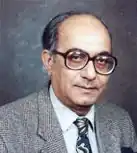 Fatehyab Ali Khan | |
| Born | 1936 Hyderabad, (Hyderabad Deccan), British India |
| Died | 26 September 2010 (aged 73–74) Karachi, Pakistan |
| Occupations |
|
| Years active | 1962 – 2010 |
| Known for | Political activist who stood up for his principles |
| Notable work | Pakistan Institute of International Affairs (Chairperson) Mazdoor Kisan Party (President) Students Union of Karachi University (President) Movement for the Restoration of Democracy (Member) |
| Spouse | Masuma Hasan |
| Children | 2 |
Fatehyab Ali Khan (1936 – 26 September 2010) was a Pakistani social and political activist and lawyer, who served as chairperson of the Pakistan Institute of International Affairs,[1][2] president of Mazdoor Kisan Party, and the first-ever president of students union of Karachi University in 1962.[3][4]
During his political activism, he criticised military dictatorship in Pakistan and was detained later displaced by the military dictator general and later field marshal Ayub Khan for taking part in political movements.[1]
Early life
Fatehyab was born in 1936 in Hyderabad (Hyderabad Deccan) of British India.[5] He migrated from Bombay (now Mumbai) to Pakistan in 1949 and settled in Karachi. He was fourteen when he entered the newly-independent Pakistan.[6] He then served as President of the University of Karachi students union in 1962.[5][4]
It is claimed he played a significant role in reducing of degree course duration from three years to two, leading students earn their degrees with a minimum time span of two years which was originally set for three years.[4] In the 1960s, University of Karachi was a major center of student politics with Fatehyab Ali Khan and Meraj Muhammad Khan being the student leaders.[5] Before that, Adeebul Hasan Rizvi and his supporters were also active in leftist politics at Dow Medical College, Karachi.[5] After completing his education, Fatehyab Ali Khan worked as a lawyer.[5]
Political activities
In 1964 general elections, he took part in election campaign of Fatima Jinnah and supported her against military dictator General Ayub Khan who later detained him for his role in the elections.[5][4] He was actively involved in Pakistan's democracy restoration movement, leading him to act against the will of general Muhammad Zia-ul-Haq.[1] He was jailed by the government for his contribution to the political movements and was displaced by the administration.[1][5][4]
He was also displaced from Sindh by the military government of the country for taking part in a movement against Ayub’s coup d'état.[7]
Fatehyab Ali Khan was also elected as the President of Mazdoor Kisan Party in Pakistan in 1989.[5]
Death
Fatahyab Ali Khan was suffering from many health issues and chronic conditions. He was subsequently admitted to the Aga Khan University Hospital, Karachi for medical treatment after suffering a cardiac arrest on 23 September 2010, and later died on 26 September 2010.[3] Among the survivors was his wife, Masuma Hasan and their two sons. Masooma Hasan later became Pakistan's ambassador to Austria.[1][3][4]
References
- 1 2 3 4 5 B. M. Kutty (10 April 2011). "A rare breed - Fatehyab Ali Khan profile (scroll down to the bottom to read article)". The News International newspaper. Retrieved 31 July 2026.
- ↑ Blua, Antoine (11 March 2003). "Pakistan: Government Faces Dilemma At UN Security Council Vote". RadioFreeEurope/RadioLiberty. Archived from the original on 28 January 2021. Retrieved 31 July 2026.
- 1 2 3 "Fatehyab Ali Khan passes away". The News International newspaper. 27 September 2010. Archived from the original on 31 July 2026. Retrieved 31 July 2026.
- 1 2 3 4 5 6 "Fatehyab Ali Khan passes away". Dawn newspaper. 27 September 2010. Archived from the original on 11 April 2021. Retrieved 31 July 2026.
- 1 2 3 4 5 6 7 8 Zamir Sheikh (28 September 2010). "Legendary student leader Fatehyab Ali Khan passes away". The Nation newspaper. Archived from the original on 19 January 2026. Retrieved 31 July 2026.
- ↑ Hasan, Shazia (28 September 2019). "Karachi is an ecologically damaged city". Dawn newspaper. Archived from the original on 6 October 2019. Retrieved 31 July 2026.
- ↑ Harris Khalique (27 September 2011). "In memoriam: Fatehyab Ali Khan". The Express Tribune newspaper. Archived from the original on 28 September 2011. Retrieved 31 July 2026.