FP802
 | |
| Identifiers | |
|---|---|
| |
| CAS Number | |
| PubChem CID | |
| ChemSpider | |
| CompTox Dashboard (EPA) | |
| Chemical and physical data | |
| Formula | C11H17ClN2 |
| Molar mass | 212.72 g·mol−1 |
| 3D model (JSmol) | |
| |
| |
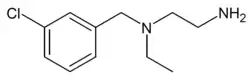
FP802 is a chemical compound which has neuroprotective effects. It is a TwinF interface inhibitor which prevents the NMDA receptor from forming a complex with the signalling factor TRPM4, and so blocks NMDA-induced neurotoxicity but without disrupting basal levels of NMDA signalling. It shows beneficial effects in animal models of conditions such as Alzheimer's disease and amyotrophic lateral sclerosis.[1][2][3][4][5]
References
- ↑ Yan J, Wang YM, Hellwig A, Bading H (February 2024). "TwinF interface inhibitor FP802 stops loss of motor neurons and mitigates disease progression in a mouse model of ALS". Cell Reports. Medicine. 5 (2) 101413. doi:10.1016/j.xcrm.2024.101413. PMC 10897598. PMID 38325382.
- ↑ Wang YM, Yan J, Williams SK, Fairless R, Bading H (September 2024). "TwinF interface inhibitor FP802 prevents retinal ganglion cell loss in a mouse model of amyotrophic lateral sclerosis". Acta Neuropathologica Communications. 12 (1) 149. doi:10.1186/s40478-024-01858-0. PMC 11391826. PMID 39267142.
- ↑ Ramírez OA, Hellwig A, Zhang Z, Bading H (January 2025). "Pharmacological Targeting of the NMDAR/TRPM4 Death Signaling Complex with a TwinF Interface Inhibitor Prevents Excitotoxicity-Associated Dendritic Blebbing and Organelle Damage". Cells. 14 (3): 195. doi:10.3390/cells14030195. PMC 11816953. PMID 39936986.
- ↑ Oberländer K, Pruunsild P, Koch P, Yan J, Szafranski K, Bading H (December 2025). "Inhba, Homer1 and Bdnf are major targets of transcriptomic dysregulation by neurodegenerative disease-associated excitotoxic NMDA receptor signaling". Communications Biology. 8 (1) 1743. doi:10.1038/s42003-025-09074-9. PMC 12678830. PMID 41339520.
- ↑ Yan J, Yang X, Li G, Ramirez OA, Hagenston AM, Chen ZY, et al. (February 2026). "The NMDAR/TRPM4 death complex is a major promoter of disease progression in the 5xFAD mouse model of Alzheimer's disease". Molecular Psychiatry. 31 (2): 635–648. doi:10.1038/s41380-025-03143-5. PMC 12815682. PMID 40858778.