Euphorbia norfolkiana
| Euphorbia norfolkiana | |
|---|---|
 | |
Scientific classification  | |
| Kingdom: | Plantae |
| Clade: | Embryophytes |
| Clade: | Tracheophytes |
| Clade: | Angiosperms |
| Clade: | Eudicots |
| Clade: | Rosids |
| Order: | Malpighiales |
| Family: | Euphorbiaceae |
| Genus: | Euphorbia |
| Species: | E. norfolkiana |
| Binomial name | |
| Euphorbia norfolkiana Boiss.[2] | |
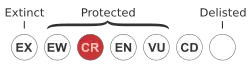
Euphorbia norfolkiana, also known as the Norfolk Island euphorbia, is a flowering plant in the spurge family. It is endemic to the Australian external territory of Norfolk Island in the south-west Pacific Ocean. It was originally described in 1862 by Swiss botanist Pierre Edmond Boissier.[2][1]
Description
The species grows as a dense, low shrub – usually up to 1 m, but sometimes to 3 m in height. It has olive-green flowers.[1]
Distribution and habitat
The plants occur in coastal pine and white oak forest, usually below pines in light shade, with coastal cliff vegetation. The species was formerly more common; its conservation status has been assessed as Critically Endangered, and it is threatened by cattle grazing and competition with invasive weeds.[1]
References
- 1 2 3 4 "Norfolk Island Region Threatened Species Recovery Plan" (PDF). Department of Climate Change, Energy, the Environment and Water. Commonwealth of Australia. 2025. Retrieved 2026-06-02.
- 1 2 "Euphorbia norfolkiana Boiss". Plants of the World Online. Royal Botanic Gardens, Kew. Retrieved 2026-06-02.