Eric Leuthardt
Eric C. Leuthardt | |
|---|---|
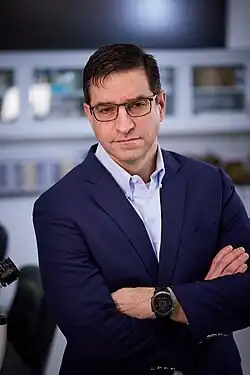 Eric C. Leuthardt in 2025 | |
| Born | 1973 (age 52–53) |
| Alma mater | Saint Louis University (B.S.) University of Pennsylvania (M.D.) Washington University in St. Louis (Executive M.B.A., 2024) |
| Known for | Brain-computer interfaces Neuroprosthetics IpsiHand system |
| Awards | Fellow, National Academy of Inventors (2018) Fellow, American Institute for Medical and Biological Engineering (2025) MIT Technology Review TR100 (2004) |
| Scientific career | |
| Fields | Neurosurgery Neurotechnology Biomedical engineering |
| Workplaces | Washington University in St. Louis |
Eric C. Leuthardt (born 1973) is an American neurosurgeon, neuroscientist, inventor, and author. He is the Shi H. Huang Professor of Neurological Surgery at Washington University in St. Louis, where he serves as vice-chair of innovation in the Department of Neurosurgery, chief of the Division of Neurotechnology, and director of the Center for Innovation in Neuroscience and Technology.[1]
He is recognized for pioneering human electrocorticographic (ECoG) brain-computer interfaces (BCI) and co-developing the IpsiHand system, one of the first FDA-cleared non-invasive BCIs for chronic stroke rehabilitation.[2][3]
Early life and education
Leuthardt was born in 1973 in Boston, Massachusetts, to a German father who worked in the auto industry and an Italian mother who was a teacher. He spent part of his early childhood in Stuttgart, Germany, before being raised primarily in Cincinnati, Ohio.[4]
He received a B.S. in biology and theology from Saint Louis University and an M.D. from the University of Pennsylvania School of Medicine. He completed his neurosurgery residency at Washington University in St. Louis and Barnes-Jewish Hospital and earned an Executive M.B.A. from the Olin Business School at Washington University in St. Louis in 2024.[1][5]
Career
Leuthardt joined the Washington University in St. Louis faculty in 2006. He holds professorships in neurological surgery, neuroscience, biomedical engineering, and mechanical engineering & materials science. His clinical practice focuses on brain tumors, epilepsy surgery, laser interstitial thermal therapy, and Gamma Knife radiosurgery at Barnes-Jewish Hospital and St. Louis Children’s Hospital.[1]
Research and inventions
In 2004, Leuthardt and colleagues published the first demonstration of a human ECoG-based brain-computer interface that allowed a paralyzed teenager to control a video game using only thought.[2][6]
His laboratory develops neurotechnologies for motor restoration after stroke, speech decoding, and advanced brain mapping. He co-developed the IpsiHand system through Neurolutions, which received FDA De Novo authorization in 2021 for chronic stroke rehabilitation.[7]
A 2025 peer-reviewed study and preliminary results from a 2026 randomized controlled trial (presented at the International Stroke Conference) demonstrated functional improvements in patients using the device; full peer-reviewed publication of the latest trial is anticipated.[8]
Leuthardt is a inventor with over 600 U.S. patents granted and more than 1,000 pending on neurotechnology devices and medical instruments.[5]
Entrepreneurship
Leuthardt has co-founded multiple startups to translate his research into clinical tools. In 2025, AI-based resting-state fMRI brain mapping software called Cirrus, developed in his lab, received FDA market authorization through Sora Neuroscience, a Washington University in St. Louis startup he co-founded. Described as a potential "sea change for clinical imaging," it enables faster, more accessible functional brain insights for neurosurgery and neurological diseases.[9]
He serves as CEO of Aurenar, developing a single-use, wearable transcutaneous auricular vagus nerve stimulation device for ICU patients to modulate inflammation non-invasively and potentially reduce life-threatening complications.[5]
Creative works
Leuthardt has written two techno-thriller novels, RedDevil 4 (2014) and Limbo (2017), which explore the ethical implications of neurotechnology. He has stated that fiction allows him to examine the broader societal consequences of the brain technologies he develops.[2] He also co-created the Regional Emmy Award-winning (Mid-America Chapter) PBS special BrainWorks.
Awards and honors
Societies
- Fellow, National Academy of Inventors (2018)[1][11]
- Fellow, American Institute for Medical and Biological Engineering (2025)[12][13][1]
Selected publications
- Leuthardt, Eric C.; Schalk, Gerwin; Wolpaw, Jonathan R.; Ojemann, Jeffrey G.; Moran, Daniel W. (June 2004). "A brain-computer interface using electrocorticographic signals in humans". Journal of Neural Engineering. 1 (2): 63–71. doi:10.1088/1741-2560/1/2/001. PMID 15876624.
- Schalk, Gerwin; Kubánek, Jan; Miller, Kai J.; Anderson, Nicholas R.; Leuthardt, Eric C.; Ojemann, Jeffrey G.; Olson, John D.; Wise, Steven P.; Wolpaw, Jonathan R. (September 2007). "Decoding two-dimensional movement trajectories using electrocorticographic signals in humans". Journal of Neural Engineering. 4 (3): 264–275. doi:10.1088/1741-2560/4/3/012. PMID 17873429.
References
- 1 2 3 4 5 6 "Eric C. Leuthardt, MD, MBA". Washington University School of Medicine. Retrieved 2026-03-06.
- 1 2 3 Fox, Killian (21 April 2018). "Neurosurgeon Eric Leuthardt: 'An interface between mind and machine will happen'". The Guardian. Retrieved 2026-03-06.
- ↑ Piore, Adam (30 November 2017). "The Surgeon Who Wants to Connect You to the Internet with a Brain Implant". MIT Technology Review. Retrieved 2026-03-06.
- ↑ "Eric C. Leuthardt, M.D.: Profile of a neuroscientist, neurosurgeon and sci-fi writer". St. Louis Public Radio. 6 December 2012. Retrieved 2026-03-06.
- 1 2 3 "EMBA innovates at intersection of brain science, business, and community". Washington University Olin Business School. 14 May 2025. Retrieved 2026-03-06.
- ↑ Leuthardt, Eric C.; Schalk, Gerwin; Wolpaw, Jonathan R.; Ojemann, Jeffrey G.; Moran, Daniel W. (2004). "A brain-computer interface using electrocorticographic signals in humans". Journal of Neural Engineering. 1 (2): 63–71. doi:10.1088/1741-2560/1/2/001. PMID 15876624.
- ↑ "Stroke-recovery device using brain-computer interface receives FDA market authorization". Washington University in St. Louis. 28 April 2021. Retrieved 2026-03-06.
- ↑ "BCI-enabled stroke rehabilitation therapy significantly improves functional outcomes in randomised trial". NeuroNews International. 13 February 2026. Retrieved 2026-03-06.
- ↑ "AI-based brain-mapping software receives FDA market authorization". Washington University School of Medicine. 23 June 2025. Retrieved 2026-03-06.
- ↑ "2020 Distinguished Faculty Awards announced". Washington University School of Medicine. March 2020. Retrieved 2026-03-06.
- ↑ "Eric C. Leuthardt, MD, MBA". Washington University School of Medicine. Retrieved 2026-03-06.
Fellow, National Academy of Inventors, Washington DC, April 2018
- ↑ "Leuthardt selected as AIMBE fellow". Washington University in St. Louis McKelvey School of Engineering. January 4, 2025. Retrieved 2026-03-06.
- ↑ "Eric C. Leuthardt, MD, MBA COF-9276". American Institute for Medical and Biological Engineering. Retrieved 2026-03-06.
External links
- Official faculty profile - Washington University School of Medicine
- Leuthardt Lab