Erdős–Mordell inequality

In Euclidean geometry, the Erdős–Mordell inequality states that for any triangle and point inside , the sum of the distances from to the sides is less than or equal to half of the sum of the distances from to the vertices. It is named after Paul Erdős and Louis Mordell. Erdős (1935) posed the problem of proving the inequality; a proof was provided two years later by Mordell and D. F. Barrow (1937).[1] This solution was however not very elementary. Subsequent simpler proofs were then found by Kazarinoff (1957), Bankoff (1958), and Alsina & Nelsen (2007).[2][3][4]


Barrow's inequality is a strengthened version of the Erdős–Mordell inequality in which the distances from to the sides are replaced by the distances from P to the points where the angle bisectors of , , and cross the sides. Although the replaced distances are longer, their sum is still less than or equal to half the sum of the distances to the vertices.


Statement and proof
Let be an arbitrary point inside a given triangle , and let , , and be the perpendiculars from to the sides of the triangles. (If the triangle is obtuse, one of these perpendiculars may cross through a different side of the triangle and end on the line supporting one of the sides.) Then the inequality states that[4]



The proof is as follows:
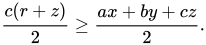
- Let the sides of be , , and , which are opposite to the vertices , , and . Let us denote the distance between internal point to all such three vertices as , , and , and the distance between internal point to all three sides of a triangle , namely the distance from to is , to is , and to is . First, we prove that This is equivalent to
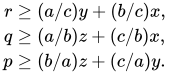
- The right side is the area of triangle ABC, but on the left side, is at least the height of the triangle; consequently, the left side cannot be smaller than the right side. Now reflect on the angle bisector at . We find that for the reflection of . Similarly, and . We solve these inequalities for , , and :
- Adding the three up, we get
- Since the sum of a positive number and its reciprocal is at least 2 by AM–GM inequality, we are finished. Equality holds only for the equilateral triangle, where is its centroid.










Another strengthened version
Let be a triangle inscribed into a circle , and be a point inside of . Let , , and be the orthogonal projections of onto , , and . Points , , and be the orthogonal projections of onto tangents to at points , , and , respectively. Then, Equality hold if and only if triangle is equilateral.[5][6]



A generalization
Let be a convex polygon, and be an interior point of . Let be the distance from to the vertex , the distance from to the side , the segment of the bisector of the angle from to its intersection with the side then[7]



In absolute geometry
In absolute geometry the Erdős–Mordell inequality is equivalent, as proved in Pambuccian (2008), to the statement that the sum of the angles of a triangle is less than or equal to two right angles.[8]
See also
Notes
References
- Alsina, Claudi; Nelsen, Roger B. (2007), "A visual proof of the Erdős-Mordell inequality", Forum Geometricorum, 7: 99–102, archived from the original on 2020-07-16, retrieved 2009-05-29.
- Bankoff, Leon (1958), "An elementary proof of the Erdős-Mordell theorem", American Mathematical Monthly, 65 (7): 521, doi:10.2307/2308580, JSTOR 2308580.
- Dao, Thanh Oai; Nguyen, Tien Dung; Pham, Ngoc Mai (2016), "A strengthened version of the Erdős-Mordell inequality" (PDF), Forum Geometricorum, 16: 317–321, MR 3556993, archived from the original (PDF) on 2018-04-24, retrieved 2017-07-20.
- Erdős, Paul (1935), "Problem 3740", American Mathematical Monthly, 42: 396, doi:10.2307/2301373, JSTOR 2301373.
- Kazarinoff, D. K. (1957), "A simple proof of the Erdős-Mordell inequality for triangles", Michigan Mathematical Journal, 4 (2): 97–98, doi:10.1307/mmj/1028988998. (See D. K. Kazarinoff's inequality for tetrahedra.)
- Lenhard, Hans-Christof (1961), "Verallgemeinerung und Verschärfung der Erdös-Mordellschen Ungleichung für Polygone", Archiv für Mathematische Logik und Grundlagenforschung, 12: 311–314, doi:10.1007/BF01650566, MR 0133060, S2CID 124681241.
- Marinescu, Dan Ștefan; Monea, Mihai (2017), "About a strengthened version of the Erdős-Mordell inequality" (PDF), Forum Geometricorum, 17: 197–202.
- Mordell, L. J.; Barrow, D. F. (1937), "Solution to 3740", American Mathematical Monthly, 44: 252–254, doi:10.2307/2300713, JSTOR 2300713.
- Pambuccian, Victor (2008), "The Erdős-Mordell inequality is equivalent to non-positive curvature", Journal of Geometry, 88 (1–2): 134–139, doi:10.1007/s00022-007-1961-4, S2CID 123082256.