Ene-reductase

Ene-reductase (ER, ERED) is an enzyme able to catalyze the stereoselective reduction of carbon-carbon double bonds (C=C) that are activated by electron withdrawing groups (EWG), like aldehydes, ketones and esters. The catalytic cycle is dependent from the cofactor nicotinamide adenine dinucleotide phosphate (NADPH).[2] Unlike traditional stereoselective chemical hydrogenation, that often uses noble metals and harsh conditions,[3] ERs can operate under mild and aqueos conditions and their stereoselectivity depends on the specific enzyme.[2][3][4]
Classification
Ene-reductases are classified as oxidoreductases (EC 1), they can be divided in two broad categories based on the performed reduction mechanism:
Both classes require, for "natural" reactions, catalytic amounts of NAD(P)H as a reducing cofactor that is often regenerated in situ.[2]
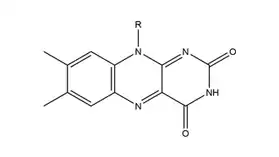
Flavin-dependent ene-reductases

Flavin-dependent ERs perform their reactions using the cofactor flavin mononucleotide (FMN) that is non-covalently bonded to the enzyme[5] and their catalytic mechanism is now well understood.
In the natural cycle, the cofactor (FMN) is first reduced by NAD(P)H, then the reduced FMNH2 reduces the substrate by Michael-type hydride transfer to the β-carbon atom. In the end the protonation of the resulting anion occurs from the opposite face of the (C=C) bond through a tyrosine moiety or solvent. The overall reaction is an anti-trans-hydrogenation.[6] This catalytic mechanism can also be regenerated from the natural nicotinamide cofactor with a substrate-coupled regeneration[7] or the use of synthetic reductants[8] and electrochemical[9] or photochemical regeneration.[10]
The most predominant family of flavin-dependent ERs is the Old Yellow Enzyme (OYE) family of oxidoreductases (EC 1.6.99.1).[11]The first OYE was discovered in baker's yeast (Saccharomyces cerevisiae) in 1933, and its name derives from the color it assumes when concentrated, which is due to the flavin cofactor.[12] They catalyze the reduction of α,β-unsaturated compounds, with a high specificity for activating groups containing aldehydes, ketones,[13] or nitro groups[14].Conversely, carboxylic acids and their derivatives such as esters and nitriles, are less activated and are considered as "borderline substrates".[15]
Another family of flavin-dependent ERs, that is specialized for substrates containing carboxylic acids and esters, are the oxygen-sensitive enoate reductases (EnoR; EC 1.3.1.31) that contain flavin adenine dinucleotide (FAD) and the [4Fe−4S] prosthetic group.[5][6][7][8][9][10][11][12][13][14][15][16]
Flavin-independent ene-reductases

Flavin-independent ERs are able to reduce their substrates directly using the NAD(P)H cofactor that can be regenerated.[7] Two families of this group are the medium-chain dehydrogenases/reductases (MDR; EC 1.3.1),[17] and the short-chain dehydrogenases/reductases (SDR; EC 1.1.1.207−8).[18]
The typical substrates reduced by those enzymes include aromatic and monocyclic alkenes containing aldehydes or ketones as activating groups.[7][17][18]
Application in fine chemicals synthesis
There are some examples of fine chemicals production using synthetic biology approaces in which ERs are used to catalyze one of the biocatalytic steps:
- The aromatic acids 3-phenylpropionic acid (3PPA) and 3-(4-hydroxyphenyl)propionic acid (HPPA) are important commodities used in the chemical, pharmaceutical, and food industrial sectors. A biosynthetic route to synthetize these compounds was designed by combining the Escherichia coli phenylalanine pathway with non-native enzymes like tyrosine ammonia lyase (TAL) and the clostridial EnoR.[19] The full pathway was assembled in Escherichia coli, which led to the production of HPPA and cinnamyl alcohol. Optimization of individual enzyme expression levels produced 3PPA and HPPA with a concentration of 367 and 225 mg/L, in this case the oxygen-sensitive EnoRs were catalytically active under the microaerophilic fermentation conditions.[19]
- The 2-methylsuccinic acid (2-MSA) is use to synthetize polymers that have application as bioplastics, cosmetic solvents and coatings. A pathway for its synthesis was designed using Escherichia coli, combining native pyruvate and acetyl-CoA biosynthesis with methanogenic citramalate synthase (CimA), isopropylmalate isomerase (LeuCD), and the ER YqjM or KpnER from Klebsiella pneumoniae. The successful production of 2-MSA was achieved with a concentration of 0.96 g/L using KpnER.[19][20]
Ene-reductases: enzymatic promiscuity
In recent studies, flavin-dependent ERs have demonstrated a remarkable catalytic promiscuity, in particular in photo-ene-reductases catalysis.[21] The non-natural reactions that can be performed can be divided in hydride-dependent and hydride-independent reactions:
- Hydride-dependent reactions: in nature the ERs promote an hydride attack on the β-carbon of an activated (C═C) bond modificating its electronic density. This catalytic abilty promotes the reduction of other functional groups of a variety of non-natural subtrates, including the hydrogenation of nitro groups, activated oximes, activated alkynes, and α,β-dicarbonyls, as well as the desaturation of α,β-saturated carbonyl compounds.[22]
- Hydride-independent reactions: ERs can catalyze reactions relyng on an external source of electrons to reduce the flavin cofactor, thereby initiating the reaction cycle. Otherwise, a desaturation reaction can rely on substrate reduction of flavin to promote the catalytic cycle.[23] However not all the hydride-independent reactions mechanistically depend on the flavin cofactor or the involvement of the hydride transfer process. Some examples of these reactions are the (C═C) bond isomerization, Knoevenagel condensation, Morita–Baylis–Hillman reaction, and radical reactions.[21][22][23]
See also
References
- ↑ Brown, B.J.; Deng, Z.; Karplus, P.A.; Massey, V. (1998-09-24). "OLD YELLOW ENZYME (OYE1) DOUBLE MUTANT H191N:N194H". Worldwide Protein Data Bank. doi:10.2210/pdb1BWL/pdb. Retrieved 2026-06-30.
- 1 2 3 Toogood, Helen S.; Scrutton, Nigel S. (2018-04-06). "Discovery, Characterization, Engineering, and Applications of Ene-Reductases for Industrial Biocatalysis". ACS Catalysis. 8 (4): 3532–3549. doi:10.1021/acscatal.8b00624. PMC 6542678. PMID 31157123.
- 1 2 Verendel, J. Johan; Pàmies, Oscar; Diéguez, Montserrat; Andersson, Pher G. (2014-02-26). "Asymmetric Hydrogenation of Olefins Using Chiral Crabtree-type Catalysts: Scope and Limitations". Chemical Reviews. 114 (4): 2130–2169. doi:10.1021/cr400037u. ISSN 0009-2665.
- ↑ Toogood, Helen S.; Gardiner, John M.; Scrutton, Nigel S. (2010). "Biocatalytic Reductions and Chemical Versatility of the Old Yellow Enzyme Family of Flavoprotein Oxidoreductases". ChemCatChem. 2 (8): 892–914. doi:10.1002/cctc.201000094. ISSN 1867-3899.
- 1 2 Pesic, Milja; Fernández‐Fueyo, Elena; Hollmann, Frank (2017-05-02). "Characterization of the Old Yellow Enzyme Homolog from Bacillus subtilis (YqjM)". ChemistrySelect. 2 (13): 3866–3871. doi:10.1002/slct.201700724. ISSN 2365-6549.
- 1 2 Toogood, Helen S; Scrutton, Nigel S (2014-04-01). "New developments in 'ene'-reductase catalysed biological hydrogenations". Current Opinion in Chemical Biology. Biocatalysis and biotransformation⬢ Bioinorganic chemistry. 19: 107–115. doi:10.1016/j.cbpa.2014.01.019. ISSN 1367-5931.
- 1 2 3 4 Toogood, Helen S.; Gardiner, John M.; Scrutton, Nigel S. (2010-08-09). "Biocatalytic Reductions and Chemical Versatility of the Old Yellow Enzyme Family of Flavoprotein Oxidoreductases". ChemCatChem. 2 (8): 892–914. doi:10.1002/cctc.201000094. ISSN 1867-3880.
- 1 2 Zhou, Jieyu; Gu, Xiangyuan; Zhu, Yichun; Tao, Zhenyan; Ni, Ye (2023). "Engineering Glucose Dehydrogenase to Favor Totally Synthetic Biomimetic Cofactors Containing Carboxyl Group". ChemBioChem. 24 (15) e202300066. doi:10.1002/cbic.202300066. ISSN 1439-7633.
- 1 2 "Towards electroenzymatic processes involving old yellow enzymes and mediated cofactor regeneration". analyticalsciencejournals.onlinelibrary.wiley.com. doi:10.1002/elsc.201600158. PMC 6999263. PMID 32624730. Retrieved 2026-07-01.
- 1 2 Peers, Martyn K.; Toogood, Helen S.; Heyes, Derren J.; Mansell, David; Coe, Benjamin J.; Scrutton, Nigel S. (2016). "Light-driven biocatalytic reduction of α,β-unsaturated compounds by ene reductases employing transition metal complexes as photosensitizers". Catalysis Science & Technology. 6 (1): 169–177. doi:10.1039/C5CY01642H. ISSN 2044-4753. PMC 4786955. PMID 27019691.
- 1 2 Scholtissek, Anika; Tischler, Dirk; Westphal, Adrie; Van Berkel, Willem; Paul, Caroline (2017-04-29). "Old Yellow Enzyme-Catalysed Asymmetric Hydrogenation: Linking Family Roots with Improved Catalysis". Catalysts. 7 (5): 130. doi:10.3390/catal7050130. ISSN 2073-4344.
- 1 2 Warburg O, Christian W. Über das gelbe Ferment und seine Wirkung. Biochem Z 1933;266:377–411 [in German].
- 1 2 Fryszkowska, Anna; Toogood, Helen; Sakuma, Michiyo; Gardiner, John M.; Stephens, Gill M.; Scrutton, Nigel S. (2009). "Asymmetric Reduction of Activated Alkenes by Pentaerythritol Tetranitrate Reductase: Specificity and Control of Stereochemical Outcome by Reaction Optimisation". Advanced Synthesis & Catalysis. 351 (17): 2976–2990. doi:10.1002/adsc.200900574. ISSN 1615-4169.
- 1 2 Bertolotti, Mattia; Brenna, Elisabetta; Crotti, Michele; Gatti, Francesco G.; Monti, Daniela; Parmeggiani, Fabio; Santangelo, Sara (2016). "Substrate Scope Evaluation of the Enantioselective Reduction of β-Alkyl-β-arylnitroalkenes by Old Yellow Enzymes 1–3 for Organic Synthesis Applications". ChemCatChem. 8 (3): 577–583. doi:10.1002/cctc.201500958. ISSN 1867-3899.
- 1 2 Tasnádi, Gábor; Winkler, Christoph K.; Clay, Dorina; Sultana, Nargis; Fabian, Walter M. F.; Hall, Mélanie; Ditrich, Klaus; Faber, Kurt (2012). "A Substrate-Driven Approach to Determine Reactivities of α,β-Unsaturated Carboxylic Esters Towards Asymmetric Bioreduction". Chemistry – A European Journal. 18 (33): 10362–10367. doi:10.1002/chem.201200990. ISSN 1521-3765.
- ↑ Rohdich, Felix; Wiese, Anja; Feicht, Richard; Simon, Helmut; Bacher, Adelbert (2001). "Enoate Reductases of Clostridia". Journal of Biological Chemistry. 276 (8): 5779–5787. doi:10.1074/jbc.m008656200. ISSN 0021-9258.
- 1 2 Mansell, David J.; Toogood, Helen S.; Waller, John; Hughes, John M. X.; Levy, Colin W.; Gardiner, John M.; Scrutton, Nigel S. (2013-03-01). "Biocatalytic Asymmetric Alkene Reduction: Crystal Structure and Characterization of a Double Bond Reductase from Nicotiana tabacum". ACS Catalysis. 3 (3): 370–379. doi:10.1021/cs300709m. PMC 4990313. PMID 27547488.
- 1 2 Lygidakis, Antonios; Karuppiah, Vijaykumar; Hoeven, Robin; Ní Cheallaigh, Aisling; Leys, David; Gardiner, John M.; Toogood, Helen S.; Scrutton, Nigel S. (2016). "Pinpointing a Mechanistic Switch Between Ketoreduction and "Ene" Reduction in Short-Chain Dehydrogenases/Reductases". Angewandte Chemie International Edition. 55 (33): 9596–9600. doi:10.1002/anie.201603785. ISSN 1521-3773. PMC 4988501. PMID 27411040.
- 1 2 3 Sun, Jing; Lin, Yuheng; Shen, Xiaolin; Jain, Rachit; Sun, Xinxiao; Yuan, Qipeng; Yan, Yajun (2016-05-01). "Aerobic biosynthesis of hydrocinnamic acids in Escherichia coli with a strictly oxygen-sensitive enoate reductase". Metabolic Engineering. 35: 75–82. doi:10.1016/j.ymben.2016.02.002. ISSN 1096-7176.
- ↑ Wang, Jian; Yang, Yaping; Zhang, Ruihua; Shen, Xiaolin; Chen, Zhenya; Wang, Jia; Yuan, Qipeng; Yan, Yajun (2018-01-01). "Microbial production of branched-chain dicarboxylate 2-methylsuccinic acid via enoate reductase-mediated bioreduction". Metabolic Engineering. 45: 1–10. doi:10.1016/j.ymben.2017.11.007. ISSN 1096-7176.
- 1 2 Ye, Yuxuan; Fu, Haigen; Hyster, Todd K (2021-04-01). "Activation modes in biocatalytic radical cyclization reactions". Journal of Industrial Microbiology and Biotechnology. 48 (3–4) kuab021. doi:10.1093/jimb/kuab021. ISSN 1367-5435. PMC 8210684. PMID 33674826.
- 1 2 Chen, Jie; Wu, Wenjing; Peng, Yongzhen; Fang, Zheng; Hu, Yujing; Guo, Kai (2025). "Ene‐Reductases‐Catalyzed Non‐Natural Reactions". Chemistry – A European Journal. 31 (25). doi:10.1002/chem.202500539. ISSN 0947-6539.
- 1 2 Winkler, Christoph K.; Clay, Dorina; Entner, Marcello; Plank, Markus; Faber, Kurt (2014). "NAD(P)H-Independent Asymmetric C=C Bond Reduction Catalyzed by Ene Reductases by Using Artificial Co-substrates as the Hydrogen Donor". Chemistry – A European Journal. 20 (5): 1403–1409. doi:10.1002/chem.201303897. ISSN 1521-3765. PMC 4413776. PMID 24382795.