Elishah
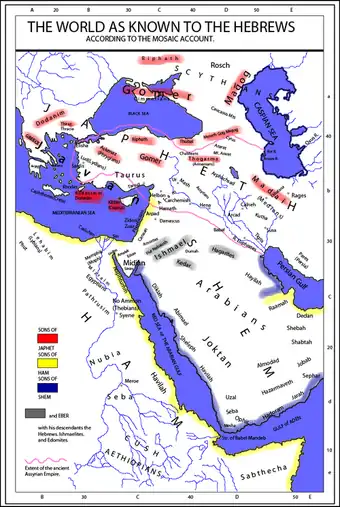
Elishah (אֱלִישָׁה ’Ĕlîšāh) was the son of Javan according to the Book of Genesis (10:4) in the Masoretic Text. The Greek Septuagint of Genesis 10 lists Elisa as the son of Javan and a grandson of Japheth. In Hebrew, his name is differentiated from that of the prophet Elisha by its ending in a hei (ה) rather than an ayin (ע).
Elishah has traditionally been associated with Cypriots, as the island of Cyprus is a possible location of the Bronze Age kingdom of Alashiya.[1][2] According to the Jewish Encyclopedia, Elishah is to be identified with Magna Graecia and Sicels.[3]Flavius Josephus related the descendants of Elishah to the Aeolians, one of the ancestral branches of the Greeks.[4] Other traditions identify Elishah with Hellas and Carthage ("Elissa").[5]
Elishah is also mentioned in the mediaeval rabbinic Book of Jasher (Hebrew transliteration: Sefer haYashar); he is said in Jasher to have been the ancestor of the "Almanim", possibly a reference to Germanic tribes (Alemanni). An older and more common tradition refers to him as a settler of Greece,[6] particularly Elis in the Peloponnese.
Portuguese traditions
Elishah features heavily in the folk traditions and national mythography of Portugal. According to tradition, Elishah (called Lysias or Lísias)[7] is an ancestor of Lusus, son of Bacchus. Elisha is older than Lusus, reaching the Iberian Peninsula with his uncle, the Biblical character Tubal, and founding the city of Portalegre.[8] He is traditionally considered the first "cultivator" of Lusitania.[9] Tradition places Lusus' reign in the 16th - 15th centuries BC, as in the Livro Primeiro da Monarchia Lusitana of Bernardo de Brito.[10][11][12][13]
The Portuguese orator and mythographer Father António Vieira (1608-1697) refers to Elishah as founder and eponym of both Lisbon and Lusitania, as well as Elysium of Greek mythology.[14][15] Vieira also identified Elisha's Biblical brother Tarshish as the founder of Tartessos in Andalucia.[16] Elishah in this portrayal is identified with Bacchus' captain Lysias/Lísias as well as with Lusus and Phoroneus,.[17] He is said to have founded Portalegre, and was buried at the Ermida de São Cristovão (Chapel of Saint Christopher).[18]
See also
References
- ↑ The expansion of the Greek world, eighth to sixth centuries B.C., John Boardman, Volume 3 Cambridge Ancient History, Cambridge University Press, 1982, ISBN 0-521-23447-6, ISBN 978-0-521-23447-4
- ↑ "Now, this Elishah is often identified with Alashiya in the scholarly literature, an ancient name often associated with Cyprus or a part of the island." Gard Granerød (26 March 2010). Abraham and Melchizedek: Scribal Activity of Second Temple Times in Genesis 14 and Psalm 110. Walter de Gruyter. p. 116. ISBN 978-3-11-022346-0.
- ↑ Jewish Encyclopedia: Elishah
- ↑ The works of Flavius Josephus: the learned and authentic Jewish historian and celebrated warrior, to which are added, three dissertations, concerning Jesus Christ, John the Baptist, James the Just, God's command to Abraham, etc. with an index to the whole, Volume 1, translated by William Whiston, Publisher Lackington, Allen and co., 1806, Princeton University
- ↑ Concordance: Elishah
- ↑ A view of ancient geography and ancient history: Accompanied with an atlas of ten select maps, calculated for the use of seminaries, &c, Robert Mayo, Robert Mayo, Volume 340 Harvard social studies textbooks preservation microfilm project, Published and sold by John F. Watson, no. 51 Chestnut Street, A. Fagan Printer, 1813, Universidade de Michigan, p. 153
- ↑ Portugal Terra de Mistérios, Paulo Alexandre Loução, p.283
- ↑ see Portalegre, *** Carlos Leite Ribeiro *** Distritos e Concelhos de Portugal, Portalegre, distoedakilo, Portalegre Deprecated link archived 2012-07-13 at archive.today.
- ↑ "Dialogos de dom Frey Amador Arraiz Bispo de Portalegre". google.pt. 1604.
- ↑ Frei Bernardo de Brito, Capítulo XV
- ↑ E.g., in Frei Bernardo de Brito's Livro Primeiro da Monarchia Lusitana, Capítulo XVIII, pg. 240, the Dialogos de dom Frey Amador Arraiz Bispo de Portalegre, p. 21, Defensam da monarchia Lvsitana, Volumes 1-2, Bernardino da Silva, pp. 36 - 37, and Ulyssipo, António de Sousa de Macedo, p. 29- 30,
- ↑ E.g., in Paulo Alexandre Loução's Portugal Terra de Mistérios, p. 283.
- ↑ For this discussion, see Livro Primeiro da Monarchia Lusitana, Frei Bernardo de Brito, pp. 242 - 243
- ↑ Cartas do padre Antonio Vieira - Volumes 1-4 de Cartas do padre Antonio Vieira, J.M.C. Seabra & T.Q. Antunes, 1854, p. 114
- ↑ Dicionário do nome das terras - origens, curiosidades e lendas das terras de portugal, João Fonseca, Cruz Quebrada/Casa das letras, 2007. Entry Lisboa
- ↑ "Historiantes: Tarsis y Tartessos". historiantes.blogspot.com.
- ↑ Portugal Terra de Mistérios, Paulo Alexandre Loução, p. 283
- ↑ Dialogos de dom Frey Amador Arraiz Bispo de Portalegre, p. 21