1945 Egyptian parliamentary election
 | |||||||||||||||||||||
9 January 1945
| |||||||||||||||||||||
| |||||||||||||||||||||
| |||||||||||||||||||||


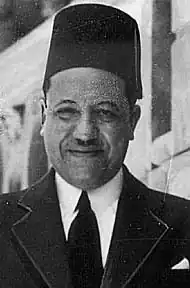
Parliamentary elections were held in Egypt on 9 January 1945.[1] Boycotted by the Wafd Party, they resulted in a victory for the Saadist Institutional Party, which won 126 of the 264 seats.
Results
Dolf Sternberger et al and P. J. Vatikiotis give the totals as 125 seats for the Saadist Institutional Party, 74 seats for the Liberal Constitutional Party, 29 for the Wafdist Block, 7 for the National Party and 29 for independents.[2][a][3] Egypt in 1945 has the same figures as except for independents, which it puts at 34, as well as 64 out of 140 Wafdists in the Senate.[4] Six members of the Muslim Brotherhood ran the election, including its founder Hasan al-Banna who ran in Ismailia, but all candidates lost.[5]
 | ||||
|---|---|---|---|---|
| Party | Votes | % | Seats | |
| Saadist Institutional Party | 739,717 | 41.95 | 126 | |
| Liberal Constitutional Party | 427,899 | 24.27 | 75 | |
| Wafdist Block[b] | 354,570 | 20.11 | 18 | |
| National Party | 67,700 | 3.84 | 7 | |
| Independents | 173,485 | 9.84 | 38 | |
| Total | 1,763,371 | 100.00 | 264 | |
| Total votes | 1,770,238 | – | ||
| Registered voters/turnout | 3,234,042 | 54.74 | ||
| Source: Khatib[6] | ||||
Aftermath
Parliament sat on 18 January that year and was dissolved on 7 November 1949.[1]
Notes
References
- 1 2 Khatib 1954, p. 171.
- ↑ Sternberger et al. 1978, p. 294.
- ↑ Vatikiotis, P. J. (1991). The History of Modern Egypt: From Muhammad Ali to Mubarak (4th ed.). Baltimore: Johns Hopkins University Press. p. 356.
- ↑ Nassif, Magd-ed Din (1946). "Party Politics in Egypt, March 1945". In Choudhury, M. L. Roy; Sastri, M.A. B.L. (eds.). Egypt in 1945. University of Calcutta. pp. 31–32.
- ↑ Mitchell, Richard P. (1969). The Society of Muslim Brothers. Oxford University Press. p. 33.
Mahir immediately made preparations for a new general election which the Brothers again prepared to contest. Banna again opted for Isma'iliyya, and five of his chief colleagues chose other areas in Egypt intending to campaign on the basis of an 'Islamic programme'. In January 1945 the elections-believed to have been among the more obviously dishonest held in Egypt-took place, and Banna and all the other Brothers were defeated in constituencies where they had been certain of victory.
- ↑ Khatib 1954, p. 489.
Sources
- Khatib, M.F. (1954). The working of parliamentary institutions in Egypt, 1924-1952 (Thesis). University of Edinburgh.
- Sternberger, Dolf; Vogel, Bernhard; Nohlen, Dieter; Landfried, Klaus, eds. (1978). Die Wahl Der Parlamente Und Anderer Staatsorgane: Ein Handbuch (in German). Walter de Gruyter GmbH.
| Presidential elections | |
|---|---|
| Parliamentary elections | |
| Shura Council elections | |
| Senate elections | |
| Municipal elections | |
| Referendums | |
