Egusi sauce
 Egusi Soup | |
| Type | Soup |
|---|---|
| Place of origin | West Africa |
| Region or state | Nigeria |
| Serving temperature | Warm |
| Main ingredients | Egusi |
| Ingredients generally used |
|
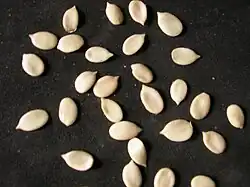

Egusi sauce or egusi soup a popular soup in Nigeria[1][2]. The word 'Egusi' is of Yoruba origin[3], believed to shortened form of Elegusi[4]. It is prepared with egusi seeds as a primary ingredient.[5][6][7][8] Egusi seeds are the fat- and protein-rich seeds of certain cucurbitaceous (squash, melon, gourd) plants. Egusi sauce is common and prevalent across Central Africa as mbíka, and may be served atop rice, cooked vegetables, or grilled meat, such as goat, chicken, beef, or fish.[8][9][10] It may also be served atop fufu, omelettes, amala, and eba,[9][11][12][13] among other foods. Egusi soup is also consumed in West Africa, sometimes with chicken.[14]
Preparation
Egusi sauce is prepared by grinding egusi seeds, from which a paste is created.[8] There are two methods of preparing egusi soup:[15]
1. Frying method: Egusi paste is fried in palm oil before adding other ingredients and sometime you can add a little salt to it before frying.[15]
2. Boiling method: Small lumps of egusi paste are added to boiling water and broken into pieces after cooking for 10 minutes.[15]
Soup ingredients may include tomato, onion, chili pepper, and cooking oil, such as palm oil.[8][10] Sometimes pumpkin seeds are substituted in place of egusi seeds.[8]
When using bitter leaf to prepare Egusi soup, it is important to wash it thoroughly to reduce the bitter taste before adding it to the soup.[16]
Similar dishes
Egusi soup is a kind of soup thickened with the ground seeds and popular in West Africa, with considerable local variation. Besides the seeds, water, and oil, egusi soup typically contains leaf vegetables and other vegetables, seasonings, and meat.
Health benefits
Egusi contains anti-inflammatory properties and compounds that have been used to help manage inflammation. It may also help reduce the effects of inflammation in the body.[17] The seed is high in nutrients, supports weight management, promotes good health, and may help reduce blood sugar levels.[18]
It is also a good source of plant-based protein, making it a valuable addition to a balanced diet, especially for vegetarians and vegans.[19]
Countries
Egusi is also prepared in several West and Central African countries outside Nigeria as a cultural delicacy, including Ghana, Cameroon, Togo, Benin, and Sierra Leone.[20][21]
See also
References
- ↑ Giwa, Solomon O.; Akanbi, Taiwo O. (2020). "A Review on Food Uses and the Prospect of Egusi Melon for Biodiesel Production". BioEnergy Research. 13 (4): 1031–1045. doi:10.1007/s12155-020-10145-4.
- ↑ Datsugwai, Mohammed Sani Sambo; Aisha, Abdulkadir; Balogu, Tochukwu Vincent (2019). "Microbial Quality and Sensory Characteristics of Instant Nigerian Egusi Soups". Annals: Food Science and Technology. 20 (3): 494–501.
- ↑ "Egusi Soup – Lumpy Yoruba Style – 9jafoodie | Nigerian Food Recipes". Retrieved 2026-05-09.
- ↑ Ilori, T. A.; Akinyele, O. A.; Aremu, D. O. (2016). "Effect of Moisture Content on Some Engineering Properties of Celosia argentea Seed". Journal of Environmental Science, Toxicology and Food Technology. 10 (9): 157–160.
- ↑ Bowen, T. J. (1857). Central Africa: Adventures and Missionary Labors in Several Countries in the Interior of Africa, from 1849 to 1856. Charleston: Southern Baptist Publication Society. p. 314.
The telfairia, which is common in Yoruba, as on the eastern coast, would grow equally well in Liberia... This is doubtless a valuable plant.
- ↑ Echeruo, Michael J. C. (1998). Igbo–English Dictionary: A Comprehensive Dictionary of the Igbo Language with an English–Igbo Index. Yale University Press. p. 66. ISBN 978-0-300-07307-2.
"Egusi, n. the seeds of the melon."
- ↑ Bascom, William (1951). "Yoruba Cooking". Africa: Journal of the International African Institute. 21 (2). Cambridge University Press: 125–137. doi:10.2307/1156465. JSTOR 1156464.
Melon is included... Melon-seed or gourd-seed is shelled, ground on a grinding stone, boiled, and added to soup or meat stew as in making vegetable stew.
- 1 2 3 4 5 Jacob, Jeanne; Ashkenazi, Michael (2014-01-15). The World Cookbook: The Greatest Recipes from Around the Globe, Revised Edition. Abc-Clio. pp. 239–240. ISBN 9781610694698.
- 1 2 "Goat and Beef With Egusi Sauce". The Washington Post. February 29, 2012. Retrieved 5 September 2014.
- 1 2 Katende, Jude (January 8, 2009). "A taste of Nigerian fufu in Kampala". New Vision. Retrieved 5 September 2014.
{{cite news}}: CS1 maint: deprecated archival service (link) - ↑ Evans, Andrew (2004). Veg Out Vegetarian Guide to Washington,, Part 3. Gibbs Smith. p. 19. ISBN 9781586854713.
- ↑ Ainley, Sarah (2008). Around the world in 450 recipes. Hermes House. p. 26. ISBN 9781844775279. Retrieved 5 September 2014.
- ↑ Adesokan, Akinwumi (2004). Roots in the Sky. FESTACBooks. p. 211. ISBN 9789780645403.
- ↑ The Recipes of Africa. p. 54.
- 1 2 3 Ajoke (2020-05-14). "Egusi Soup Recipe - How to cook egusi soup". My Active Kitchen. Retrieved 2022-10-13.
- ↑ Adeyemi, Kofi (2024-07-19). "How to Make Traditional Egusi Soup - A Step-by-Step Recipe". Cultures of West Africa. Retrieved 2026-05-09.
- ↑ Nwokolo, Collins (2024-07-09). "10 Perfect Health Benefits of Egusi Seeds". Health Guide NG. Retrieved 2026-05-09.
- ↑ "Top 10 Egusi Seed Health Benefits For Nigerians". Retrieved 2026-05-09.
- ↑ Healthy, Be (2025-10-16). "Potential Health Benefits of Egusi". Amazing Health Benefits. Retrieved 2026-05-09.
- ↑ "WHERE IS FUFU AND EGUSI FROM". Retrieved 2026-05-09.
- ↑ Adamu, Imma (2022-03-22). "Egusi Soup". Immaculate Bites. Retrieved 2026-05-09.