Eel River Estuary Preserve
| Eel River Estuary Preserve | |
|---|---|
IUCN category V (protected landscape/seascape)[1] | |
 Eel River Estuary channel | |
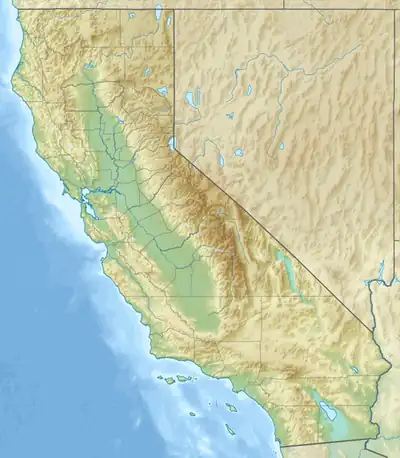  Location within California | |
Interactive map of Eel River Estuary Preserve | |
| Location | Humboldt County, California |
| Nearest city | Fortuna, California |
| Coordinates | 40°37′39″N 124°18′59″W / 40.62750°N 124.31639°W |
| Area | 1,100 acres (450 ha)[2] |
| Max. elevation | 30 ft (9.1 m)[3] |
| Min. elevation | 0 ft (0 m)[3] |
| Established | 2008[3] |
| Operator | The Wildlands Conservancy |
| Website | Eel River Estuary Preserve |
Eel River Estuary Preserve and the adjoining Sounding Seas Dunes Reserve are nature preserves in California, protecting the estuary at the mouth of the Eel River together with surrounding wetlands, dunes, and shoreline habitats. Together the preserves total 1,300 acres (530 ha) and are owned and managed by The Wildlands Conservancy as part of its system of preserves.
Geography

The preserves are located at the mouth of the Eel River and include tidal wetlands, freshwater marsh, grasslands, beach, and coastal dunes. The landscape includes a half-moon bay, coastal habitat used by migratory waterfowl, and a small island that serves as a haul-out site for seals. The preserve landscape transitions from estuary wetlands to coastal dunes and the Pacific Ocean.[4]
Flora and fauna

The Eel River estuary includes tidal marshes, freshwater wetlands, grasslands, dunes, intertidal flats, and eelgrass beds.[5] The estuary provides rearing habitat for juvenile salmonids, including Chinook salmon, coho salmon, and steelhead trout.[6] Juvenile Chinook occur at high densities during summer months.[7]
The dunes provide habitat for the federally listed snowy plover and the rare beach layia.[8][9]

The estuary lies within the Eel River Delta and the Humboldt Bay Important Bird Area, designated by the National Audubon Society.[10]
The Pacific Birds Habitat Joint Venture describes Humboldt Bay, the Eel River Delta, and Lake Earl as the largest coastal wetlands between San Francisco Bay and the Columbia River. The mouth of the Eel River is designated as a site of International Importance under the Western Hemisphere Shorebird Reserve Network.[11] Species reported in the estuary include Aleutian cackling geese, black brant, and tundra swans.[12] Tundra swans winter regularly in the estuary as part of the Pacific Flyway.[13]
Marine mammals are present in the estuary. Harbor seals regularly use haul-out sites near the river mouth. Sea lions, dolphins, and porpoises occasionally enter the estuary during seasonal fish runs.[14]
History

Beginning in the late 19th century, much of the estuary was diked, drained, and converted to agricultural pastureland, reducing tidal wetlands and narrowing Centerville Slough.[15] In 1974, the California Department of Fish and Wildlife identified the Eel River estuary as a top acquisition priority.[3] The Wildlands Conservancy purchased the former Connick Ranch in 2008, creating the Eel River Estuary Preserve.[3] The following year, the conservancy acquired the adjoining dunes, establishing the Sounding Seas Dunes Reserve.[4]
Conservation
The Eel River estuary has long been identified as a priority area for tidal wetland restoration and salmon habitat recovery.[16] Restoration planning has included proposals to restore tidal inundation, improve fish passage, restore tidal marsh processes, and expand estuarine rearing habitat for salmonids.[17]
In August 2025, the California Coastal Commission approved the Russ Creek and Centerville Slough Restoration Project, affecting much of the preserve and surrounding estuary lands.[18] The project includes removal of levees and tidal gates to restore tidal flow, along with demolition of selected ranch-era structures associated with former land use.[18] During the review process, representatives of the Wiyot Tribe raised concerns regarding cultural impacts, grazing, and consultation, while other environmental organizations expressed conditional support for the project.[18] Construction is scheduled from 2026 to 2028.[19]
Recreation
Public access to the preserve has historically been limited and reservation-based.[4] The approved restoration project includes expanded public access, including approximately three miles of trails, kayak launch sites, and public access along the beach between Centerville Beach County Park and the mouth of the Eel River.[18]
See also
References
- ↑ "Eel River Estuary". Protected Planet. UNEP-WCMC and IUCN. Retrieved May 15, 2026.
- ↑ Loeb, David (July 9, 2021). "Two Projects for the Eel River Gain Momentum". Bay Nature. Retrieved May 15, 2026.
- 1 2 3 4 5 Proposition 1 Funding Recommendations: Habitat Restoration and Climate Resilience Projects (PDF) (Report). California Ocean Protection Council. July 25, 2018. pp. 6–7. Retrieved May 15, 2026.
- 1 2 3 "Eel River Estuary Preserve and Sounding Seas Dunes Reserve". The Wildlands Conservancy. Retrieved May 15, 2026.
- ↑ Schlosser, Susan; Eicher, Annie (2012). Humboldt Bay and Eel River Estuary Benthic Habitat Project (Report). California Sea Grant. pp. xvi–xvii. Retrieved May 15, 2026.
- ↑ Cannata, S.; Hassler, T. (1995). Juvenile Salmonid Utilization of the Eel River Estuary (Report). California Cooperative Fishery Research Unit, Humboldt State University.
- ↑ Schlosser, Susan; Eicher, Annie (2012). Humboldt Bay and Eel River Estuary Benthic Habitat Project (Report). California Sea Grant. p. 2. Retrieved May 15, 2026.
- ↑ Humboldt Bay and Eel River Estuary Lowlands Report (PDF) (Report). California Sea Grant. 2007. p. 132. Retrieved May 15, 2026.
- ↑ Eel River Estuary and Centerville Slough Enhancement Project (PDF) (Report). California State Lands Commission. 2016. p. A-7. Retrieved May 15, 2026.
- ↑ "Eel River Delta – Humboldt Bay Important Bird Area". Audubon Important Bird Areas. National Audubon Society. Retrieved May 15, 2026.
- ↑ "Pacific Birds in California". Pacific Birds Habitat Joint Venture. Retrieved May 15, 2026.
- ↑ "Humboldt Bay Goose & Swan Study". Cal Poly Humboldt Department of Wildlife. Retrieved May 15, 2026.
- ↑ Black, Jeffrey M.; Gress, Carol; Byers, Jacob W.; Jennings, Emily; Ely, Craig R. (2010). "Behaviour of wintering Tundra Swans Cygnus columbianus columbianus at the Eel River delta and Humboldt Bay, California, USA". Wildfowl. 60: 38–51. Retrieved May 15, 2026.
- ↑ Schlosser, Susan; Eicher, Annie (2012). Humboldt Bay and Eel River Estuary Benthic Habitat Project (Report). California Sea Grant. pp. 132–133. Retrieved May 15, 2026.
- ↑ Russ Creek and Centerville Slough Restoration Project Draft Environmental Impact Report (PDF) (Report). Humboldt County Resource Conservation District. May 26, 2023. p. 3.4-1. Retrieved May 15, 2026.
- ↑ Humboldt Bay and Eel River Estuary Lowlands Report (PDF) (Report). California Sea Grant. 2007. Retrieved May 15, 2026.
- ↑ Eel River Estuary Restoration (PDF) (Report). California Trout. 2014. Retrieved May 15, 2026.
- 1 2 3 4 Alexander, Sage (August 14, 2025). "Coastal Commission OKs restoration project along mouth of Eel River". Times-Standard. Retrieved May 15, 2026.
- ↑ Gwynn, Liam (August 29, 2025). "A Look Inside the Ambitious Restoration Project Bringing Outdoor Recreation and Restored Tidal Wetlands to Ferndale". Redwood News. Retrieved May 15, 2026.