List of ecoregions in Pakistan
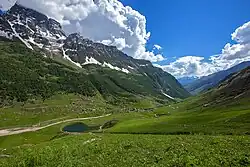
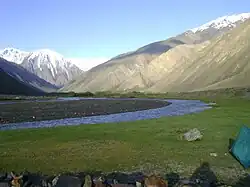
Pakistan has a wide variety of landscapes, having Riparian forest along the Indus, dry mountain ranges along the border with Afghanistan (like Safed Koh and Hindu Kush) and the Thar Desert shared with India. Much of the land is dry but there are humid areas especially along the lower Himalayas.[1] This also gives Pakistan a high variety of ecoregions, both Palearctic and Indomalayan.[2] Pakistan encompasses two Biodiversity hotspots: the Mountains of Central Asia and Himalayas.
This is a list of ecoregions of Pakistan.




References
- ↑ Unit, Biosafety. "Main Details". www.cbd.int. Retrieved 2026-03-07.
- ↑ Shah, M.; Baig, K.J. (1999). "Threatened Species Listing in Pakistan: status, issues and prospects". In IUCN (ed.). Using IUCN Red List Criteria at National Level: A Regional Consultative Workshop for South and Southeast Asia, Sri Lanka. IUCN Regional Biodiversity Program, Asia. pp. 70–81.
- ↑ World Wildlife Fund, ed. (2001). "Himalayan subtropical pine forests". WildWorld Ecoregion Profile. National Geographic Society. Archived from the original on 2010-03-08.
- ↑ World Wildlife Fund, ed. (2001). "Western Himalayan broadleaf forests". WildWorld Ecoregion Profile. National Geographic Society. Archived from the original on 2010-03-08.
- ↑ World Wildlife Fund, ed. (2001). "Western Himalayan subalpine conifer forests". WildWorld Ecoregion Profile. National Geographic Society. Archived from the original on 2010-03-08.
- ↑ World Wildlife Fund, ed. (2001). "Indus Valley desert". WildWorld Ecoregion Profile. National Geographic Society. Archived from the original on 2010-03-08.
- ↑ World Wildlife Fund, ed. (2001). "Thar Desert". WildWorld Ecoregion Profile. National Geographic Society. Archived from the original on 2010-03-08.
- ↑ World Wildlife Fund, ed. (2001). "Rann of Kutch seasonal salt marsh". WildWorld Ecoregion Profile. National Geographic Society. Archived from the original on 2010-03-08.
- ↑ World Wildlife Fund, ed. (2001). "Indus River Delta-Arabian Sea mangroves". WildWorld Ecoregion Profile. National Geographic Society. Archived from the original on 2010-03-08.
- ↑ World Wildlife Fund, ed. (2001). "East Afghan montane conifer forests". WildWorld Ecoregion Profile. National Geographic Society. Archived from the original on 2010-03-08.
- ↑ World Wildlife Fund, ed. (2001). "Karakoram-West Tibetan Plateau alpine steppe". WildWorld Ecoregion Profile. National Geographic Society. Archived from the original on 2010-03-08.
- ↑ World Wildlife Fund, ed. (2001). "Northwestern Himalayan alpine shrub and meadows". WildWorld Ecoregion Profile. National Geographic Society. Archived from the original on 2010-03-08.
- ↑ World Wildlife Fund, ed. (2001). "Kuhrud-Kohbanan Mountains forest steppe". WildWorld Ecoregion Profile. National Geographic Society. Archived from the original on 2010-03-08.
- ↑ World Wildlife Fund, ed. (2001). "Baluchistan xeric woodlands". WildWorld Ecoregion Profile. National Geographic Society. Archived from the original on 2010-03-08.
- ↑ World Wildlife Fund, ed. (2001). "Registan-North Pakistan sandy desert". WildWorld Ecoregion Profile. National Geographic Society. Archived from the original on 2010-03-08.
List of ecoregions in Asia | |
|---|---|
| Sovereign states |
|
| States with limited recognition |
|
| Dependencies and other territories |
|

