ETAR (antiviral)
 | |
| Legal status | |
|---|---|
| Legal status | |
| Identifiers | |
| |
| PubChem CID | |
| Chemical and physical data | |
| Formula | C9H11N3O4 |
| Molar mass | 225.204 g·mol−1 |
| 3D model (JSmol) | |
| |
| |
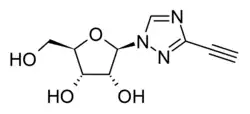
ETAR (1β-D-ribofuranosyl-3-ethynyl-[1,2,4]triazole) is a nucleoside analogue which has antiviral effects, related to compounds such as EICAR. It shows broad spectrum antiviral action against viruses such as hantaviruses, flaviviruses and bunyaviruses.[1][2][3][4][5][6][7][8][9]
See also
References
- ↑ Chung DH, Kumarapperuma SC, Sun Y, Li Q, Chu YK, Arterburn JB, et al. (July 2008). "Synthesis of 1-beta-D-ribofuranosyl-3-ethynyl-[1,2,4]triazole and its in vitro and in vivo efficacy against Hantavirus". Antiviral Research. 79 (1): 19–27. doi:10.1016/j.antiviral.2008.02.003. PMC 2692291. PMID 18394724.
- ↑ McDowell M, Gonzales SR, Kumarapperuma SC, Jeselnik M, Arterburn JB, Hanley KA (July 2010). "A novel nucleoside analog, 1-beta-d-ribofuranosyl-3-ethynyl-[1,2,4]triazole (ETAR), exhibits efficacy against a broad range of flaviviruses in vitro". Antiviral Research. 87 (1): 78–80. doi:10.1016/j.antiviral.2010.04.007. PMC 2892036. PMID 20416341.
- ↑ Gowen BB, Hickerson BT (March 2017). "Hemorrhagic fever of bunyavirus etiology: disease models and progress towards new therapies". Journal of Microbiology. 55 (3): 183–195. doi:10.1007/s12275-017-7029-8. PMID 28243938.
- ↑ Dheerasekara K, Sumathipala S, Muthugala R (2020). "Hantavirus Infections-Treatment and Prevention". Current Treatment Options in Infectious Diseases. 12 (4): 410–421. doi:10.1007/s40506-020-00236-3. PMC 7594967. PMID 33144850.
- ↑ El-Sebaey SA. Recent Advances in 1,2,4-Triazole Scaffolds as Antiviral Agents. ChemistrySelect 2020; 5(37):11654-11680. doi:10.1002/slct.202002830
- ↑ Deng X, Tian S, Yu Z, Wang L, Liang R, Li Y, Xiang R, Jiang S, Ying T, Yu F. Development of small-molecule inhibitors against hantaviruses. Microbes and Infection 2020; 22(6-7): 272-277. doi:10.1007/s10593-021-02912-8
- ↑ Kataev VE, Garifullin BF (2021). "Antiviral nucleoside analogs". Chemistry of Heterocyclic Compounds. 57 (4): 326–341. doi:10.1007/s10593-021-02912-8. PMC 8118684. PMID 34007086.
- ↑ De A, Sarkar S, Majee A (2021). "Recent advances on heterocyclic compounds with antiviral properties". Chemistry of Heterocyclic Compounds. 57 (4): 410–416. doi:10.1007/s10593-021-02917-3. PMC 8113790. PMID 33994556.
- ↑ Khan A, Wahab S, Hong ST (February 2025). "Advances in antiviral strategies targeting mosquito-borne viruses: cellular, viral, and immune-related approaches". Virology Journal. 22 (1) 26. doi:10.1186/s12985-025-02622-z. PMC 11792744. PMID 39905499.
Categories: