EA-1699
 | |
| Names | |
|---|---|
| Preferred IUPAC name
2-[ethoxy(methyl)phosphoryl]sulfanyl-N,N-dimethylethanamine | |
| Other names
S-(2-(Dimethylamino)ethyl) O-ethyl P-methylphosphonothioate IIVX Medemo | |
| Identifiers | |
3D model (JSmol) |
|
| ChemSpider | |
PubChem CID |
|
| UNII | |
CompTox Dashboard (EPA) |
|
| |
| |
| Properties | |
| C7H18NO2PS | |
| Molar mass | 211.26 g·mol−1 |
| Density | 1.06 g/ml[1] |
| Boiling point | 200 °C to 250 °C[2] |
| 248 g/L[2] | |
| Hazards | |
| NFPA 704 (fire diamond) | |
| Lethal dose or concentration (LD, LC): | |
LD50 (median dose) |
17 μg/kg (intravenous, rat)[3] 23.6 μg/kg (intramuscular, rat)[3] 54.5 μg/kg (intraperitoneal, rat)[3] 121.9 μg/kg (oral, rat)[3] |
Except where otherwise noted, data are given for materials in their standard state (at 25 °C [77 °F], 100 kPa).
Infobox references | |

| Part of a series on | |||
| Chemical agents | |||
|---|---|---|---|
| Lethal agents | |||
| Incapacitating agents | |||
|
|||
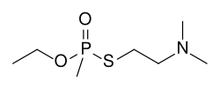
EA-1699, also known as IIVX,[2] is an extremely toxic synthetic chemical compound in the organophosphorus class, specifically, a thiophosphonate. It was derived from the more widely known nerve agent VX and can be seen as the dimethyl analogue of it.[2]
Indicators of EA-1699 have been detected at a Syrian chemical weapons production facility.[4][5]
Synthesis
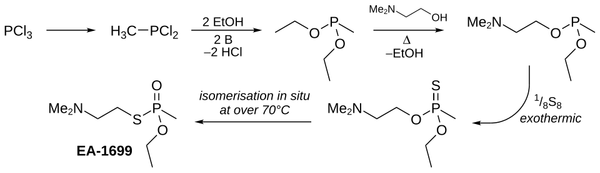
The synthesis of EA-1699 is analogous to that of VX with the N,N-diisopropylaminoethanol being replaced with N,N-dimethylaminoethanol.[2]
The B in the following diagram denotes a base with diethylaniline being described as a suitable one in literature.[2]
References
- ↑ Pampalakis, Georgios; Kostoudi, Stavroula (2023-05-11). "Chemical, Physical, and Toxicological Properties of V-Agents". International Journal of Molecular Sciences. 24 (10). MDPI AG: 8600. doi:10.3390/ijms24108600. ISSN 1422-0067. PMC 10218410. PMID 37239944.
- 1 2 3 4 5 6 Ledgard, Jared B. (2006). The Laboratory History of Chemical Warfare Agents. Paranoid Publications Group. p. 227. ISBN 978-1-4116-9432-3.
- 1 2 3 4 J, Bajgar; J, Fusek; J, Patocka (1978). "Toxicities and the rates of penetration of O-ethyl-S-(2-dimethylaminoethyl)-methylphosphonothioate into the blood following different routes of intoxication". Acta Biologica et Medica Germanica. 37 (4). Acta Biol Med Ger: 633–636. ISSN 0001-5318. PMID 735630.
- ↑ "Statement by H.E. Ambassador SHINO Mitsuko, Deputy Permanent Representative of Japan to the United Nations, at the Security Council Briefing on "the situation in the Middle East (Syria chemical weapons)"". 国際連合(国連)日本政府代表部. Retrieved September 24, 2025.
- ↑ "Two New Outstanding Issues with Syria's Chemical Weapon Declarations 'Extremely Worrying', United Nations Official Tells Security Council". Meetings Coverage and Press Releases. September 5, 2024. Retrieved September 24, 2025.