Dumbleton Hall

Dumbleton Hall is a 19th-century country house in the village of Dumbleton, between Evesham and Tewkesbury on the boundary of Worcestershire and Gloucestershire, England.[1] The present house was built between 1830 and 1832 in the Tudor style to designs by the architect George Stanley Repton for the agriculturist and Member of Parliament Edward Holland, and is a Grade II* listed building.[1] It replaced an earlier house built by the Cocks family, who held the estate for about two centuries; the property later passed to the Eyres-Monsell family. From 1959 it was owned by the Post Office Fellowship of Remembrance and run as a holiday hotel, and after a two-year restoration it reopened as a country house hotel in 2026.[2][3]
History
Earlier hall and the Cocks family

The Dumbleton estate passed to the Cocks family in the early 17th century and remained in their hands for around two hundred years.[4] Sir Richard Cocks, three times a member of parliament for the county and high sheriff in 1692, built the first Dumbleton Hall on a site south-west of the parish church in the late 17th century. An engraving by Johannes Kip published in 1712 depicts it as a double-pile house of five bays with projecting wings, a hipped roof and a central pediment bearing the family arms.[4] The first hall was largely demolished in 1779; a surviving fragment served as a farmhouse until it too was taken down in 1830, when work began on the present house.[4]
The present hall

In 1830 the agriculturist Edward Holland, the estate's new owner, employed the architect George Stanley Repton — the youngest son of the landscape gardener Humphry Repton — to build the present hall in the Tudor style; it is generally said to have been completed in 1832.[4][5] Holland (1806–1875) sat in the House of Commons as member of parliament for East Worcestershire and later for Evesham, ran a model farm on the estate and served as a president of the Royal Agricultural Society.[6] He was a cousin of the novelist Elizabeth Gaskell, a frequent visitor to the hall, and his eldest son married Gaskell's daughter.[1]
The Eyres-Monsell family
By the end of the 19th century the estate had passed to the Eyres, and subsequently the Eyres-Monsell, family, who remodelled the interior.[1][4] Bolton Eyres-Monsell, 1st Viscount Monsell, Conservative member of parliament for Evesham and First Lord of the Admiralty, raised his family at Dumbleton; his daughter Joan Eyres Monsell — later the wife of the writer Patrick Leigh Fermor — grew up there.[7] The poet John Betjeman stayed at the house and wrote three poems there.[1] According to a history of the house by John Richard Hodges, guests during this period also included the Mitford sisters and the German diplomat Joachim von Ribbentrop.[8] The family sold Dumbleton Hall in the late 1950s.[4]
Post Office Fellowship of Remembrance
In 1959 the house was acquired by the Post Office Fellowship of Remembrance, a members' organisation founded as a living memorial to General Post Office staff killed in the two world wars, which ran it as a holiday hotel for postal workers.[2][9] The Fellowship's two illuminated Books of Remembrance, recording the names of 12,830 Post Office employees who died in the First and Second World Wars, were handwritten and bound over three years by a Post Office employee, James Trezies, and unveiled in 1957 in the presence of Queen Elizabeth The Queen Mother; they were subsequently given to The Postal Museum in London.[9][10] A garden of remembrance, laid out on the site of the hall's former Victorian swimming pool, was opened in 2001.[11] The Fellowship sold the last of its hotels, Dumbleton among them, between 2019 and 2021.[9]
21st century
Marketed openly for the first time in some sixty years, Dumbleton Hall was sold off-market in 2021, during the COVID-19 pandemic, for a guide price of £6 million, to a company controlled by Paul Vezolles of Chatham Park Development, a United States–based property developer.[2] After a two-year, £25 million restoration the house reopened as a hotel in 2026, operated by Bespoke Hotels, with 34 bedrooms and suites and an all-day restaurant, Cedar 1905 — named after the date of the hall's porte-cochère — set in a 16-acre estate.[3][12]
Architecture
Dumbleton Hall is built in the Tudor style in ashlar limestone from the Temple Guiting quarries under a slate roof, with a service wing added in two phases in the late 19th and early 20th centuries. The three-storey main range has twin gables to the entrance front, a curving orangery at the south-west corner, octagonal stair turrets with ogee cupolas and a central porte-cochère added in 1905.[1] The interior, remodelled by the Eyres and Eyres-Monsell families around the turn of the 20th century, retains a panelled hall with a 17th-century-style ribbed ceiling and a Tudor-arched stone fireplace, together with a panelled ballroom with linenfold panelling and finely executed Arts and Crafts plasterwork.[1] The house was listed at Grade II* in 1987.[1]
Grounds and estate
The house stands on the lower north-eastern slope of Dumbleton Hill, an outlying foothill of the Cotswolds near Bredon Hill. Its landscaped park, in the manner of the 18th-century designer Capability Brown, is approached by an avenue from the north lodge; the gardens were laid out after the house was built in the 1830s, and a man-made lake was formed on the slope below the hall between 1883 and 1923.[4][13]
The nearby parish church of St Peter, a Grade I listed building of 12th- to 15th-century origin, contains monuments to families connected with the estate, including a brass to Edward Holland (died 1875) and memorials to members of the Cocks family. Patrick Leigh Fermor, the husband of Joan Eyres Monsell, is buried in its churchyard.[14][15]
Namesake
The Great Western Railway named a GWR 4900 Class locomotive after the hall in 1929.[16] Dumbleton Hall has been preserved.
Gallery
- Dumbleton Hall following its 2026 restoration
 Dumbleton Hall from the grounds
 The hall and its parkland setting
 The east terrace
 The porte-cochère entrance, added in 1905
 The approach to the entrance
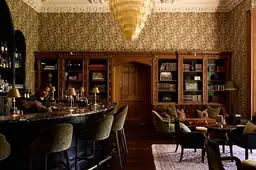 The Library Bar
 The Oak Room
 The Pheasant Lounge
 The Allied Room
 The Cedar 1905 restaurant
 The Cedar 1905 restaurant interior
 The Cedar 1905 restaurant, with garden views
 The Master Suite
 The Master Suite, looking over the grounds
 The Master Suite bathroom
 A Junior Suite
 A guest room with parkland views
 A guest bathroom
References
- 1 2 3 4 5 6 7 8 Historic England. "Dumbleton Hall, Dumbleton (1091709)". National Heritage List for England. Retrieved 9 July 2026.
- 1 2 3 Witts, Sophie (29 March 2021). "Dumbleton Hall sold to US-based buyer off guide price of £6m". The Caterer. Retrieved 9 July 2026.
- 1 2 Seo, Jungmin (15 May 2026). "Dumbleton Hall reopens in the Cotswolds following two-year refurbishment". The Caterer. Retrieved 9 July 2026.
- 1 2 3 4 5 6 7 "Dumbleton Conservation Area Character Statement" (PDF). Tewkesbury Borough Council. June 2002. Retrieved 9 July 2026.
- ↑ Hodges, John Richard (2015). Dumbleton Hall: The Story of a Victorian Country House. John Richard Hodges. ISBN 978-0-9931638-0-7.
- ↑ "Mr Edward Holland". Hansard 1803–2005. UK Parliament. Retrieved 9 July 2026.
- ↑ Fenwick, Simon (2017). Joan: The Remarkable Life of Joan Leigh Fermor. Macmillan.
- ↑ "Book reveals hall's eminent connections". Evesham Observer. 11 September 2015. Retrieved 9 July 2026.
- 1 2 3 "History". Post Office Remembrance Fellowship. Retrieved 9 July 2026.
- ↑ "About the books". GPO War Heroes. The Postal Museum. Retrieved 9 July 2026.
- ↑ "Post Office Fellowship of Remembrance Garden of Remembrance". War Memorials Online. War Memorials Trust. Retrieved 9 July 2026.
- ↑ Crowe, Eamonn (2026). "Dumbleton Hall Hotel reopens following major £25m makeover". Boutique Hotelier. Retrieved 9 July 2026.
- ↑ "Dumbleton Hall". Parks & Gardens UK. Retrieved 9 July 2026.
- ↑ Historic England. "Church of St Peter, Dumbleton (1154563)". National Heritage List for England. Retrieved 9 July 2026.
- ↑ "St Peter, Dumbleton". National Churches Trust. Retrieved 9 July 2026.
- ↑ "Dumbleton Hall fades into retirement". The Railway Magazine. No. 1185. January 2000. p. 49.