Dreamcore (aesthetic)

Dreamcore is a surreal Internet aesthetic that gained popularity in the late 2010s through early 2020s. It focuses on visuals inspired by dreams and nostalgia.
Characteristics
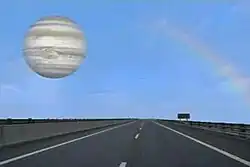
Dreamcore imagery combines familiar and dreamlike elements to create atmospheres that may be comforting, eerie or unsettling,[1] including "hazy and recognizable old settings".[2] This imagery may heavily rely on kenopsia to induce an unsettling environment. It commonly uses surreal or low-fidelity imagery, including optical illusions, clouds, long corridors and imagery associated with dreams or nightmares.[3] Nylon profiled creator Jordan Gretzner, whose Dreamcore posts often addressed themes of existentialism and derealization.[3] The aesthetic overlaps with Weirdcore and liminal-space imagery, mainly through its use of uncanny or seemingly familiar environments in popular culture.[1][3] Dreamcore imagery depicts 2000s and 2010s environments, which can make the viewer experience nostalgia or anemoia.
History
The precise origins of Dreamcore are unclear.[1] The aesthetic gained traction on TikTok and in other online communities during the early to mid-2020s,[1][3][4][5] obtaining millions of views on social media platforms.[6]
In China, the Dreamcore aesthetic is particularly popular among members of Generation Z, and centers primarily on recreating the feeling of an idealized version of early-2000s China.[7][8][9]
Reception and analysis
Nylon described Dreamcore as combining comfort and nostalgia with eeriness and unease.[3] Writing for the magazine in 2021, Jack Riewe associated the aesthetic with surrealism, isolation, uncertainty and questioning reality.[3] The publication reported that the #dreamcore hashtag had received approximately 923.7 million views on TikTok by October 2021.[3]
A 2026 study involving 449 adults divided responses to Dreamcore imagery into two dimensions: darker or eerie imagery and warmer or comforting imagery.[1] The researchers found that participants with stronger nostalgic tendencies tended to respond more positively to both dimensions.[1] They described their findings as preliminary and noted that their selected images did not represent every possible form of Dreamcore.[1]
Related aesthetics
Dreamcore overlaps with multiple aesthetics, including Weirdcore, liminal spaces, and other similar aesthetics. Nylon described Dreamcore as a "sister" to Weirdcore.[3] Academic research has identified liminal-space imagery as a possible major influence, while Dreamcore places particular emphasis on motifs associated with dreams, daydreams and nightmares.[1]
In media
The 2025 video game Dreamcore is based entirely around the Dreamcore aesthetic.[10]
References
- 1 2 3 4 5 6 7 8 Song, Jia-Yu; Choi, Won-Ho; Li, Ru (2026). "What Makes People Like Dreamcore Aesthetics? The Role of Trait Nostalgia in Preferences for Dreamcore Imagery". Empirical Studies of the Arts. 44 (2): 529–551. doi:10.1177/02762374251356955.
- ↑ Zhou, Yingcan (19 April 2024). "The Nihilistic Future of Post-internet Era: Analysis of the Production Mechanism of Core Aesthetics". Communications in Humanities Research. 28 (1): 24–30. doi:10.54254/2753-7064/28/20230029. ISSN 2753-7064.
- 1 2 3 4 5 6 7 8 Riewe, Jack (10 November 2021). "Dreamcore, Sister To Weirdcore, Is The Internet Aesthetic Packed With Uneasiness". Nylon. Retrieved 29 July 2026.
- ↑ Finn, Rachel (13 June 2021). "What is 'Dreamcore' and why is it all over TikTok?". i-D. Retrieved 29 July 2026.
- ↑ Holstein, Philipp (30 June 2021). "Dreamcore-Trend bei TikTok: Alles so schön unheimlich hier". Rheinische Post (in German). Retrieved 1 August 2026.
- ↑ Adam, Thilo (9 August 2026). "»Ich bin fasziniert davon, dass es keinen Sinn ergibt«". Die Zeit. Retrieved 9 August 2026.
Auf Social Media erzielen »Dreamcore«-Inhalte Millionen von Aufrufen.
- ↑ Kuo, Lily; Wu, Pei-Lin (5 July 2026). "Inside 'Chinese Dreamcore,' Where Gen Z Relives a Brighter Past". The New York Times. ISSN 0362-4331. Retrieved 1 August 2026.
- ↑ Kılıç, Sinem (17 July 2026). "Dreamcore-Hype: Mit dem Traum ist dann Schluss". Die Zeit (in German). ISSN 0044-2070. Retrieved 1 August 2026.
- ↑ "Trend: Junge Chinesen wollen in die 2000er zurück". Kronen Zeitung (in German). 5 July 2026. Retrieved 9 August 2026.
- ↑ Packwood, Lewis (23 January 2025). "Dreamcore review: when style is the whole game". Creative Bloq. Retrieved 4 August 2026.