Donner (crater)
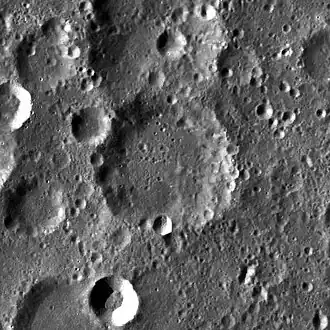 LRO mosaic | |
| Coordinates | 31°24′S 98°00′E / 31.4°S 98.0°E |
|---|---|
| Diameter | 55.05 km (34.21 mi)[1] |
| Depth | Unknown |
| Colongitude | 263° at sunrise |
| Eponym | Anders Donner |

Donner is a lunar impact crater on the far side of the Moon. It is located just to the northeast of the Mare Australe, behind the southeastern limb of the Moon.[2] To the northeast is the larger Titius formation,[3] while the basalt-flooded Abel lies to the southwest.
This crater has a moderately eroded outer rim, and several small and tiny craterlets lie along the edge. A joined pair of small craters lie across the southern rim and inner wall, including the Copernican period crater Donner M.[4] An unnamed, crater-like feature with about the same diameter as Donner is attached to the northern outer rim. The structure along the inner wall has been softened and rounded by a long history of minor impacts.
The interior floor is relatively level, and is pock-marked by multiple tiny craterlets. There is a curving ridge in the southern part of the floor that is attached to the inner wall, and possibly forms the remnant of a small crater rim.[5]: 100
This formation is named after Finnish astronomer Anders Donner (1854-1938).[6] Its designation was formally adopted by the International Astronomical Union in 1970.[1]
Satellite craters
By convention these features are identified on lunar maps by placing the letter on the side of the crater midpoint that is closest to Donner.[7]
| Donner[5]: 297 | Latitude | Longitude | Diameter |
|---|---|---|---|
| M | 32.2° S | 98.0° E | 8 km |
| N | 33.2° S | 97.1° E | 19 km |
| P | 33.5° S | 96.3° E | 39 km |
| Q | 34.3° S | 95.6° E | 15 km |
| R | 34.4° S | 92.3° E | 15 km |
| S | 32.1° S | 92.9° E | 23 km |
| T | 31.1° S | 94.8° E | 46 km |
| V | 30.5° S | 95.7° E | 19 km |
| Z | 29.7° S | 97.8° E | 13 km |
Donner M lies across the southern rim of the larger Donner. An impact flow extends from this satellite formation to the south.[8][9]
References
- 1 2 "Donner". Gazetteer of Planetary Nomenclature. USGS Astrogeology Research Program. Retrieved 2026-08-25.
- ↑ Byrne, Charles J. (2008). The Far Side of the Moon. Springer. p. 23. ISBN 978-1-4899-8806-5.
- ↑ "LAC 100" (PDF). Gazeteer of Planetary Nomenclature. Retrieved 2026-08-25.
- ↑ Hu, Haojin; et al. (November 2025). "Lunar highland preserves meteoritic-iron-rich materials in the Earth─Moon system". The Astrophysical Journal. 993 (1). id. 148. Bibcode:2025ApJ...993..148H. doi:10.3847/1538-4357/ae08b5.
- 1 2 Bussey, B.; Spudis, P. (2004). The Clementine Atlas of the Moon. New York: Cambridge University Press. ISBN 978-0-521-81528-4.
- ↑ Menzel, D. H.; et al. (1971). "Report on Lunar Nomenclature by the Working Group of Commission 17 of the IAU". Space Science Reviews. 12 (2): 136–186. Bibcode:1971SSRv...12..136M. doi:10.1007/BF00171763. S2CID 122125855.
- ↑ Grego, P. (2015). "Satellite Crater". In Hargitai, H.; Kereszturi, Á. (eds.). Encyclopedia of Planetary Landforms. New York, NY: Springer. doi:10.1007/978-1-4614-3134-3_328.
- ↑ Neish, C. D.; et al. (March 2014). Global Distribution of Lunar Impact Melt Flows. 45th Lunar and Planetary Science Conference, held 17-21 March, 2014 at The Woodlands, Texas. LPI Contribution No. 1777. p. 1159. Bibcode:2014LPI....45.1159N.
- ↑ Gallinger, Cailin L.; et al. (November 2024). "Thermophysical Diversity of Young Lunar Crater Ejecta Revealed with LRO Diviner Observations". The Planetary Science Journal. 5 (11). id. 261. Bibcode:2024PSJ.....5..261G. doi:10.3847/PSJ/ad84e3.
Sources
- Price, Fred W. (1988). The Moon Observer's Handbook. Cambridge University Press. ISBN 978-0-521-33500-3.
- Rükl, Antonín (1990). Atlas of the Moon. Kalmbach Books. ISBN 978-0-913135-17-4.
- Wlasuk, Peter T. (2000). Observing the Moon. Springer. ISBN 978-1-85233-193-1.
| Physical properties |  | |
|---|---|---|
| Orbit | ||
| Surface and features | ||
| Science | ||
| Exploration | ||
| Time-telling and navigation | ||
| Phases and names | ||
| Daily phenomena | ||
| Related |
| |
