Dónde Están los Ladrones?
| Dónde Están los Ladrones? | ||||
|---|---|---|---|---|
 | ||||
| Studio album by | ||||
| Released | 25 September 1998[1] | |||
| Recorded | 1998 | |||
| Studios | Crescent Moon Studios; Criteria Recording Studios (Miami, Florida) | |||
| Genres | ||||
| Length | 41:06 | |||
| Languages |
| |||
| Label | Sony Music Entertainment (Colombia)[6] | |||
| Producer |
| |||
| Shakira chronology | ||||
| ||||
| Singles from Dónde están los ladrones? | ||||
| ||||
Dónde Están los Ladrones? (Spanish: [ˈdonde esˈtan los laˈðɾones]; transl. Where Are the Thieves?) is the fourth studio album by Colombian singer-songwriter Shakira, released on 25 September 1998 by Sony Music Colombia.[1] After attaining success in Latin America with her major international debut, Pies Descalzos (1995),[3] Shakira met producer Emilio Estefan, who identified her potential to break into the U.S. Latin market and became her manager. For work on the new album, Shakira also enlisted her previous collaborator Luis Fernando Ochoa, along with Lester Mendez, Javier Garza, Pablo Flores and Estéfano Salgado.[6] Dónde Están los Ladrones? is stylistically rock en español; it incorporates Latin pop elements and influences of Middle Eastern music.[3][8]
Upon its release, Dónde Están los Ladrones? received positive reviews from music critics, who praised its sound and lyrics;[8] Shakira was sometimes compared to Alanis Morissette.[3] Commercially, the album was a success, selling over one million copies within its first month of release. It peaked at number 131 on the U.S. Billboard 200 and topped Billboard's Top Latin and Latin Pop Albums charts. The album received numerous record certifications in various countries, including a platinum certification in the United States and a triple-platinum certification in Shakira's native Colombia.[8] Dónde Están los Ladrones? won several accolades and was nominated for Grammy Award for Best Latin Rock/Alternative Performance at the 41st Grammy Awards. In 2020, it was ranked number 496 by Rolling Stone on its 500 Greatest Albums of All Time.[5]
Six singles were released from Dónde Están los Ladrones?. Its lead single, "Ciega, Sordomuda", reached the top of both Billboard's Hot Latin and Latin Pop Songs component charts, and also reached number one on charts of countries in Central America and Venezuela. Follow-up singles "Tú", "Inevitable", "No Creo", "Ojos Así" and "Moscas en la Casa" also debuted high on the charts. The album was promoted through several televised performances, including her debut on American television through The Rosie O'Donnell Show. In August 1999, Shakira gave an acoustic MTV Unplugged concert in New York City, which resulted in the live MTV Unplugged album.[8] Her second tour, Tour Anfibio, visited South and North America in March–May 2000 and promoted both records.
Background and development

After she rose to prominence with the success of her Pies Descalzos album (1995), Shakira was introduced to Emilio Estefan, the most important producer in the U.S. Latin music market at the time, by her promoter and longtime friend, Jairo Martínez.[9] Estefan was renowned for launching the careers of several Hispanic singers, including Enrique Iglesias, Thalía, and his wife Gloria Estefan. The Estefans recognized early Shakira's potential and helped her break into the U.S. music market. One of Shakira's concerns about working with Emilio Estefan was creative control over her music. Before signing their contract, the roles and duties were defined: Estefan would be her manager and executive producer, but she would be in charge of all material and arrangements and have final approval over her records. She later stated about Estefan, "He had a great respect for me as an artist and trusted me totally on this project".[10] They worked on the new album at Estefan's Crescent Moon Studios in Miami,[10][11] where Shakira now lived and where Sony Music officially launched and promoted the record on 25 September 1998.[1]
Having been labeled a major music phenomenon and having become an international youth idol after the Pies Descalzos success,[1] Shakira was mindful of the many who would judge her based on her fourth studio album. She knew that some would say that "she had changed too much" and others would reproach her if she remained the same. "All I could do was to be myself. I understood that all I had to do was write the music I knew how to write and to write from the heart when I was compelled to. In that way, everything developed naturally, more so than I could have imagined", she said.[11] Being a perfectionist, she worked on the material to the point of exhaustion. "I made two or three demos of each song. I became a human being so demanding of myself that until the song made my hair stand on end, I wouldn't stop". Shakira was passionate for her profession; she realized that fame had not changed her as a person and she needed to continue with her personal artistic style, allowing change in form, but not in substance of her music.[1] Equipment for the recording of Dónde Están los Ladrones? included old amplifiers to achieve a better sound, a 40-year-old German microphone, and several innovations in the instrumental mixes.[1] The album took nine months to produce and more people worked on it than on Pies Descalzos,[12] where all songwriting was done by Shakira and Ochoa and all production by Ochoa and Shakira.[6][13] She commented, "To me it's a normal time, the gestation period for a baby. But many people wag their finger and tell me that the next one cannot take so long..."[11]
Title and artwork

The album's title was inspired by an incident in Bogotá. At the El Dorado International Airport, during her Tour Pies Descalzos, a briefcase that contained all the lyrics Shakira had been working on for the next album was stolen; the songs had to be rewritten.[9][10] She commented, "The worst part about the whole thing was that I couldn't remember them because of the mental block that can be caused by such a traumatic experience as the robbery of such a personal item".[14] She was overcome by feelings of impotence and emptiness and for a couple of days could think of nothing but the people who had taken her material: "Who are they? What were they looking for? Where are they?".[14] She searched for a reason behind the theft of her songs. "I came to the conclusion that there are all types of thieves. A thief is not just a person who takes a physical object that doesn't belong to him or her. There are thieves who steal feelings, space, time, dreams, rights", she explained.[11]
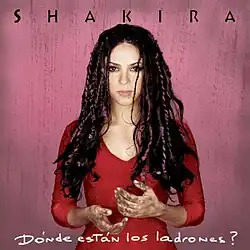
The album's title also evolved into a reference to political corruption and general social mistrust pervading contemporary Colombian society. The cover features a photo of Shakira with her hands soot-covered, as if caught with her hands dirty.[15] She explained: "from that point of view, we all have stolen at one time or another, myself included. The dirty hands represent the shared guilt. No one is completely clean, in the end we are all accomplices".[11] In keeping with her "rockera" style, the cover shows her hair loose and messy and filled up with little colorful braids, looking like a "modern Medusa", according to biographer Ximena Diego.[11] Because of the album's popularity, girls from various countries copied Shakira's style, colorfully braiding their hair and wearing friendship bracelets.[11]
Composition
"For me, singing about the manifestations of love is inevitable. That marvelous feeling that seduces us into a hypnotic trance, like in 'Ciega sordomuda', or forces us to give up everything, like in 'Tú', makes us believe solely in the person we love, as in 'No creo', makes it difficult for us to forget, as in 'Sombra de ti'... But my songs include social views as well. That is the case in 'Octavo día' and 'Dónde están los ladrones?' which, with a dose of humor or irony, question certain attitudes that we frequently see".
Dónde Están los Ladrones? consists of rock en español and Latin pop styles.[3] In a 2026 Boston Herald article, Jed Gottlieb advises the reader to spin the record to hear Shakira's alt rock roots.[2] The album opens with "Ciega, Sordomuda", which utilizes mariachi Mexican trumpets over a disco dance loop and an electric guitar.[16] In "Si Te Vas", angry Shakira tells her lover "if you leave and change me for that witch, piece of skin, don't come back anymore" (she'll quit him once she strips him of his last pennies, the singer warns).[6] "Moscas en la Casa" was inspired by Shakira's relationship with Puerto Rican actor Osvaldo Ríos.[17] She expresses the sadness that she feels after the partner's departure, still waiting for his return.[18] In "No Creo", Shakira cheerfully declares that she believes in nothing and nobody except for her friend, his kisses and everything he says. He is her stairway to heaven, she desires to be his inspiration, she will go and do the way he wants her to. Among the gods, personalities and factors she does not believe in are Venus, Mars, Karl Marx, Jean-Paul Sartre, Brian Weiss, luck, and even herself.[6] The fifth song on Dónde Están los Ladrones? is "Inevitable". In the dramatic hard rock ballad, self-critical Shakira finds it inevitable that she keeps loving her partner who is gone, but struggles to figure out what to do with herself.[6] "Octavo Día" is a rock song with satirical lyrics.[19] God comes to Earth after finishing his work, discovers everything to be in ruins, and hopelessly tries to live as an ordinary man, unemployed and lonely. She namechecks Michael Jackson, Bill Clinton and Tarzan as idols left for humanity to worship if God decides to abandon his creation.[20]
The lost love poetry of "Que Vuelvas" was inspired by Shakira's relationship with Ríos.[21] It was musically compared to her 1995 song "Estoy Aquí".[4] In "Tú", "one of the best Latin love songs of all time", she lyrically expresses the enchantment and power of love.[22] The ninth track is the guitar-driven "Dónde Están los Ladrones?", where Shakira utilizes her reflections brought about by her stolen luggage incident to criticize the theft, murder and negative aspects of political and social reality in South American nations.[19][23] She sees "the thieves" most everywhere, does not exclude herself ("and what if it's me ... the one who sings this song"), but refers specifically to corrupt practices of the ruling elites.[24] In "Sombra de Ti", she is overwhelmed by painful memories of a past love.[25] The album's closing "mega-hit" "Ojos Así" is accompanied by a Middle Eastern rhythm and contains a verse in Arabic.[3][20] The singer laments that even though she has traveled from Bahrain to Beirut and from the North to South Pole, she has never found black eyes like the object of her desire has, without which she cannot now live.[20]
Singles
"Ciega, Sordomuda" was released on 7 September 1998 as the album's lead single.[7][26] It reached number one on Colombian radio in a record time of less than a week after its release.[7] It also reached number one on charts of the United States, countries in Central America and Venezuela.[27] In the song's music video, Shakira is arrested in an unprovoked police attack, along with many other street-partying people. She escapes with the help of her boyfriend dressed as a policeman (the police is also shown surrealistically as robots in police uniforms). Shakira hides in a wig store, pretending to be a mannequin, and drives a car blindfolded while the whole city searches for her, blindfolded as well. The video was directed by Gustavo Garzón. It was nominated for a Lo Nuestro Award for Video of the Year in 1999.[28] "Tú" was selected as the second single from the album.[29] It repeated the success of the previous one, reaching the top positions on both the U.S. Billboard Latin Pop Songs and Hot Latin Songs charts.[30][31] Its black-and-white music video was directed by Emilio Estefan in Orlando, Florida.[32] "Inevitable" was released as the album's third single.[33] In the music video directed by Garzón, Shakira sings the song to an audience in a circular stage. The single reached numbers two and three on the U.S. Latin Pop Songs and Hot Latin Songs charts.[30][31]
"No Creo" was released as the fourth single from Dónde Están los Ladrones?,[34] and was also a commercial success, reaching numbers two and nine on the U.S. Latin Pop Songs and Hot Latin Songs charts, respectively.[30][31] The song's video was directed by Garzón.[8] "Ojos Así" was released as the album's fifth single.[35] The track reached numbers nine and twenty-two on the U.S. Latin Pop Songs and Hot Latin Songs component charts.[30][31] The music video for "Ojos Así" features Shakira performing the song for a festive, dancing crowd, with a giant neon eye in the background, which shoots out sparks and catches fire towards the end of the video. There are also scenes of Shakira belly dancing in front of a dark purple background, with snakes painted down her arms and red lines painted on her head. The video won the International Viewer's Choice Award (North) at the 2000 MTV Video Music Awards, while it was also nominated for the same award in the South category and for a Latin Grammy Award for Best Short Form Music Video.[36] "Moscas en la Casa" was released as the sixth single.[37] It peaked at numbers ten and twenty-five on the U.S. Latin Pop Songs and Hot Latin Songs charts, respectively.[30][31] Promotional singles released in select countries included "Dónde Están los Ladrones?",[38] "Octavo Día",[39] and "Si Te Vas".[40]
Critical reception
| Review scores | |
|---|---|
| Source | Rating |
| AllMusic |  [3] |
| Billboard | favorable[41] |
| Latin Beat Magazine | mixed[42] |
| Sputnikmusic |  [43] |
| The New Rolling Stone Album Guide | [44] |
Dónde Están los Ladrones? received critical acclaim from music critics.[8][19] Alex Henderson from AllMusic gave the album five stars out of five, saying that it was "arguably the finest and most essential album that she recorded in the 1990s". Besides "poetic" lyrics, the "superb CD" would impress even non-Spanish-speaking listeners with its "attractive melodies and the emotion that the artist brings to her songs". He finds the second major international production of the "superstar in Latin America" to be "musically exciting".[3] Billboard magazine was also positive and called it a "like-minded set brimming with forlorn, lovesick testimonials set to a mainstream pop/rock sound laced occasionally with edgy guitar and vocal interludes", picking the song "Ojos Así" as the "most satisfying" track on the album.[41] Christopher John Farley wrote positively of Dónde Están los Ladrones? in his Time magazine review: "The fuss over Shakira is justified. On her latest CD she charges Latin pop with rock 'n' roll to thrilling effect. Even when her music gets loud, Shakira's vibrant contralto remains sweet and expressive." "Missing out on this collection would be at least a misdemeanor", he concluded.[45] Mark Kemp, writing for the book The New Rolling Stone Album Guide, said that the album mined a familiar territory in Shakira's music, but it "holds together with stronger songs, a beefier sound, and more confident vocals". To him, it was "hard to imagine a singer barely into her 20s having written and recorded such an inventive set of songs".[44]
According to the reviewer from MTV, "This album finds the charismatic songstress combining traditional Latin roots (represented by the occasional acoustic touches) with post-Alanis angry-young-woman sensibilities, Sheryl Crow-esque pop eclecticism and an electrifying rock & roll rhythm. Those expecting polite recreations of Latin styles past will be sorely disappointed, but listeners for whom crossover is the norm will find a wealth of satisfaction in DONDE ESTAN LOS LADRONES, whether or not they understand the words".[46] Leila Cobo Hanlon from Miami Herald was positive, saying that the album "retains Shakira's trademark sound — rock-laced pop melodies backed by acoustic guitars — as well as her deeply personal approach to music-making". As she saw it, "the album's only failures occur when it looks too closely at its predecessor".[4] Sputnikmusic website wrote that Dónde Están Los Ladrones? is "on the verge of being spectacular", "the gem of Shakira's discography, and one of the best Spanish pop releases of the past decade", although it criticized its "slight lack of variety".[43] Franz Reynold from Latin Beat Magazine noted that "while many of the cuts on this collection are definitely chart-bound, that is due more to the fact that she doesn't stray too far from the previous formula, than it does to any hope that success provides room for expansion", but complimented tracks like "Inevitable" and "Tú".[42] Rubens Herbst from Brazilian newspaper A Notícia gave a mixed review, writing that the album was "homogeneous, well-produced and full of potential hits", however "competent but empty and forgettable". He noted "Inevitable" as a song with "powerful melody and cool riff".[47]
Lists
| Critic/Publication | List | Rank | Ref. |
|---|---|---|---|
| Los 600 de Latinoamérica | 600 discos 1920-2022 | 10 |
|
| Rolling Stone | The 100 Best Album Covers of All Time | 82 |
|
| Rolling Stone | The 500 Greatest Albums of All Time | 496 |
|
Accolades
At the 41st Annual Grammy Awards in 1999, Dónde Están Los Ladrones? received a nomination for Best Latin Rock/Alternative Album.[49] At the 11th Annual Lo Nuestro Awards in the same year, it won the Lo Nuestro Award for Pop Album of the Year in a tie with Sueños Líquidos by Maná.[50] Also in 1999, at the Billboard Latin Music Awards, it won Pop Album of the Year by a Female Artist,[51] and El Premio de la Gente for Female Pop Artist or Group at the Ritmo Latino Music Awards.[52] The record won in the category of Best Pop Album by a Female Artist at the 1999 Premios Globo.[53] It was recognized as Latin Album of the Year at the 2000 Premios Gardel.[54] In the updated 500 Greatest Albums of All Time published in 2020 by Rolling Stone, it ranked at number 496 as the only rock en español on the list and was described as a "stellar globetrotting dance-rock set, which blends sounds from Colombia, Mexico, and her father's native Lebanon."[5][55]
Commercial performance

Dónde Están los Ladrones? sold 300,000 copies on the day of its release, and over one million copies by the end of its first month of release.[15] On the U.S. Billboard 200, the album debuted at number 141 for the week dated 17 October 1998, selling 10,500 units;[56] the next week it climbed to number 131, its peak.[57] It reached number one on Billboard Top Latin Albums, Latin Pop Albums,[58][59] and number 30 on Catalog Albums component charts.[58] By December 1998, it had reached 500,000 copies sold in the United States and 1.5 million worldwide.[60] On 23 December 1999, it was certified platinum by the Recording Industry Association of America (RIAA).[61] As of October 2017, over 920,000 copies were sold in the U.S., making it the ninth bestselling Latin album in the country, according to Nielsen SoundScan.[62] Across Europe, Dónde Están los Ladrones? made appearances at the lower ranges of Top 100 album charts.[63][64][65]
In Hispanic countries, the album was a success. In Shakira's native Colombia, it was certified triple-platinum by the Asociación Colombiana de Productores de Fonogramas (ASINCOL), after selling 180,000 copies.[66][67] It was also certified triple-platinum in Chile and Venezuela,[66][68] double-platinum in Mexico and Uruguay,[69][70] quadruple-platinum in Argentina,[71] and platinum in Spain.[72] According to different sources, Dónde Están los Ladrones? sold 4 million or even 8 million copies worldwide.[73][74][75][76]
Legacy

According to music journalist Sebastián Peña from Shock magazine, the record was intended to surpass the success, quality and attention that Shakira had achieved with her previous album, something that she undoubtedly accomplished. He stressed that she dared to do something that very few artists of that time had done for the fear of not being played on the radio, making statements, criticizing the corrupt and those who live their lives superficially, achieving, in her lyrics, revolutionary effects. While other Latin artists, such as Carolina Sabino, were taking off, none managed to transcend with a well-established fan base, something that Shakira did. She was also credited with opening doors for women in the industry and showing to people that she could be a "superhero" for men as well as women, whom female artists had previously kept in the background. She was seen by some in the media as the Latin Alanis Morissette, due to the similarity of their ways of expressing themselves and their visual proposals. With this album, Shakira gave greater strength and visibility to the international female performer boom at the end of the century.[77] The record caused her to be dubbed "the princess of rock" by Time magazine and to be described as "the Colombian artist of the millennium" in her country.[78]
According to Ximena Diego's book Shakira: Woman Full of Grace, Shakira's style on the album, and on the "Ciega, Sordomuda" video in particular, became a trend for young women, with teenage girls imitating the singer's outfit and accessories. Thousands of letters reached her from fans, her music sounded in children's toys. Because of her, Latin music was taken to distant cultures in Europe and Asia.[79] Rolling Stone credited 21-year-old Shakira with redefining Latin music with her last two albums, Dónde Están los Ladrones? being the one in which she "created a bold, female-led pop-rock style that stood out from the male-dominated balladry that was all over Latin radio in the Nineties" and that "set her up for massive global fame". Shakira was introduced to the wider American public and became a household name in Latin rock. According to the magazine, she was committed to "making the music sound exactly how she heard it in her head". Francisca Valenzuela and Jessie Reyez explained in interviews how Shakira's "frank and witty lyrics" of love and heartbreak inspired other female artists to write their own "unapologetic" songs.[12]
In a 2021 feminist media survey report, Dónde Están los Ladrones? was seen as the most important Spanish-language album by a Latin American artist in history. About 50 Latin music industry women and LGBT people from a number of countries participated in the survey. The album made Shakira the most influential female artist for them (her track record was considered together with Pies Descalzos). During the 1990s, the "rockera" was a daring and groundbreaking author and performer with the image of an ordinary Latin American girl, which was soon to acquire a somewhat different quality, when she transformed more into a global pop star. The professional women in the report developed strong personal identifications with Shakira of the 1990s, then intensely disliked her "crossover" and blonde hair, but with time her legacy and profound impact had become self-evident to them. [75]
Dónde Están los Ladrones? was a benchmark for the younger generation of Latin artists. Sebastián Yatra and Camilo have cited it as a point of inspiration for their musical works.[80][81] In July 2017, it ranked at number 95 among the 150 greatest female albums of all time by the National Public Radio.[82] Dónde Están los Ladrones? was included as one of the "1000 Recordings You Must Hear Before You Die" by Sony Music.[76] In 2024, a group of music journalists from across Latin America ranked the record tenth on their list of "600 essential albums for the history of Latin America."[83] In 2024, Rolling Stone placed its cover at number 82 of the "100 greatest album covers of all time."[84]
Promotion
Promotion for Dónde Están los Ladrones? began in September 1998, when Shakira performed the album's lead single "Ciega, Sordomuda" on the Con T de Tarde show in Spain.[85] In October, she was featured in many TV programs in Brazil, including two appearances on Domingo Legal (SBT).[86][87] On 28 January 1999, she made her debut on American television by appearing on The Rosie O'Donnell Show. Gloria Estefan introduced and interviewed the singer instead of O'Donnell, before Shakira performed an English version of "Inevitable" (she sang it while suffering from fever due to nervousness).[88] In February 1999, she went to Peru to perform on Laura TV show.[89] She also sang "Inevitable" in a medley with "Come to My Window" with Melissa Etheridge on the ALMA Awards, on 6 March 1999.[90] During a promotional tour, Shakira returned to Brazil in March 1999 and performed on several TV shows, such as Domingão do Faustão.[91] In May, she returned to the United States, to perform at the Premio Lo Nuestro 1999 in Miami and at the Cinco de Mayo Festival in Los Angeles.[92][93] In November, Shakira sang at the Premios Amigo in Spain.[94] Also in November, her show officially closed the Miss Colombia 1999 election in Cartagena.[95]
To promote Dónde Están los Ladrones? and MTV Unplugged, Shakira embarked on the Tour Anfibio, which began on 17 March 2000 in Panama City and ended on 12 May 2000 in Buenos Aires.[96] The tour was sponsored by Nokia. The name "anfibio" (amphibian) was chosen by Shakira because she thought it represented her own characteristics: earthy, viscerally connected to the water element, capable of adapting and undergoing metamorphosis.[97] Before the tour, she predicted a transformed artistic personality: "It has nothing to do with past performances. You will see an evolved and renewed Shakira".[98] The tour's setlist consisted of songs from her albums Pies Descalzos and Dónde Están los Ladrones?[99] In addition, she included an a cappella song, "Alfonsina y el Mar", originally by Argentine folk singer Mercedes Sosa.[100] Criticism of the tour included high ticket prices, overselling of tickets in Guatemala, which, according to the press, could have caused a tragedy, long delays at the start of the show, and the accusation of the use of pre-recorded music in Puerto Rico. Tour Anfibio lasted for a short period of time and comprised few concerts in comparison with Shakira's first Tour Pies Descalzos. She may have been in a hurry to get on with her next studio album project; she said in March 2000 that she would be going to the Bahamas to start recording as soon as she was done with the present tour.[98] The tour was still a financial success, earning her a position in the list of Top 50 Tours published in the summer of 2000 by Pollstar magazine.[101] Shakira performed "Ojos Así" on the first-ever Latin Grammy Awards on 13 September 2000 in Los Angeles, giving an "electrifying" and "wildly choreographed" performance, predicted to "expedite her breakthrough into the U.S." (music market), as the singer reported working on her first English-language album.[102]
Attempted English version
The success of Dónde Están los Ladrones? prompted Gloria Estefan to persuade Shakira to record the album in English. Estefan offered help with lyrics translation to make it possible for Shakira to "cross over" into the mainstream U.S. popular music industry. Shakira was hesitant to record songs in English as it was not her first language, but began translating "Ojos Así".[103][104] However, she wanted to have full control over her music, so she decided to learn English better and write her own new songs in that language.[104] She was supposed to return to the studio to record an English version of Dónde Están los Ladrones? in January 1999,[105] but it did not come to fruition and a new album titled Laundry Service was eventually released instead as her first crossover album.[104]
Track listing
All lyrics are written by Shakira Mebarak R.[6]
| No. | Title | Music | Producer(s) | Length |
|---|---|---|---|---|
| 1. | "Ciega, Sordomuda" |
|
| 4:28 |
| 2. | "Si Te Vas" |
|
| 3:30 |
| 3. | "Moscas en la Casa" | Mebarak |
| 3:32 |
| 4. | "No Creo" |
|
| 3:53 |
| 5. | "Inevitable" |
|
| 3:13 |
| 6. | "Octavo Día" |
|
| 4:32 |
| 7. | "Que Vuelvas" | Mebarak |
| 3:51 |
| 8. | "Tú" |
|
| 3:35 |
| 9. | "Dónde Están los Ladrones?" |
|
| 3:14 |
| 10. | "Sombra de Ti" |
|
| 3:35 |
| 11. | "Ojos Así" |
|
| 3:57 |
| No. | Title | Music | Length |
|---|---|---|---|
| 12. | "Ciega, Sordomuda" (12" full mix) |
| 10:52 |
| 13. | "Ciega, Sordomuda" (Radio edit) |
| 4:37 |
| No. | Title | Music | Length |
|---|---|---|---|
| 12. | "Estoy Aquí" |
| 3:44 |
| 13. | "Ojos Así" (Single Version) |
| 3:56 |
| No. | Title | Music | Length |
|---|---|---|---|
| 12. | "Estoy Aquí" (Album version) |
| 3:44 |
| 13. | "Estoy Aquí" (Love + Tears Mix) |
| 5:07 |
| 14. | "Estoy Aquí" (Club Mix) |
| 9:04 |
| No. | Title | Music | Length |
|---|---|---|---|
| 12. | "Si Te Vas" (Live & off the Record) |
| 4:36 |
| 13. | "Ciega, Sordomuda" (Live & off the Record) |
| 4:58 |
| 14. | "Ojos Así" (Thunder Mix Radio Edit) |
| 3:52 |
| 15. | "Ciega, Sordomuda" (12" full mix) |
| 10:52 |
| 16. | "Estoy Aquí" (Extended Club Mix) |
| 9:32 |
Personnel
Credits adapted from the liner notes of Dónde Están los Ladrones?.[6]
- Shakira – producer, songwriter, vocals, backing vocals, harmonica
- Emilio Estefan Jr. – executive producer
- Javier Garza – producer, engineer, mixer, programmer, songwriter
- Luis Fernando Ochoa – producer, songwriter, guitar, bass guitar, tambourine
- Lester Mendez – producer, songwriter, arrangements, string arrangements, programmer, keyboards
- Pablo Flores – producer, programmer, songwriter
- Sebastian Krys – engineer, mixer
- Bob Ludwig – mastering
- Adam Zimmon – guitar
- Marcelo Acevedo – guitar
- Randy Barlow – accordion
- Teddy Mulet – trumpet
- Brendan Buckley – drums, percussion
- Edwin Bonilla – percussion
- John Falcone – bass guitar
- Julio Hernández – bass guitar
- Claudio Spiewak – guitar
- Wendy Pedersen – backing vocals
- Tommy Anthony – backing vocals
- Nicolás Tovar – backing vocals
- Rita Quintero – backing vocals
- Nicole Yarling – backing vocals
- Nicolas W. Farhoury – backing vocals
- Oussamah Karaki – backing vocals
- Raúl Midon – backing vocals
- Ron Taylor – Hammond B-3, engineer
- Chris Glansdorp – cello
- Dan Warner – guitar
- A. J. Nillo – guitar
- Alan Kendal – steel pedal
- Lee Levin – drums
- Miriam Elli – percussion
- Joe Zaytoonian – oud
- Michelle Massad – oud
- Jack Stamates – violin
- Fadi Hardan – accordion
- Estéfano Salgado – songwriter
- Dillon O'Brian – songwriter
- Eric Shilling – engineer
- Joel Numa – engineer
- Marcelo Anez – engineer
- Marcelo Acevedo – engineer
- Paul Hoyle – engineer
- Felipe Alvarez – engineer
- Steve Meneses – assistant engineer
- Simon Ramone – assistant engineer
- Alfred Figueroa – assistant engineer
- Kieran Wagner – assistant engineer
- Chris Wiggins – assistant engineer
- Andy Pechenik – technical support
- José Maldonado – technical support
- Kevin Dillon – studio coordinator
Charts
Weekly charts
|
Year-end charts
|
Certifications and sales
| Region | Certification | Certified units/sales |
|---|---|---|
| Argentina (CAPIF)[71] | 4× Platinum | 365,000[119] |
| Brazil | — | 100,000[120] |
| Chile[121] | 28× Platinum | 100,000[122] |
| Colombia[123] Physical sales |
4× Diamond | |
| Colombia[123] Digital streams |
Platinum+2× Gold | |
| Mexico (AMPROFON)[124] | Diamond+Platinum+2× Gold | 1,450,000‡ |
| Peru[125] | Gold | |
| Spain (Promusicae)[72] | Platinum | 100,000^ |
| Turkey (Mü-Yap)[126] | 3× Platinum | |
| United States (RIAA)[127] | Platinum | 920,000[62] |
| Uruguay (CUD)[70] | 2× Platinum | 30,000[128] |
| Venezuela[68] | 3× Platinum | 159,351[129] |
| Summaries | ||
| Central America (CFC)[66] | 4× Platinum | |
|
^ Shipments figures based on certification alone. | ||
See also
- 1998 in Latin music
- List of number-one Billboard Top Latin Albums from the 1990s
- List of number-one Billboard Latin Pop Albums from the 1990s
- List of best-selling albums in Argentina
- List of best-selling albums in Chile
- List of best-selling albums in Colombia
- List of best-selling albums in Mexico
- List of best-selling Latin albums
- List of best-selling Latin albums in the United States
Footnotes
- 1 2 3 4 5 6 "Shakira contraataca". El Tiempo (in Spanish). 25 September 1998. Retrieved 9 January 2017.
- 1 2 Gottlieb, Jed (29 June 2026). "Shakira's World Cup anthem journey: It's 'about more than futbol'". Boston Herald. Retrieved 29 June 2026.
- 1 2 3 4 5 6 7 8 Henderson, Alex. "Dónde Están los Ladrones? - Shakira". AllMusic. Retrieved 22 March 2024.
- 1 2 3 Cobo Hanlon, Leila (4 October 1998). "Donde proves Shakira is no slash in the pan". Miami Herald. Retrieved 7 January 2017.(Subscription required.)
- 1 2 3 "The 500 Greatest Albums of All Time". Rolling Stone. 22 September 2020. Retrieved 22 September 2020.
- 1 2 3 4 5 6 7 8 9 Shakira (1998). Dónde Están los Ladrones? (CD liner notes, 2023 LP linear notes). Sony BMG Music Entertainment, Sony Music Entertainment (Colombia), Epic Records. EPC 485719 6, 19658796391.
- 1 2 3 "Buena esa!". El Tiempo (in Spanish). 13 September 1998. Retrieved 16 June 2017.
- 1 2 3 4 5 6 "Shakira" (in Spanish). Los 40 Principales. 22 January 2003. Archived from the original on 5 September 2017. Retrieved 16 June 2017.
- 1 2 Lopez, Julyssa (5 October 2018). "An Oral History of Dónde Están Los Ladrones? – the Album That Made Shakira a Renegade Pop Star". Remezcla. Retrieved 17 June 2026.
- 1 2 3 "Driven: Shakira". VH1. Archived from the original on 15 January 2007. Retrieved 2 January 2017.
- 1 2 3 4 5 6 7 Diego 2001b, pp. 83–84
- 1 2 Lopez, Julyssa (21 December 2021). "'500 Greatest Albums' Podcast: How Shakira Reshaped Latin Pop". Rolling Stone. Retrieved 26 July 2022.
- ↑ Pies Descalzos (CD and brochure) (Media notes). Shakira. Sony Music (Colombia). 1995.
{{cite AV media notes}}: CS1 maint: others in cite AV media (notes) (link) - 1 2 Diego 2001b, p. 85
- 1 2 Cepeda, María Elena (2003). The Colombian connection: popular music, transnational identity, and the political moment. University of Michigan. p. 117. ISBN 978-049-62-7300-3.
- 1 2 Diego 2001b, p. 91
- ↑ Gomez, Shirley (23 December 2024). "Shakira's ex-boyfriend discusses their 16-year age gap and the reasons for not marrying". ¡Hola!. Retrieved 6 June 2026.
- ↑ Rothman, A.M. (2015). ¿Cómo escribir canciones y componer música?: El arte de hacer canciones. Escribir Canciones. p. 146. ISBN 978-987-33-5294-2.
- 1 2 3 4 ""Dónde están los ladrones?" Shakira". Los 600 Discos (in Spanish). Retrieved 3 December 2024.
- 1 2 3 4 "Shakira: Donde Estan Los Ladrones?". Orlando Sentinel. 1 January 1999. Retrieved 6 January 2017.
- ↑ García Ochoa 2001, p. 179
- ↑ Flores, Griselda (8 April 2017). "10 Shakira Songs That Prove She's a Hopeless Romantic: From 'Te Necesito' to 'Me Enamore' & More". Billboard. Retrieved 16 June 2017.
- 1 2 "The 100 Best Album Covers of All Time". Rolling Stone. 18 July 2024. Archived from the original on 9 December 2020. Retrieved 18 July 2024.
- ↑ Burr, Ramiro (20 December 1998). "Roots music, rock fusions marked best of Latin in '98". San Antonio Express-News. Retrieved 7 January 2017.(Subscription required.)
- ↑ "Sombra de ti - Letra - Shakira". Colombia.com. 26 October 2012. Retrieved 6 January 2017.
- ↑ Diego 2001b, p. 89
- ↑ "Shakira vuelve a su raz". El Tiempo (in Spanish). 4 December 1998. Retrieved 16 June 2017.
- ↑ "Quiénes se llevarán esta noche el Premio Lo Nuestro?". Panamá América (in Spanish). 5 May 1999. Retrieved 16 June 2017.
- ↑ Shakira (1998). Inevitable (CD single liner notes). Sony Music Latin. PRCD 97513.
- 1 2 3 4 5 "Shakira – Chart history". Billboard Latin Pop Songs for Shakira. Retrieved 7 July 2017.
- 1 2 3 4 5 "Shakira – Chart history". Billboard Hot Latin Songs for Shakira. Retrieved 7 July 2017.
- ↑ "Production Notes". Billboard. Vol. 111, no. 16. 17 April 1999. p. 83. ISSN 0006-2510. Retrieved 7 July 2017.
- ↑ Shakira (1998). Inevitable (CD single liner notes). Sony Music Latin. 2-000489.
- ↑ Shakira (1999). No Creo (CD single liner notes). Sony Music Latin. PRCD 97947.
- ↑ Shakira (1999). Ojos Así (CD single liner notes). Sony Music Latin. EPC 667769 2.
- ↑ "List of Nominees / Lista de nominados". Los Angeles Times (in Spanish). 12 September 2000. p. 3. Archived from the original on 8 November 2012. Retrieved 23 August 2012.
- ↑ Shakira (1999). Moscas en la Casa (CD single liner notes). Sony Music Latin. CDP 14226.
- ↑ Shakira - Dónde Están Los Ladrones, 2000, retrieved 19 January 2025
- ↑ Shakira - Octavo Día, retrieved 19 January 2025
- ↑ Shakira - Si Te Vas, 1999, retrieved 19 January 2025
- 1 2 "Reviews & Previews". Billboard. Vol. 110, no. 41. 10 October 1998. p. 23. ISSN 0006-2510. Retrieved 16 June 2013.
- 1 2 Reynold, Franz (1 November 1998). "Ritmo: la música de hoy". Latin Beat Magazine. Archived from the original on 30 May 2007. Retrieved 19 December 2016.(subscription required)
- 1 2 "Review: Shakira - ¿Dónde están los Ladrones?". Sputnikmusic. 28 November 2006. Retrieved 25 June 2013.
- 1 2 Brackett, Nathan; Hoard, Christian David (28 November 2004). "Shakira Reviews". The New Rolling Stone Album Guide. Simon and Schuster. ISBN 9780743201698. Retrieved 13 December 2016.
- ↑ Farley, Christopher John (15 February 1999). "Music: Donde Estan Los Ladrones?". Time. Retrieved 2 January 2017.
- ↑ "Album Info - Donde Estan Los Ladrones?". MTV. Archived from the original on 15 October 2002. Retrieved 10 July 2017.
- ↑ Herbst, Rubens (22 October 1998). "Musa do rádio". A Notícia (in Portuguese). Archived from the original on 25 March 2010. Retrieved 10 July 2017.
- ↑ "The 500 Greatest Albums of All Time". Rolling Stone. 31 December 2023. Archived from the original on 9 December 2020. Retrieved 31 December 2023.
- ↑ "List of Grammy Nominations". The Washington Post. 5 January 1999. Retrieved 18 October 2013.
- ↑ "Lo Nuestro – Historia". Univision (in Spanish). Univision Communications. Archived from the original on 26 June 2015. Retrieved 8 March 2014.
- ↑ Lannert, John (24 April 1999). "10th Annual Billboard Latin Music Conference". Billboard. Vol. 111, no. 17. p. 49. ISSN 0006-2510. Retrieved 18 October 2013.
- ↑ Lannert, John (30 October 1999). "Ritmo Winners Chosen Martin, Gabriel, Shakira Are Tops". Billboard. p. 74. ISSN 0006-2510. Retrieved 25 August 2013.
- ↑ "Ricky Martin y Elvis Crespo ganan premios Globo". El Salvador (in Spanish). 18 November 1999. Retrieved 7 September 2017.
{{cite news}}: CS1 maint: deprecated archival service (link) - ↑ "Los ganadores en cada rubro". La Nación (in Spanish). 26 April 2000. Archived from the original on 7 September 2017. Retrieved 7 September 2017.
- ↑ Radio, Caracol (23 September 2020). "Disco de Shakira entre los 500 grandes de todos los tiempos". Caracol Radio (in Spanish). Retrieved 26 July 2022.
- ↑ "Billboard's Heatseekers Album Chart". Billboard. Vol. 110, no. 42. 17 October 1998. p. 24. ISSN 0006-2510. Retrieved 6 January 2017.
- ↑ Lannert, John (24 October 1998). "Notas". Billboard. Vol. 110, no. 43. p. 56. ISSN 0006-2510. Retrieved 6 January 2017.
- 1 2 3 "Shakira Chart History (Top Latin Albums)". Billboard. Retrieved 14 January 2023.
- 1 2 "Shakira Chart History (Latin Pop Albums)". Billboard. Retrieved 14 January 2023.
- ↑ "Shakira vendió 1,5 milliones de discos". El Informador (in Spanish). Guadalajara: 7C. 9 December 1998.
- ↑ "Gold & Platinum". Recording Industry Association of America. Retrieved 7 July 2017.
- 1 2 Estevez, Marjua (17 October 2017). "The Top 25 Biggest Selling Latin Albums of the Last 25 Years: Selena, Shakira & More". Billboard. Prometheus Global Media. Archived from the original on 17 October 2017. Retrieved 18 October 2017.
- ↑ "TOP 100 ALBUM-CHARTS" (in German). Offizielle Top 100. 11 October 2002. Retrieved 6 January 2017.
- 1 2 "Dutchcharts.nl – Shakira – Dónde Están los Ladrones?" (in Dutch). Hung Medien. Retrieved 18 December 2016.
- 1 2 "Swisscharts.com – Shakira – Dónde Están los Ladrones?". Hung Medien. Retrieved 18 December 2016.
- 1 2 3 "Shakira en 'Servicio de Lavandería'". El Diario de Hoy (in Spanish). 8 December 2001. Archived from the original on 6 March 2016. Retrieved 17 June 2013.
- ↑ "The Year in Latin Music: U.S. and Argentine Flies while others fizzle". Billboard. 26 December 1998 – 2 January 1999.
- 1 2 D'Alessandria, Pedro (20 February 1999). "Shakira: Una Chica Pop Con Rock en el Corazón". El Universal (in Spanish). Retrieved 17 June 2013.
- ↑ "Certificaciones Amprofon". Asociación Mexicana de Productores de Fonogramas y Videogramas. Archived from the original on 3 April 2015. Retrieved 5 April 2018.
- 1 2 "Premios" (in Spanish). Cámara Uruguaya del Disco. Archived from the original on 9 December 2004. Retrieved 7 July 2017.
- 1 2 "Discos de oro y platino" (in Spanish). Cámara Argentina de Productores de Fonogramas y Videogramas. Archived from the original on 6 July 2011. Retrieved 4 November 2012.
- 1 2 "Spanish album certifications – Shakira – Dónde Están los Ladrones?". El portal de Música. Productores de Música de España. Retrieved 13 October 2024.
- ↑ Ruarte, Luciana (28 September 2018). "Una furia con rímel y trompetas". La Agenda (in Spanish). Archived from the original on 19 April 2019. Retrieved 10 February 2021.
- ↑ "La cantante colombiana Shakira cumple 32 años". La Vanguardia (in Spanish). 3 February 2009. Archived from the original on 4 June 2019. Retrieved 20 May 2019.
- 1 2 "Las músicas de tu corazón: 10 artistas latinoamericanas que marcaron tu vida". LatFem (in Spanish). 18 May 2021. Retrieved 26 July 2022.
- 1 2 "¿Dónde están los ladrones?". 1000 Recordings You Must Hear Before You Die. Archived from the original on 17 August 2016. Retrieved 2 January 2017.
- ↑ Peña, Sebastián (13 August 2018). "¿Dónde están los ladrones? Cuando Shakira hizo del pop rock un dardo venenoso". Shock (in Spanish). Retrieved 26 July 2022.
- ↑ Wilson, Wayne (2002). Shakira (1st print ed.). Bear, Del.: Mitchell Lane Publishers. ISBN 1-58415-071-8. OCLC 45668897.
- ↑ Diego, Ximena (2001a). Shakira : mujer llena de gracia. New York: Libros en Español. ISBN 0-7432-1599-0. OCLC 47201284.
- ↑ "Sebastián Yatra: "No me gusta que todo deba tener un orden"". Ultima Hora (in Spanish). 20 July 2022. Retrieved 26 July 2022.
- ↑ Kalle, Redacción digital La (6 October 2019). ""Casi me DESMAYO", la reacción de Camilo Echeverry cuando Shakira cantó su canción". La Kalle (in Spanish). Retrieved 26 July 2022.
- ↑ Diaz-Hurtado, Jessica (24 July 2017). "The 150 Greatest Albums Made By Women". National Public Radio. Retrieved 4 September 2017.
- ↑ Mercado, José Luis (23 March 2024). "Introducción a los 600 discos de Latinoamérica". Los 600 de Latinoamérica (in Spanish). Retrieved 18 July 2024.
- ↑ "The 100 Best Album Covers of All Time". Rolling Stone. 18 July 2024. Retrieved 19 July 2024.
- ↑ "Shakira y Terelu Campos en 'Con T de Tarde' en Telemadrid" (in Spanish). Formula TV. 25 July 2014. Retrieved 6 January 2017.
- ↑ "Shakira on Domingo Legal". Domingo Legal. 11 October 1998. SBT.
- ↑ "Shakira on Domingo Legal". Domingo Legal. 18 October 1998. SBT.
- ↑ Diego 2001b, p. 94
- ↑ "Shakira on Laura". Laura. 8 February 1999. América Televisión.
- ↑ "1999 NCLR ALMA Awards" (PDF). ALMA Awards. Retrieved 6 January 2017.
- ↑ Castro, Daniel (28 March 1999). "Aos 10 anos, Faustão perde espaço". Folha de S. Paulo (in Portuguese). Retrieved 6 January 2017.
- ↑ "Otro premio a la talentosa Shakira". El Universal (in Spanish). 8 May 1999. Retrieved 9 September 2017.
- ↑ Valdes-Rodriguez, Alisa (4 May 1999). "More Than a Single Voice". Los Angeles Times. Retrieved 6 January 2017.
- ↑ "Shakira at the Premios Amigo". Premios Amigo. 4 November 1999. Televisión Española.
- ↑ "Cartagena vibró hasta el final". El Tiempo (in Spanish). 15 November 1999. Retrieved 6 January 2017.
- ↑ Diego 2001b, p. 110
- ↑ Diego 2001b, pp. 57
- 1 2 "Jamás peleé con los Estefan". El Tiempo (in Spanish). 2 March 2000. Retrieved 6 January 2017.
- ↑ "Shakira". La Nación (in Spanish). 24 March 2000. Retrieved 6 January 2017.
- ↑ Ramos, Sebastián (27 March 2000). "Shakira, un fenómeno inexplicable". La Nación (in Spanish). Retrieved 6 January 2017.
- ↑ Diego 2001b, pp. 110
- ↑ Gallo, Phil (14 September 2000). "Music Latin class". Variety. Retrieved 6 January 2017.
- ↑ Romero, Angie (29 September 2011). "Gloria Estefan Week: Will There Ever Be Another Shakira? Gloria Thinks So!". Latina. Retrieved 10 November 2013.
- 1 2 3 Heuy, Steve. "Shakira - Biography". AllMusic. Retrieved 31 December 2016.
- ↑ Lannert, John (5 December 1998). "Pondering Shakira's anglo crossover". Billboard. Vol. 110, no. 49. p. 74. ISSN 0006-2510. Retrieved 7 July 2017.
- ↑ Shakira (1998). Dónde Están los Ladrones? (Japanese CD liner notes). Epic Records. ESCA 7401.
- ↑ "Donde Estan Los Ladrones - Shakira" (in Finnish). Musa24. Retrieved 14 February 2012.
- ↑ Shakira (1998). Dónde Están los Ladrones? (Indonesian cassette liner notes). Columbia Records. 494996.4.
- ↑ "Donde Estan Los Ladrones? - (Lp) - Shakira" (in Spanish). Mixup. Retrieved 6 December 2023.
- ↑ "Hits of the World". Billboard. Vol. 112, no. 6. Nielsen Business Media. 5 February 2000. p. 89. ISSN 0006-2510. Retrieved 7 September 2017.
- ↑ "Offiziellecharts.de – Shakira – Dónde están los ladrones?" (in German). GfK Entertainment charts.
- ↑ Salaverri, Fernando (September 2005). Sólo éxitos: año a año, 1959-2002 (1st ed.). Spain: Fundación Autor-SGAE. ISBN 84-8048-639-2.
- ↑ "Shakira Chart History (Billboard 200)". Billboard. Retrieved 14 January 2023.
- ↑ "Shakira Chart History (Top Catalog Albums)". Billboard. Retrieved 14 January 2023.
- ↑ "Shakira Chart History (Heatseekers Albums)". Billboard. Retrieved 14 January 2023.
- ↑ promusicae.es. "Top 100 Álbumes 39 2023". www.promusicae.es (in Spanish). Retrieved 13 October 2023.
- 1 2 "1998: The Year in Music". Billboard. Vol. 110, no. 52. 26 December 1998. pp. YE-66, 70. Retrieved 17 June 2013.
- 1 2 "1999: The Year in Music". Billboard. Vol. 111, no. 52. 25 December 1999. pp. YE-71, 72. Retrieved 17 June 2013.
- ↑ "Sony restructures: set strategy in Argentina". Billboard. 29 April 2000. Retrieved 22 July 2018.
- ↑ Castro, Daniel (28 July 2000). "Produtor de fenômenos como Ricky Martin e Jennifer Lopez diz que os latinos estão revolucionando a música Pop norte-americano se esgotou, diz Estefan". Folha de S.Paulo (in Portuguese). Retrieved 16 September 2020.
{{cite journal}}: CS1 maint: deprecated archival service (link) - ↑ "Shakira Placa entregada por Sony Chile". Wayback Machine. 19 April 2025. Retrieved 20 April 2025.
- ↑ "Shakira presentará su nuevo disco en Chile". El Siglo de Torreón (in Spanish). Retrieved 13 August 2021.
- 1 2 "Shakira se convierte en la artista colombiana con más discos certificados". El Heraldo. 18 April 2025. Retrieved 18 April 2025.
- ↑ "Certificaciones" (in Spanish). Asociación Mexicana de Productores de Fonogramas y Videogramas. Retrieved 8 April 2026. Type Shakira in the box under the ARTISTA column heading and Donde Estan los Ladrones in the box under the TÍTULO column heading.
- ↑ "Shakira recibiendo disco de oro en Perú por su disco ¿Dónde Están los Ladrones?" (in Spanish). Wayback Machine. 14 October 1998. Retrieved 16 May 2024.
- ↑ "DISCO DE PLATINO PARA SHAKIRA". El Pais. Archived from the original on 15 January 2020. Retrieved 30 September 2019.
- ↑ "American album certifications – Shakira – Donde Estan los Ladrones". Recording Industry Association of America.
- ↑ "Shakira suspende show no Uruguai por causa de chuva". Folha de S.Paulo. UOL HOST. 24 March 2000. Archived from the original on 13 June 2024. Retrieved 13 June 2024.
A cantora já vendeu mais de 30 mil cópias do seu CD no Uruguai." English translation: "The singer has already sold more than 30 thousand copies of her CD in Uruguay.
- ↑ Blanco, Pablo (27 March 2011). "Las cifras de Shakira". Estampas. El Universal. Archived from the original on 2 December 2013. Retrieved 25 May 2013.
References
- García Ochoa, Edgar (2001). Shakira: ¡Que Viva Colombia!. Planeta. ISBN 958-42-0103-4.
- Diego, Ximena (2001b). Shakira: Woman Full of Grace. Simon & Schuster. ISBN 978-0743216234.
| Studio albums | |
|---|---|
| Live albums | |
| Compilation albums | |
| Tours | |
| Concerts | |
| Fragrances | |
| Related |
|
