Disitamab vedotin
 | |
| Clinical data | |
|---|---|
| Trade names | Aidixi |
| Legal status | |
| Legal status |
|
| Identifiers | |
| CAS Number | |
| PubChem SID | |
| UNII | |
| KEGG | |
| ChEMBL | |
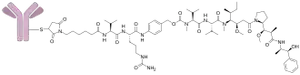
Disitamab vedotin (brand name Aidixi in China, development code RC48) is an antibody-drug conjugate (ADC) developed by RemeGen for the treatment of various HER2-positive cancers.[1] It comprises a humanized monoclonal antibody against human epidermal growth factor receptor 2 (HER2) conjugated via a cleavable linker to the cytotoxic agent monomethyl auristatin E (MMAE).[2][3]
Disitamab vedotin became the first homegrown ADC approved in China in 2021, initially for the treatment of HER2-overexpressing gastric cancer.[4]
Structure and mechanism
Disitamab vedotin is an antibody-drug conjugate comprising a monoclonal antibody against human epidermal growth factor receptor 2 (HER2) conjugated via a cleavable linker to the cytotoxic agent monomethyl auristatin E (MMAE).[2] The conjugation occurs through a cleavable maleimidocaproyl-valyl-citrullinyl-p-aminobenzyloxycarbonyl (mc-val-cit-PABC) type linker, with an average of 4 cysteinyl residues conjugated to MMAE.[5] The mechanism of action involves binding to HER2-positive tumor cells, followed by internalization and intracellular release of MMAE, which disrupts microtubule assembly and leads to cell death. Disitamab vedotin enhances antitumor immunity.[2]
Clinical development
Gastric cancer
In June 2021, disitamab vedotin received its first Biologics License Application (BLA) approval in China for the treatment of patients with HER2-overexpressing (defined as IHC2+ or 3+) locally advanced or metastatic gastric cancer (including gastroesophageal junction adenocarcinoma) who have received at least two prior systemic chemotherapy regimens.[3][6]
Urothelial carcinoma
Clinical studies in HER2-positive locally advanced or metastatic urothelial carcinoma have shown promising results. More than half of patients (50.5%) achieved objective response with the median progression-free survival (PFS) of 5.9 months and the median overall survival (OS) of 14.2 months with a well-tolerated safety profile.[7]
Other malignancies
Disitamab vedotin is being investigated for the treatment of various other HER2-expressing solid tumors, including:
Regulatory status
China
In June 2021, the NMPA granted conditional approval of disitamab vedotin (Aidixi) for the treatment of patients with HER2-overexpressing locally advanced or metastatic gastric cancer (including gastroesophageal junction adenocarcinoma) who have received at least two systemic chemotherapy regimens.[9][10]
United States
The U.S. Food and Drug Administration (FDA), in September 2021, granted Breakthrough Therapy designation for disitamab vedotin for the second-line treatment of patients with HER2 positive locally advanced or metastatic gastric cancer following treatment with platinum-based chemotherapy..[6][11][12]
Combination therapy
RC48 is a newly developed ADC drug targeting HER2 that comprises hertuzumab coupled with monomethyl auristatin E (MMAE) via a cleavable linker. Studies have investigated disitamab vedotin in combination with immune checkpoint inhibitors such as toripalimab for HER2-expressing advanced gastric or gastroesophageal junction and other solid tumors.[13]
Real-world studies have also evaluated the combination of disitamab vedotin with immune checkpoint inhibitors for locally advanced bladder urothelial carcinoma.[14]
Administration and dosing
Disitamab vedotin is administered intravenously. The recommended dosing regimen varies based on the indication and has been established through dose-escalation studies in various cancer types.
Development and partnerships
Disitamab vedotin is developed by RemeGen, a Chinese biotechnology company. The company has established partnerships for global development and commercialization, including collaborations with Pfizer.[4]
See also
References
- ↑ Shi F, Liu Y, Zhou X, Shen P, Xue R, Zhang M (December 2022). "Disitamab vedotin: a novel antibody-drug conjugates for cancer therapy". Drug Delivery. 29 (1): 1335–1344. doi:10.1080/10717544.2022.2069883. PMC 9090390. PMID 35506447.
- 1 2 3 "Disitamab vedotin (RC48)". MedChemExpress. Retrieved 2025-09-05.
- 1 2 Deeks ED (October 18, 2021). "Disitamab Vedotin: First Approval". Drugs. 81 (15): 1797–1802. doi:10.1007/s40265-021-01614-x. PMID 34661865.
- 1 2 3 "Pfizer partner RemeGen touts HER2 ADC trial win in bladder cancer". Fierce Pharma. May 13, 2025. Retrieved 2025-09-05.
- ↑ "Disitamab Vedotin - RC-48 - RC 480-ADC - RC48". ADC Review. December 24, 2024. Retrieved 2025-09-05.
- 1 2 "Chinese Regulator Conditionally Approves Disitamab Vedotin in Advanced or Metastatic Gastric Cancer". ADC Review. June 15, 2021. Retrieved 2025-09-05.
- ↑ Sheng X, Wang L, He Z, Shi Y, Luo H, Han W, et al. (2024). "Efficacy and Safety of Disitamab Vedotin in Patients With Human Epidermal Growth Factor Receptor 2–Positive Locally Advanced or Metastatic Urothelial Carcinoma: A Combined Analysis of Two Phase II Clinical Trials". Journal of Clinical Oncology. 42 (12): 1391–1402. doi:10.1200/JCO.22.02912. PMC 11095880. PMID 37988648.
- ↑ Wang D, Li H, Xing Y, Wu M, Lin Z, Li J (December 1, 2024). "Efficacy and safety of disitamab vedotin in treatment of HER2 expressed advanced or recurrent gynecological cancers". Annals of Oncology. 35: S1546. doi:10.1016/j.annonc.2024.10.399.
- ↑ Najminejad Z, Dehghani F, Mirzaei Y, Mer AH, Saghi SA, Abdolvahab MH, et al. (2023). "Clinical perspective: Antibody-drug conjugates for the treatment of HER2-positive breast cancer". Molecular Therapy. 31 (7): 1874–1903. doi:10.1016/j.ymthe.2023.03.019. PMC 10362395. PMID 36950736.
- ↑ Deeks ED (November 2021). "Disitamab Vedotin: First Approval". Drugs. 81 (16): 1929–1935. doi:10.1007/s40265-021-01614-x. PMID 34661865.
- ↑ "Disitamab Vedotin Conditionally Approved by Chinese Regulator for treatment of Gastric Cancer". Onco'Zine. June 16, 2021. Retrieved 2025-09-05.
- ↑ "Disitamab vedotin plus toripalimab shows promise for advanced urothelial carcinoma". Urology Times. June 8, 2023.
- ↑ Wang Y, Gong J, Wang A, Wei J, Peng Z, Wang X, et al. (January 5, 2024). "Disitamab vedotin (RC48) plus toripalimab for HER2-expressing advanced gastric or gastroesophageal junction and other solid tumours: a multicentre, open label, dose escalation and expansion phase 1 trial". eClinicalMedicine. 68 102415. doi:10.1016/j.eclinm.2023.102415. PMC 10789637. PMID 38235421.
- ↑ Wei Y, Zhang R, Yu C, Hong Z, Lin L, Li T, et al. (August 14, 2023). "Disitamab vedotin in combination with immune checkpoint inhibitors for locally and locally advanced bladder urothelial carcinoma: a two-center's real-world study". Frontiers in Pharmacology. 14 1230395. doi:10.3389/fphar.2023.1230395. PMC 10461006. PMID 37645442.