Diazabicyclooctane β-lactamase inhibitor
| Diazabicyclooctane β-lactamase inhibitor | |
|---|---|
| Drug class | |
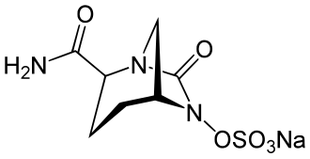 Avibactam is the founding member of this class | |
| Class identifiers | |
| Use | In combination with β-lactam antibiotics, treatment of infections caused by multidrug-resistant Gram-negative bacteria, |
| Mechanism of action | inhibitor |
| Biological target | β-Lactamase |
| Chemical class | Diazabicyclooctane |
| Legal status | |
| In Wikidata | |
A diazabicyclooctane β-lactamase inhibitor is a novel class of β-lactamase inhibitors (BLIs) that contain a strained urea functional group imbedded within the diazabicyclooctane (DBO) ring system.[1] This strained urea acts as a warhead that reacts with the active site serine residue in β-lactamases. The main use of this class of BLIs is to restore β-lactam antibiotic activity against resistant Gram-negative bacteria when it is co-administered.[2]
Avibactam is the founding member of this class of drugs. Other drugs in this class include durlobactam, nacubactam, pilabactam, pralurbactam, relebactam, and zidebactam.[3][4]
References
- ↑ Peilleron L, Cariou K (February 2020). "Synthetic approaches towards avibactam and other diazabicyclooctane β-lactamase inhibitors". Organic & Biomolecular Chemistry. 18 (5): 830–844. doi:10.1039/c9ob02605c. PMID 31956877.
- ↑ Coleman K (October 2011). "Diazabicyclooctanes (DBOs): a potent new class of non-β-lactam β-lactamase inhibitors". Current Opinion in Microbiology. 14 (5): 550–555. doi:10.1016/j.mib.2011.07.026. PMID 21840248.
- ↑ Gourabi MJ, Nikoo A, Khanbabaei B, Kargar M, Fayyazi A, Mousavi SM, et al. (2026). "A Review of β-Lactamase Inhibitors in Clinical Use and Development: Mechanisms, Spectrum, and Therapeutic Applications". International Journal of Microbiology. 2026 4479031. doi:10.1155/ijm/4479031. PMC 13191775. PMID 42180394.
- ↑ Davies DT, Leiris S, Zalacain M, Sprynski N, Castandet J, Bousquet J, et al. (December 2020). "Discovery of ANT3310, a Novel Broad-Spectrum Serine β-Lactamase Inhibitor of the Diazabicyclooctane Class, Which Strongly Potentiates Meropenem Activity against Carbapenem-Resistant Enterobacterales and Acinetobacter baumannii". Journal of Medicinal Chemistry. 63 (24): 15802–15820. doi:10.1021/acs.jmedchem.0c01535. PMID 33306385.