Dharti Ki Aawaz
| Dharti Ki Aawaz | |
|---|---|
 | |
| Directed by | K. D. Singh |
| Written by | K. D. Singh (story) K. D. Singh (screenplay) Vishwanath Pandey (dialogue) |
| Produced by | Bhuvneshwar Jha Jawaharlal Jha |
| Starring | Sujit Kumar Padma Khanna Kunal Singh |
| Cinematography | V. Shaukat |
| Music by | Onkar |
Production company | Jawahar Picture Palace Productions |
Release date |
|
Running time | 176 minutes |
| Country | India |
| Language | Bhojpuri |
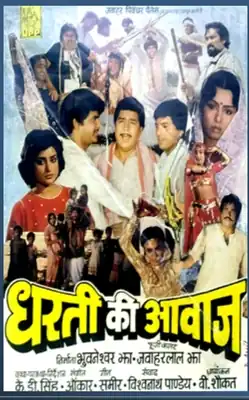
Dharti Ki Aawaz (Bhojpuri for The Voice of the Earth) is a 1987 Bhojpuri social drama film directed by K. D. Singh. The film was produced by Bhuvneshwar Jha and Jawaharlal Jha under the banner of Jawahar Picture Palace Productions. The film stars Sujit Kumar, Padma Khanna, Kunal Singh in the lead roles with Manoj Verma, Bandini Mishra and Shweta appearing in supporting roles.[1]
Plot
Cast
- Sujit Kumar
- Padma Khanna
- Kunal Singh
- Manoj Verma
- Bandini Mishra
- Shweta
Production and background
Dharti Ki Aawaz was produced by Bhuvneshwar Jha and Jawaharlal Jha[2] shortly after the release of their film Ganga Ki Beti (1986), a box office success of the Bhojpuri cinema[3] and a film that has been identified as a "significant milestone" in the regional industry's development.[4] The producers brought back K. D. Singh—who had directed Ganga Ki Beti—to direct Dharti Ki Awaaz, and again hired Onkar, the earlier film's music composer, to score the soundtrack.
Legacy
As observed by film scholar Ratnakar Tripathy, Bhojpuri films “are as a matter of rule not reviewed in newspapers or websites except for promotional commentaries and insertions”, and at the time there was in his words “a near absence of textual analysis of Bhojpuri cinema either in the press or academic circles”.[5] In the absence of published reviews and detailed production reportage, the historical significance of Dharti Ki Awaaz is therefore discussed in secondary sources primarily with reference to its ensemble of cast and crew. Kathryn Hardy’s research on Bhojpuri cinema indicates that distributors consistently identify star power—especially that of a well-known male lead—as a primary determinant of a film’s commercial success, on the grounds that major stars are believed to secure strong openings and mitigate financial risk.[6] The significance of Dhari Ki Awaaz can be understood within this framework, as its producers assembled an ensemble cast featuring two prominent male stars in leading roles: Sujit Kumar—widely regarded as the first superstar of Bhojpuri cinema[7][8] and his co-lead, Kunal Singh had emerged as one of the industry’s most bankable stars following a succession of commercially successful films,[9] culminating in his receipt of the Rashtra Kavi Dinkar Sammaan from Pranab Mukherjee, the President of India.[10] Both worked together for the first time for director K. D. Singh after the commercial success of his film Ganga Ki Beti.
Soundtrack
The film's soundtrack was composed by Onkar and lyrics written by Sameer.[11][12]
| No. | Title | Singers |
|---|---|---|
| 1 | Shaadi Shaadi Ratte Ratte Main To Dubli Ho | Shabbir Kumar, Kavita Krishnamurthy |
| 2 | Mujhko Rahne Do Parde Mein Rahne Do | Dilraj Kaur |
| 3 | Bahua Piyare Kaise Karun Tera | Usha Mangeshkar, Suresh Wadkar |
| 4 | Mera Ghar Parivaar Bata Sushiyon Ka Sansar | Suresh Wadkar |
| 5 | Dharti Ki Aawaaz Suno Kya Hai Smasya Aaj | Mahendra Kapoor |
| 6 | Chakua Marela Karejwa Mein Dard Nahin | Dilraj Kaur |
| 7 | Gayi Bambai Delhi Culcatta | Usha Mangeshkar |
| 8 | Aaisa Gul Gulshan Sansar | Suresh Wadkar |
| 9 | Palna Mein Khele Lalnare | Vinod Sehgal |
| 10 | He Hari Jhinjhari Naiya Mori Paar Karo | Suresh Wadkar |
References
- ↑ "Dharti Ki Aawaz". Indian Film History. Retrieved 19 April 2026.
- ↑ "Dharti Ki Awaaz". Moviebuff. Retrieved 19 April 2026.
- ↑ Neelakantan, Latika (October 2006). "Special Report: The Heartland Values of Bhojpuri Cinema". Himal Southasian. pp. 41–45. Retrieved 23 April 2026.
- ↑ Maurya, Riya (December 2024). "Class Bias, Marginalisation and Sensationalism: Reading the Cultural Narratives and Social Dynamics of Bhojiwood". Journal of Media and Communication. 8 (2): 55. eISSN 2581-513X. Retrieved 31 May 2026.
- ↑ Tripathy, Ratnakar (2013). "Mapping the Invisible World of Bhojpuri Cinema and Its Changing Audience". In Gokulsing, K. Moti; Dissanayake, Wimal (eds.). Routledge Handbook of Indian Cinemas. London: Routledge. p. 261. doi:10.4324/9780203556054-13 (inactive 8 June 2026). ISBN 978-0-415-67774-5.
Bhojpuri films "are as a matter of rule not reviewed in newspapers or websites except for promotional commentaries and insertions", and there is "a near absence of textual analysis of Bhojpuri cinema either in the press or academic circles".
{{cite book}}: CS1 maint: DOI inactive as of June 2026 (link) - ↑ Hardy, Kathryn C. (2014). Becoming Bhojpuri: Producing Cinema and Producing Language in Post-Liberalization India. South Asia Regional Studies (PhD dissertation). University of Pennsylvania. pp. 199–201.
- ↑ "Happy Birthday, Sujit Kumar! The first superstar of Bhojpuri films was first approached by THIS director". Times of India. 7 February 2022. Retrieved 26 January 2026.
- ↑ "Bhojpuri cinema will always be indebted to Sujit Kumar". The Times of India. 6 February 2010. Retrieved 16 May 2026.
- ↑ Ghosh, Avijit (2010). Cinema Bhojpuri. New Delhi: Penguin Books India. pp. 111–112. ISBN 978-0-14-310378-3.
- ↑ "Kunal Singh honored with Rashtra Kavi Dinkar Sammaan". The Times of India. 10 January 2017. Retrieved 16 May 2026.
- ↑ "Dharti Ki Aawaz". Gaana. Retrieved 19 April 2026.
- ↑ "Dharti Ki Aawaz: Suno Kya Hai Smasya Aaj Suno". JioSaavn. 30 August 1986. Retrieved 19 April 2026.