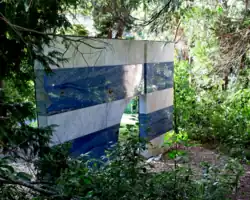
O'Connor's early work was made using white porcelain and the iron-rich clay which he found near his studio on Waiheke Island. In 1985 he was awarded the Frances Hodgkins Fellowship at Otago University, and during his tenure he switched to using limestone. More recently he has incorporated found objects and has started to use black slate, which has introduced a more minimalist aesthetic.[2]
Residencies
He has held international residencies including:[1]
Frances Hodgkins Fellowship, Otago University (1985)[2]
Moet and Chandon Fellowship, Champagne, France (1996)
Rathcoola Fellowship, Cork, Ireland (2005)
Blumhardt Foundation Residency in Gulgong, New South Wales, Australia (2016), (2017–18)
1234Dunn, Michael, 1942– (2008). New Zealand sculpture: a history. Auckland University Press. pp.100–101. ISBN978-1-86940-425-3. OCLC1164063154.{{cite book}}: CS1 maint: multiple names: authors list (link) CS1 maint: numeric names: authors list (link)
↑O'Connor, Denis (1984). Songs of the gulf: Denis O'Connor. Auckland City Art Gallery, Silverfish. Auckland: Auckland City Art Gallery. ISBN0-86463-117-0. OCLC20442879.
↑"The Gorse King"(PDF). Christchurch City Art Gallery. Retrieved 12 October 2020.
↑O'Connor, Denis, 1947– (2007). What the roof dreamt. O'Brien, Gregory, 1961–, Strongman, Lara., Two Rooms (Gallery). Waiheke, N.Z.: Aitche Books. ISBN978-0-473-12115-0. OCLC174083323.{{cite book}}: CS1 maint: multiple names: authors list (link) CS1 maint: numeric names: authors list (link)