Von der Decken's sifaka
| Von der Decken's sifaka | |
|---|---|
 | |
Scientific classification  | |
| Kingdom: | Animalia |
| Phylum: | Chordata |
| Class: | Mammalia |
| Infraclass: | Placentalia |
| Order: | Primates |
| Suborder: | Strepsirrhini |
| Family: | Indriidae |
| Genus: | Propithecus |
| Species: | P. deckenii |
| Binomial name | |
| Propithecus deckenii | |
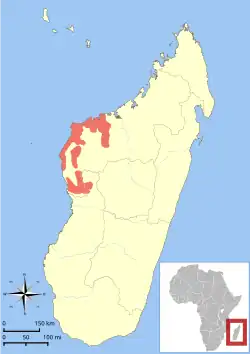 | |
| Distribution of P. deckenii[1] | |

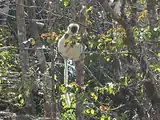
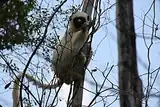
Von der Decken's sifaka (Propithecus deckenii) is a sifaka lemur that is endemic to the arid, deciduous and spiny succulent forests of Western Madagascar.[5] It has a length of 92 to 107 centimetres (36 to 42 in), of which 42 to 48 centimetres (17 to 19 in) are tail. The species is named in honor of the German explorer Karl Klaus von der Decken.
Its pelage is usually creamy white, with tinges of yellow-gold, silver-grey or pale brown on the neck, shoulders, back and limbs. The face is entirely black. Group size is between two and ten individuals, with groups of three to six being the most common.[5]
The IUCN lists its status as critically endangered, and it is listed in CITES Appendix I.[1][2]
Anatomy and physiology
Von der Decken's sifaka is a large lemur, with a body length of 92 to 107 centimetres (36 to 42 in), and a tail length of 42 to 48 centimetres (17 to 19 in).[5] It has long hind legs[6]: 516 and the hands are narrow.[6]: 519 The fingers are linked by a cutaneous webbing up to the proximal phalanges, and the digital formula is 4>3>5>2>1.[6]: 518 The digital webbing is more pronounced in the feet than in the hands.[7]: 338 The skull is short and conical, and is articulated at a right angle atop the spinal column, giving von der Decken's sifaka an upright posture.[6]: 520 Unlike most lemurs, the facial skeleton is positioned in front of the braincase, rather than below it.[7]: 184 Von der Decken's sifaka possesses a prominent boss on the nasal bone,[8] which is a trait that is shared with the crowned sifaka (Propithecus coronatus), and is indicative of the two species' phylogenetic closeness relative to the other members of Propithecus.[9] The mandible is deep and robust, such that it appears simian-like when viewed laterally.[7]: 184
The dentition follows the indrisine pattern of having two types of deciduous teeth that are not replaced in the permanent dentition. Two so-called "deciduous premolars" are present in the deciduous dentition, but are not replaced.[6]: 529 The deciduous dental formula is 2.1.22.1.2 × 2 = 20.[7]: 254 Conflicting models for the permanent dentition of von der Decken's sifaka have been proposed. Unlike most other lemurs, the indrisine dentition presents a toothcomb consisting of only four, rather than six, teeth. The outer tooth in the permanent toothcomb has been described as either an incisor accompanied by a missing lower canine (C−) (2.1.2.32.0.2.3 × 2 = 30), or as an incisiform canine accompanied by a missing lower incisor (I2) (2.1.2.31.1.2.3 × 2 = 30).[7]: 254
Most individuals possess wholly white pelages that are tinged with a yellowish or gray hues. The tail is tawny at the base, and the skin is black.[5] A white tinge is present on top of the nose.[7]: 75 Some inland individuals' pelages have a gray ring encircling the neck, whereas some coastal individuals may have a gray dorsal spot.[6]: 573 The coloration of the lower back and legs turn gray with age in some individuals.[10] A cutaneous fold runs along the side of the thorax, forming a membrane connecting to the arms.[6]: 518
Von der Decken's sifaka presents many variant color patterns, ranging from the typical coloration described above to almost entirely black melanistic forms.[11] Hybridization with crowned sifakas has been proposed from field reports from the upper Mahavavy River.[9] Jean-Jacques Petter and André Peyriéras observed a mating event between a male exhibiting the pelage coloration of a crowned sifaka and a female von der Decken's sifaka, which produced an apparent hybrid offspring that possessed a pelage pattern akin to its father's, featuring a dark brown head and anterior face of the torso.[9] However, such pelage patterns have been observed in individuals that do not live near sites where intersepcific mating could have occurred,[9] and hybridization does not explain the occurrence of individuals with melanism that exceed the head-torso pattern exhibited by crowned sifakas.[11] Petter and Peyriéras proposed that melanism could be an adaptation to altitudnal and climatic factors.[9] Laingoniaina Herifito Fidèle Rakotonirina et al. posited that perceived hybridization between the two species could be the result of von der Decken's sifaka occasionally exhibiting a pelage pattern akin to that of the crowned sifaka, thereby calling into question whether or not they are sympatric.[11]
Distribution
The range of von der Decken's sifaka has been confused by inconsistent sightings of individuals beyond the species' expected distribution.[1] Most recordings of the species are in agreement of its distribution west of the Mahavavy River and north of the Manambolo River.[1][12] These boundaries have been complicated by reports of von der Decken's sifakas beyond these limits, such as east of the Mahavavy in the Bongolava region.[11] Anomalous sightings have been attributed to river crossing events as a result of seasonal changes in river directions and sizes.[13] However, more recent surveys have reiterated the role of the Mahavavy as a geographic barrier for von der Decken's sifaka, even at its southern headwaters.[12] This could indicate that anomalous sightings of von der Decken's sifakas outside of its aforementioned range are the result of anthropogenic factors such as captive releases, or that they are due to river crossings that are too infrequent to be considered natural extensions of the species' range.[1]

References
- 1 2 3 4 5 6 King, T.; Rakotonirina, L. (2020). "Propithecus deckenii". IUCN Red List of Threatened Species. 2020 e.T18357A115572684. doi:10.2305/IUCN.UK.2020-2.RLTS.T18357A115572684.en. Retrieved 19 November 2021.
- 1 2 "Checklist of CITES Species". CITES. UNEP-WCMC. Retrieved 18 March 2015.
- ↑ "Propithecus deckenii W. C. H. Peters, 1870". ASM Mammal Diversity Database. American Society of Mammalogists. Retrieved 2022-10-04.
- ↑ Beolens, Bo; Watkins, Michael; Grayson, Michael (2009). The Eponym Dictionary of Mammals. The Johns Hopkins University Press. p. 104. ISBN 978-0-8018-9304-9.
- 1 2 3 4 Garbutt, Nick (2007). Mammals of Madagascar, A Complete Guide. pp. 196–197.
- 1 2 3 4 5 6 7 Hill, W.C.O. (1953). "Family III. Indriidae". Primates: Comparative Anatomy and Taxonomy. Edinburgh: Edinburgh University Press.
- 1 2 3 4 5 6 Ankel-Simons, F. (2007). Primate Anatomy: An Introduction (3rd ed.). London: Elsevier Science & Technology. ISBN 978-0-12-372576-9. Retrieved 16 May 2026.
- ↑ Groves, C.P.; Helgen, K.M. (December 2007). "Craniodental Characters in the Taxonomy of Propithecus". International Journal of Primatology. 28 (6): 1363–1383. doi:10.1007/s10764-007-9226-5.
- 1 2 3 4 5 Petter, J.J.; Peyrieras, A. (July 1972). "Melanization in the genus Propithecus Malagasey Lemur". Journal of Human Evolution. 1 (4): 379–388. doi:10.1016/0047-2484(72)90114-5.
- ↑ Peters, W.C.H. (1870). "über Propithecus Deckenii, eine neue Art von Halbaffen aus Madagascar". Monatsberichte der Königlichen Preussischen Akademie der Wissenschaften zu Berlin: 421–424. Retrieved 14 July 2026.
- 1 2 3 4 Rakotonirina, L.H.F.; Randriantsara, F.; Rakotoarisoa, A.H.; Rakotondrabe, R.; Razafindramanana, J.; Ratsimbazafy, J.; King, T. (December 2014). "A Preliminary Assessment of Sifaka ( Propithecus ) Distribution, Chromatic Variation and Conservation in Western Central Madagascar". Primate Conservation. 28 (1): 43–53. doi:10.1896/052.028.0116.
- 1 2 King, T.; Rakotonirina, L.H.F.; Rakotoarisoa, A.H.; Razafindramanana, J.; Ratsimbazafy, J. (December 2014). "Distributional Limits and Melanism in the South-West of the Range of the Crowned Sifaka ( Propithecus coronatus ), Madagascar". Primate Conservation. 28 (1): 55–64. doi:10.1896/052.028.0109.
- ↑ Thalmann, U.; Kümmerli, R.; Zaramody, A. (1 July 2002). "Why Propithecus verreauxi deckeni and P. v. coronatus are valid taxa – quantitative and qualitative arguments". Lemur News. 7: 11–16. Retrieved 18 July 2026.