David Foote Rivers
David Foote Rivers | |
|---|---|
 | |
| Member of the Tennessee House of Representatives | |
| In office 1883–1885 | |
| Personal details | |
| Born | July 18, 1859 |
| Died | July 5, 1941 (aged 81) |
| Resting place | Lincoln Memorial Cemetery Prince George's County, Maryland |
| Spouse | Silene Gale |
| Children | 4, including Francis E. Rivers |
| Education | Roger Williams University |
| Occupation | Politician |
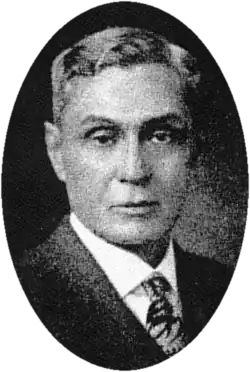
David Foote Rivers (July 18, 1859 – July 5, 1941) was a theologian and politician in the United States. An African American and a Republican, he served as a member of the Tennessee House of Representatives from 1883 to 1885,[1][2] representing Fayette County.[3]
Biography
Rivers was born in Montgomery, Alabama to Edmonia Rivers, a free black woman. His father, who may have been a white man, is not known. They moved to Mississippi and then to Fayette County, Tennessee. Rivers did not learn to write until the age of nineteen.[4] He received a Peabody Scholarship which allowed him to attend Roger Williams University, in Nashville, Tennessee.[1] Rivers studied theology[4] and graduated with honors.[1]
His eligibility for office was contested because he studied out of county during the year prior to his election to the Tennessee House of Representatives in 1882.[4] H. C. Jarvis submitted a minority report supporting his eligibility.[5] He was reelected in 1884 and seated in 1885 but was soon forced to flee the county due to rising racist violence.[4]
Rivers moved to Nashville, where there was less racial tension. He taught at his alma mater, Roger Williams University. For a time, he also lived in southern Kentucky while preaching at the Fifth Ward Baptist Church just over the river in Clarksville, Tennessee.[1]
Rivers became the pastor of Metropolitan Baptist Church in Kansas City, Kansas from 1893 to 1898,[4] and he then served as the pastor of Berean Baptist Church in Washington, D.C.[1][6] from 1898 to 1941.[7] After his death in New York City, he was interred at Lincoln Cemetery near Washington, D.C.[4]
Family
Rivers married Silene Gale (1861–1937) in Davidson County, Tennessee on December 20, 1887. They had three sons and a daughter.[4] Their son Francis E. Rivers served in New York State's General Assembly and was an assistant district attorney and judge.[8][9] Another son, Mark Edmond Rivers, became a dentist.[10] His son, Mark Edmond Rivers Jr., in turn became one of only five African American graduates of the United States Military Academy during World War II.[11]
See also
References
- ↑ Cartwright, Joseph H. (1973). "Black Legislators in Tennessee in the 1800's: A Case Study in Black Political Leadership". Tennessee Historical Quarterly. 32 (3): 265–284. JSTOR 42623393. Archived from the original on August 11, 2022. Retrieved August 11, 2022.
- ↑ Woodson, Carter Godwin; Logan, Rayford Whittingham (March 7, 1920). "The Journal of Negro History". Association for the Study of Negro Life and History – via Google Books.
- 1 2 3 4 5 6 7 McBride, Robert M.; Robison, Dan M. (1979). Biographical Directory of the Tennessee General Assembly. Vol. II. Nashville, Tennessee: Curley Printing Company. pp. 771–772.
- ↑ "House Journal". 1883.
- ↑ "Dr. David F. Rivers Dies In New York After Long Illness". The New York Age. July 12, 1941. p. 4. Retrieved April 12, 2019 – via Newspapers.com.
- ↑ "Berean to Hold Memorial Rites For Rev. Rivers". The Washington Post. February 14, 1942. p. 13. ProQuest 151586721. Retrieved July 24, 2026.
- ↑ Lovett, Bobby L. (2005). The Civil Rights Movement in Tennessee: A Narrative History. ISBN 9781572334434.
- ↑ Fowle, Farnsworth (July 29, 1975). "Francis E. Rivers Dies; Black City Judge Was 82". New York Times.
- ↑ Alumni Directory, 1870–1919. Washington, D.C.: Howard University. 1919. Retrieved July 25, 2026.
- ↑ Murray, Florence (1947). The Negro Handbook 1946–1947. Current Books, Inc. p. 341. Retrieved July 25, 2026.
- 1859 births
- 1941 deaths
- People from Montgomery, Alabama
- People from Fayette County, Tennessee
- Roger Williams University alumni
- African-American state legislators in Tennessee
- Republican Party members of the Tennessee House of Representatives
- Roger Williams University faculty
- African-American Baptist ministers
- 20th-century African-American people
- 19th-century members of the Tennessee General Assembly
- Tennessee politician stubs