Daniell (crater)
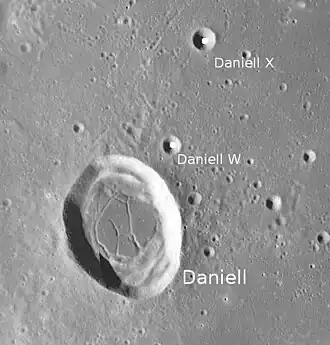 Daniell and two satellite craters, W and X | |
| Coordinates | 35°25′N 31°10′E / 35.42°N 31.16°E |
|---|---|
| Diameter | 28.20 km (17.52 mi)[1] |
| Depth | 1.9 km (1.2 mi)[2] |
| Colongitude | 329° at sunrise |
| Formation | Copernican[3] |
| Eponym | John F. Daniell |


Daniell is a lunar impact crater located in the southern half of the Lacus Somniorum.[4] To the south-southeast is the much larger crater Posidonius. The Rimae Daniell rille system is to the west of Daniell crater,[5] and consists of a set of graben oriented along a NNW-SSE direction.[6] This feature can be resolved with a 150 mm (6 in) telescope.[7]
The Daniell formation dates to the Copernican period on the lunar geologic timescale.[3] The rim is oval in form, with the long axis oriented north-northwest to south-southeast. Most of the wall is well-formed and relatively free of wear, although it appears slumped at the southern end.[8] The interior lacks a central peak.[3]: 26
The floor surface has a lower albedo than the surroundings and is fractured.[9] Lunar geologist Chuck Wood speculated that the fractured floor may have been uplifted by the massive slumps on northwest and southeast rims.[10] The mineralogical composition of the floor consists of pyroxenes with pyroclastic deposits on the low albedo areas.[3]
The crater is named after British physicist, chemist, and meteorologist John F. Daniell (1790-1845).[1] His name was included in the lunar nomenclature of William R. Birt and John Lee during the 19th century.[11] Its designation was formally adopted by the International Astronomical Union in 1935.[1]
Satellite craters
By convention these features are identified on lunar maps by placing the letter on the side of the crater midpoint that is closest to Daniell.[12]
| Daniell[8]: 296 | Latitude | Longitude | Diameter |
|---|---|---|---|
| D | 37.0° N | 25.8° E | 6 km |
| W | 35.9° N | 31.5° E | 3 km |
| X | 36.6° N | 31.8° E | 5 km |
References
- 1 2 3 "Daniell". Gazetteer of Planetary Nomenclature. USGS Astrogeology Research Program. Retrieved 2026-07-23.
- ↑ Pike, R. J. (September 1976). "Crater Dimensions from Apollo Data and Supplemental Sources". The Moon. 15 (3–4): 463–477. Bibcode:1976Moon...15..463P. doi:10.1007/BF00562253.
- 1 2 3 4 Pathak, Sumit; et al. (2017). A mineralogical appraisal of the lunar floor-fractured Crater Daniell using datasets from recent lunar missions (PDF). Lunar and Planetary Science. Vol. XLVIII. Retrieved 2026-07-23.
- ↑ Moore, Patrick (2001). On the Moon. Sterling Publishing Co. p. 174. ISBN 978-0-304-35469-6.
- ↑ "LAC 26" (PDF). Gazeteer of Planetary Nomenclature. Retrieved 2026-07-23.
- ↑ Ahrens, Caitlin; et al. (December 2024). Geomorphic Studies of Lunar Graben, Domes, and Pit Crater Chains near Daniell Rimae. AGU Fall Meeting 2024, held in Washington, D.C., 9-13 December 2024, Session: Planetary Sciences / To the Moon: A New Era of Lunar Science—Geology and Geophysics II Poster, Poster No. 2827, id. P31C-2827. Bibcode:2024AGUFMP31C.2827A.
- ↑ Grego, Peter (2005). The Moon and How to Observe It. Astronomers' Observing Guides Series. London: Springer-Verlag. p. 137. ISBN 1-85233-748-6.
- 1 2 Bussey, B.; Spudis, P. (2004). The Clementine Atlas of the Moon. New York: Cambridge University Press. ISBN 978-0-521-81528-4.
- ↑ Wilhelms, Don E.; McCauley, John F.; Trask, Newell J. (1987). The geologic history of the Moon. USGS Professional Paper 1348. Washington: U.S. Government Printing Office. doi:10.3133/pp1348.
- ↑ Wood, Chuck (October 27, 2006). "A Very Strange Crater". Lunar Photo of the Day. Archived from the original on 2007-09-29. Retrieved 2006-10-27.
- ↑ Whitaker, Ewen A. (1999). Mapping and Naming the Moon. Cambridge University Press. pp. 136, 221. ISBN 978-0-521-62248-6.
- ↑ Grego, P. (2015). "Satellite Crater". In Hargitai, H.; Kereszturi, Á. (eds.). Encyclopedia of Planetary Landforms. New York, NY: Springer. doi:10.1007/978-1-4614-3134-3_328.
Sources
- Price, Fred W. (1988). The Moon Observer's Handbook. Cambridge University Press. ISBN 978-0-521-33500-3.
- Rükl, Antonín (1990). Atlas of the Moon. Kalmbach Books. ISBN 978-0-913135-17-4.
- Wlasuk, Peter T. (2000). Observing the Moon. Springer. ISBN 978-1-85233-193-1.

| Physical properties |  | |
|---|---|---|
| Orbit | ||
| Surface and features | ||
| Science | ||
| Exploration | ||
| Time-telling and navigation | ||
| Phases and names | ||
| Daily phenomena | ||
| Related |
| |
