Cyclodextran
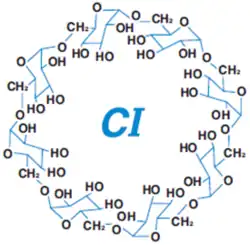
Cyclodextran, also known as cyclic isomaltooligosaccharide (CI), is a cyclic oligosaccharide composed of glucose units linked primarily by α-1,6 glycosidic bonds. It is a non-reducing carbohydrate derived from dextran or related glucans through enzymatic cyclization.
Structure and nomenclature
Cyclodextran is distinct from cyclodextrin, another class of cyclic glucose oligomers, in its linkage pattern. Whereas cyclodextrins are composed of α-1,4-linked glucose units, cyclodextrans consist of α-1,6-linked glucose units. Reported cyclodextrans vary in ring size, and multiple homologues have been identified.[1]
Discovery and production
Cyclodextran was first reported in 1993 during studies of bacterial cultures grown on dextran-containing media. It was identified as a cyclic product distinct from linear isomaltooligosaccharides.[2]
Trace amounts of cyclodextran have also been reported from brown sugar.[3]
Cyclodextran is produced by enzymatic conversion of dextran, typically through the action of cycloisomaltooligosaccharide glucanotransferase (CITase). Some studies have also described pathways in which related enzymes generate cyclodextrans from starch-derived glucans.[4][5]
Properties
As a cyclic carbohydrate, cyclodextran lacks a reducing end and is classified as a non-reducing oligosaccharide. It is water-soluble and relatively stable under a range of chemical conditions.[5] Studies have also examined its ability to interact with other compounds in aqueous systems.[6]
Cyclodextran has also been examined in studies of glucan-related processes in oral bacteria.[7]
References
- ↑ Funane K, Terasawa K, Mizuno Y, Ono H, Gibu S, Tokashiki T, Kawabata Y, Kim YM, Kimura A, Kobayashi M (December 2008). "Isolation of Bacillus and Paenibacillus Bacterial Strains That Produce Large Molecules of Cyclic Isomaltooligosaccharides". Bioscience, Biotechnology, and Biochemistry. 72 (12): 3277–80. doi:10.1271/bbb.80384. PMID 19060390.
- ↑ Oguma T, Horiuchi T, Kobayashi M (January 1993). "Novel Cyclic Dextrins, Cycloisomaltooligosaccharides, from Bacillus sp. T-3040 Culture". Bioscience, Biotechnology, and Biochemistry. 57 (7): 1225–27. doi:10.1271/bbb.57.1225. PMID 27281012.
- ↑ Tokasiki T, Kinjyo K, Funane K, Itou H (2007). "Novel Cycloisomaltooligosaccharides Contained in the Kokuto Produced in Okinawa Prefecture". Journal of Applied Glycoscience. 54 (1): 27–30. doi:10.5458/JAG.54.27.
- ↑ Ichinose H, Suzuki R, Miyazaki T, Kimura K, Momma M, Suzuki N, Fujimoto Z, Kimura A, Funane K (2017). "Paenibacillus sp. 598K 6-α-glucosyltransferase is essential for cycloisomaltooligosaccharide synthesis from α-(1 → 4)-glucan". Applied Microbiology and Biotechnology. 101 (10): 4115–4128. doi:10.1007/s00253-017-8174-z. PMID 28224195.
- 1 2 Oguma, Tetsuya; Kawamoto, Hiroshi (2003). "Production of Cyclodextran and Its Application". Trends in Glycoscience and Glycotechnology. 15 (82): 91–99. doi:10.4052/tigg.15.91.
- ↑ Hong, Seong-Jin; Park, Bo-Ram; Lee, Byung-Hoo; Park, Boo-Su; Kim, Young-Min (2023). "New Potential Applications of Cyclodextran in High Water Solubility and in Vitro Digestive System". SSRN. SSRN 4477437.
- ↑ Kobayashi M; Funane K; Oguma T (1995). "Inhibition of Dextran and Mutan Synthesis by Cycloisomaltooligosaccharides". Bioscience, Biotechnology, and Biochemistry. 59 (10): 1861–65. doi:10.1271/bbb.59.1861. PMID 8534976.