Cyclamen hederifolium
| Cyclamen hederifolium | |
|---|---|
 | |
| Cyclamen hederifolium subsp. hederifolium in flower in the Riserva naturale Montedimezzo in Molise, Italy | |
Scientific classification  | |
| Kingdom: | Plantae |
| Clade: | Embryophytes |
| Clade: | Tracheophytes |
| Clade: | Angiosperms |
| Clade: | Eudicots |
| Clade: | Asterids |
| Order: | Ericales |
| Family: | Primulaceae |
| Genus: | Cyclamen |
| Species: | C. hederifolium |
| Binomial name | |
| Cyclamen hederifolium | |
| Synonyms | |
|
Cyclamen neapolitanum Ten. | |

Cyclamen hederifolium, sowbread,[2] or ivy-leaved cyclamen,[1] is a species of flowering plant in the family Primulaceae, native to woodland, shrubland, and rocky areas at altitudes of up to 1,200 metres in the Mediterranean region from southern France to western Turkey and on Mediterranean islands. It is also naturalised farther north in Europe and in Oregon.[3][2][4] This widespread cyclamen species is widely cultivated and among the most hardy and vigorous in oceanic climates.
Taxonomy
Two subspecies are accepted:[3]
- Cyclamen hederifolium subsp. hederifolium — throughout the range of the species, except as below
- Cyclamen hederifolium subsp. crassifolium (Hildebr.) Culham, Denney & P.Moore — southern Greece
Another related cyclamen from Crete, formerly known as Cyclamen hederifolium var. confusum, is now treated as a separate species, Cyclamen confusum.[5]
Etymology
The species name hederifolium comes from the Latin hedera (ivy) and folium (leaf),[6] because of the shape and patterning of the leaves. The synonym C. neapolitanum refers to Naples, where the species grows.
Description
Cyclamen hederifolium is a tuberous perennial growing up to 30 cm tall that flowers and produces leaves in autumn, grows through the winter, and aestivates through the summer after the seed capsules ripen and open.[7]
 Leaves of C. hederifolium in Serbia
 C. h. subsp. crassifolium in Messenia in southern Greece
 Seed capsule on a spiralled stem
Tuber
The tuber is round-flattened and produces roots from the top and sides, leaving the base bare. In some other cyclamens (e.g. Cyclamen persicum), the roots come from the bottom, leaving the top and sides bare. The tuber becomes larger with age; older specimens commonly become more than 20 cm (8 in) across.[4] The leaves and flowers grow from buds on the exposed upper surface of the tuber.
Leaves
The leaves are 2.5–8 cm long, variable in shape; depending on the specimen, the leaf shape varies from heart-shaped to long and arrow-shaped, usually with 2–3 angled lobes on each side, resembling the juvenile leaves of ivy (Hedera). They are naturally variegated, most commonly with a hastate pattern in silver to grey-green and various shades of green. In cultivation, plants have been selected where the leaves can be from all-green to all-silver.
The petiole and flower stalks of Cyclamen hederifolium grow outwards and then up, forming an "elbow". From Latin, 'hederifolium' translates to ivy-like leaves. In the closely related Cyclamen africanum, the stalks grow up from the tuber without a bend near the base.[7]
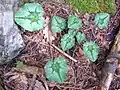 Typical leaves, Mount Olympus, Greece
 Leaves collected on Zakynthos, showing range of leaf shapes
 New leaves among fallen autumn leaves

Flowers
The flowers are produced from late summer to autumn before the leaves; they have five petals 1.2–2.5 cm long; usually pink, purple, or white with a streaky magenta V-shaped marking on the throat, but sometimes pure white with no markings.[7] They are self-fertile, producing seed without the need for pollination.[2]
The edges of the petals near the tip of the flower are curved outwards into strong auricles. The style protrudes only minimally out of the throat of the flower.[7] These are not present in some other species, such as C. persicum. The flowers are occasionally fragrant. The shape of the flower varies from long and thin to short and squat.[8]
 Flowers with particularly prominent auricles
 Short flowers with wide throats
 Underside of auricles
Fruit
After the flowers finish, the flower stem coils tightly, starting at the end, and rests above the tuber.[7] The seeds are yellow-brown, held in a round pod, which opens by 5–10 flaps at maturity. The seeds are covered in a sweet sticky substance attractive to ants,[4] which can disperse the seeds up to several hundred metres.[2]
 Coiling flower stalk
 Pods and exposed tubers
Cultivation

Cyclamen hederifolium is usually listed as the hardiest species of cyclamen. In oceanic climates, it self-seeds abundantly and will crowd out less vigorous species such as Cyclamen coum if the two are planted together. In cold continental climates such as Calgary, Alberta, where Cyclamen purpurascens grows well, it may not survive.[9] It is hardy to zone 6, tolerating temperatures down to -18°C, or lower (to -30°C) if protected by reliable snow cover.[10]
This plant has gained the Royal Horticultural Society's Award of Garden Merit[11] (confirmed 2017).[12]
Cultivars and cultivar groups
C. h. subsp. hederifolium has sometimes been divided into two forms differentiated by leaf and flower characteristics, forma hederifolium with pink or purple flowers with darker markings at the base of the petals, and forma albiflorum with white flowers, sometimes with pale pink throat.[13] These are however not considered botanically distinct by the Plants of the World Online (POWO) database, which treats f. albiflorum as a synonym.[14] The white-flowered form has won the RHS AGM.[13]
Another published varietal name Cyclamen hederifolium var. poli, with long sagittate (arrowhead-shaped) leaves, is listed by the Pacific Bulb Society, but is also treated as a synonym of the type by POWO.[14]
 Pink throat of a white cultivar
 A cultivar with fully silvered leaves
 Plant of 'Amaze Me' with purple flowers
 Plant with all-white flowers
Selected cultivars of Cyclamen hederifolium include:
References
Notes
- 1 2 Meredith, C. R. (2024-03-01). "Ivy-leaved Cyclamen Cyclamen hederifolium". IUCN Red List of Threatened Species. Retrieved 2026-07-18.
- 1 2 3 4 "Sowbread Cyclamen hederifolium Aiton". PlantAtlas. Retrieved 2026-07-18.
- 1 2 "Cyclamen hederifolium Aiton". Plants of the World Online. 2020-09-02. Retrieved 2026-07-18.
- 1 2 3 Blamey, Marjorie; Grey-Wilson, C. (1989). The Illustrated Flora of Britain and Northern Europe. London: Hodder & Stoughton. pp. 298–299. ISBN 0-340-40170-2.
- ↑ "Cyclamen confusum (Grey-Wilson) Culham, Jope & P.Moore". Plants of the World Online. Retrieved 2026-07-18.
- ↑ hedera, folium. Charlton T. Lewis and Charles Short. A Latin Dictionary on Perseus Project.
- 1 2 3 4 5 Thorogood, Chris (2016). Field guide to the wild flowers of the western Mediterranean. Richmond: Kew publishing Royal Botanic Gardens. pp. 374–375. ISBN 978-1-84246-616-2.
- ↑ post 434. Cyclamen 2009. Scottish Rock Garden Club Forum.
- ↑ post 20. Cyclamen kuznetzovii. Scottish Rock Garden Club Forum.
- ↑ New Royal Horticultural Society Dictionary of Gardening. Vol. 1. London : New York: Macmillan Press. 1992. pp. 792, 796. ISBN 1-56159-001-0.
- ↑ "Cyclamen hederifolium". Royal Horticultural Society. Retrieved 2020-04-17.
- ↑ "AGM Plants - Ornamental" (PDF). Royal Horticultural Society. July 2017. p. 22. Retrieved 24 January 2018.
- 1 2 "Cyclamen hederifolium var. hederifolium f. albiflorum". RHS. Retrieved 5 May 2020.
- 1 2 "Cyclamen hederifolium subsp. hederifolium". Plants of the World Online. Retrieved 2026-07-18.
- ↑ photos from AGS Loughborough Autumn show. Alpines for the Enthusiast (blog).
- ↑ Cyclamen hederifolium 'Stargazer'. GAP photos.
Sources
- Cyclamen: a guide for gardeners, horticulturists, and botanists by C. Grey-Wilson (Google Books)
External links
