Cusanus (crater)
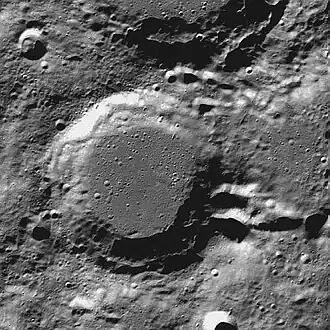 LRO image | |
| Coordinates | 72°00′N 70°48′E / 72.0°N 70.8°E |
|---|---|
| Diameter | 60.87 km (37.82 mi)[1] |
| Depth | 3.39 km (2.11 mi)[2] |
| Colongitude | 293° at sunrise |
| Eponym | Nikolaus K. Cusanus |

Cusanus is a lunar impact crater that is located near the northeastern limb of the Moon.[3] In this location the crater appears foreshortened when observed from the Earth.[4] The northern rim of Cusanus is nearly joined to the south-southeastern rim of the larger crater Petermann. To the west is Baillaud and to the southeast is Hayn.[5]
The rim of this crater has been eroded and rounded due to a history of minor impacts. The terraces are still visible along the inner walls, although they are less sharply defined compared to younger crater formations. A pair of tiny craters form a notch along the eastern rim, and there is a slight inward bulge along the western inner wall. The interior has apparently been resurfaced with lava, leaving a flat and relatively featureless floor. But the lava was not of sufficient depth to significantly reduce the width of the inner walls.[6]: 5
This formation is named after German mathematician and philosopher Nikolaus K. Cusanus (1401-1464).[7] His name was included in the lunar nomenclature of Italian astronomer Giovanni B. Riccioli in 1651, but was apparently assigned to a crater later identified as 'T. Mayer alpha'.[8] Its modern designation was officially adopted by the International Astronomical Union in 1935.[1]
Satellite craters
By convention these features are identified on lunar maps by placing the letter on the side of the crater midpoint that is closest to Cusanus.[9]
| Cusanus[6]: 296 | Latitude | Longitude | Diameter |
|---|---|---|---|
| A | 70.6° N | 64.0° E | 16 km |
| B | 70.1° N | 64.5° E | 21 km |
| C | 70.4° N | 60.8° E | 25 km |
| E | 72.0° N | 72.3° E | 10 km |
| F | 70.7° N | 73.3° E | 10 km |
| G | 69.9° N | 76.9° E | 10 km |
| H | 69.4° N | 59.4° E | 8 km |
References
- 1 2 "Cusanus". Gazetteer of Planetary Nomenclature. USGS Astrogeology Research Program. Retrieved 2026-07-19.
- ↑ Joshi, Maitri P. (February 2017). "Physical properties of lunar craters". Research in Astronomy and Astrophysics. 17 (3). id. 24. Bibcode:2017RAA....17...24J. doi:10.1088/1674-4527/17/3/24.
- ↑ Moore, Patrick (2001). On the Moon. Sterling Publishing Co. p. 173. ISBN 978-0-304-35469-6.
- ↑ Whitaker, E. A.; et al. (1963). Rectified Lunar Atlas: Supplement No. 2 to the Photographic Lunar Atlas. Tucson: University of Arizona Press. Retrieved 2026-06-01. See Field 3.
- ↑ The described features span two charts:
- 1 2 Bussey, B.; Spudis, P. (2004). The Clementine Atlas of the Moon. New York: Cambridge University Press. ISBN 978-0-521-81528-4.
- ↑ Jones, Brian (2024). Who's who in the Moon: from Abbot to Zupus, a guide to the Moon and the people on it. White Owl. ISBN 978-1-5267-3708-3.
- ↑ Whitaker, Ewen A. (1999). Mapping and Naming the Moon. Cambridge University Press. pp. 60, 211. ISBN 978-0-521-62248-6.
- ↑ Grego, P. (2015). "Satellite Crater". In Hargitai, H.; Kereszturi, Á. (eds.). Encyclopedia of Planetary Landforms. New York, NY: Springer. doi:10.1007/978-1-4614-3134-3_328.
Sources
- Price, Fred W. (1988). The Moon Observer's Handbook. Cambridge University Press. ISBN 978-0-521-33500-3.
- Rükl, Antonín (1990). Atlas of the Moon. Kalmbach Books. ISBN 978-0-913135-17-4.
- Wlasuk, Peter T. (2000). Observing the Moon. Springer. ISBN 978-1-85233-193-1.
| Physical properties |  | |
|---|---|---|
| Orbit | ||
| Surface and features | ||
| Science | ||
| Exploration | ||
| Time-telling and navigation | ||
| Phases and names | ||
| Daily phenomena | ||
| Related |
| |
