Conasprella baileyi
| Conasprella baileyi | |
|---|---|
 | |
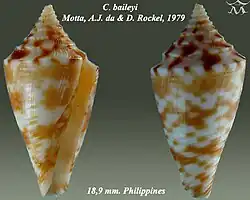
| Apertural and abapertural views of shell of Conasprella baileyi (Motta, A.J. da & D. Rockel, 1979) | |
 | |
Scientific classification  | |
| Kingdom: | Animalia |
| Phylum: | Mollusca |
| Class: | Gastropoda |
| Subclass: | Caenogastropoda |
| Order: | Neogastropoda |
| Superfamily: | Conoidea |
| Family: | Conidae |
| Genus: | Conasprella |
| Species: | C. baileyi |
| Binomial name | |
| Conasprella baileyi | |
| Synonyms[2] | |
| |

Conasprella baileyi is a species of sea snail, a marine gastropod mollusk in the family Conidae, the cone snails and their allies.[2]
Like all species within the genus Conasprella, these snails are predatory and venomous. They are capable of stinging humans, therefore live ones should be handled carefully or not at all.
Description
Exterior Shell and Structure
The size of the shell varies between 20 mm and 32 mm. C. baileyi is white with tawny to orange colored spirally aligned blotches that follow the curvature of the body whorl. The larval whorl, or protoconch, typically has lighter colored splotches than on the body whorl.[3] The aperture is narrow and written descriptions state that the aperture is white, though photos often show it as a sandy tan to orange color.[4] The spire is moderate and concave conical coming to a pointed end at the protoconch. The spire consists of approximately 9-11 total whorls. The shell has a carinate, or sharp edged, shoulder.[3]
Live Snail
See Conidae page for further information about live snails in the cone snail family. Little is known about C. baileyi as an individual living organism.
Like other species in Conidae, C. baileyi has an extendable proboscis and a radula used for hunting.[5]
Distribution and Habitat
This marine species occurs in the tropical Indo-West Pacific (the Philippines, Solomon Islands, New Caledonia, Loyalty Islands) and off Queensland, Australia.[6] C. baileyi is a marine benthic species. Specimens are typically found between 100 and 400 meters below the surface in rocky rubble or hard coral.[7][8]
Life Habits
Diet
For hunting tactics of Conidae species, see Conidae.
C. baileyi is a carnivorous predator like other species in the family Conidae. [9][10] This species is vermivorous and uses conotoxins to immobilize its prey before utilizing its proboscis to engulf the prey entirely for consumption.[5]
Reproduction
C. baileyi reproduces sexually.[7]
Locomotion
C. baileyi moves using mucus mediated gliding.[7]
References
- ↑ Bouchet, P. (2013). "Conus baileyi". IUCN Red List of Threatened Species. 2013 e.T192400A2088275. doi:10.2305/IUCN.UK.2013-1.RLTS.T192400A2088275.en. Retrieved 12 February 2025.
- 1 2 Bouchet, P. (2015). Conasprella baileyi. Accessed through: World Register of Marine Species at http://www.marinespecies.org/aphia.php?p=taxdetails&id=580167 on 2015-03-01
- 1 2 "Conus (Conasprella) baileyi Röckel & da Motta 1979". theconecollector.com. Retrieved 10 June 2026.
- ↑ "Conasprella baileyi - Gastropods by Eddie Hardy". conchology.be. Retrieved 10 June 2026.
- 1 2 THOMAS F. DUDA, ALAN J. KOHN, STEPHEN R. PALUMBI, Origins of diverse feeding ecologies within Conus, a genus of venomous marine gastropods, Biological Journal of the Linnean Society, Volume 73, Issue 4, August 2001, Pages 391–409, https://doi.org/10.1111/j.1095-8312.2001.tb01369.x
- ↑ "Conasprella baileyi | Ocean Biodiversity Information System (OBIS)". obis.org. Retrieved 10 June 2026.
- 1 2 3 "Conasprella baileyi (Röckel & da Motta 1979) data - Encyclopedia of Life". eol.org. Retrieved 10 June 2026.
- ↑ "Ecology Summary - Conasprella baileyi". sealifebase.org. Retrieved 10 June 2026.
- ↑ "MolluscaBase - Conasprella baileyi (Röckel & da Motta, 1979)". www.molluscabase.org. Retrieved 10 June 2026.
- ↑ Mahardika, Gusti. (2016). Dietary breadth is positively correlated with venom complexity in cone snails. BMC Genomics. 2016. 401. 10.1186/s12864-016-2755-6.
- Röckel, D. & Motta, A.J. da 1979. New Cone from the Solomon Sea. La Conchiglia 11(126–127): 9
- Röckel, D., Korn, W. & Kohn, A.J. 1995. Manual of the Living Conidae. Volume 1: Indo-Pacific Region. Wiesbaden : Hemmen 517 pp
- Tucker J.K. & Tenorio M.J. (2009) Systematic classification of Recent and fossil conoidean gastropods. Hackenheim: Conchbooks. 296 pp
- Rabiller M. & Richard G., 2014. Conus (Gastropoda, Conidae) from offshore French Polynesia: Description of dredging from TARASOC expedition, with new records and new species. Xenophora Taxonomy 5: 26-49
- Puillandre N., Duda T.F., Meyer C., Olivera B.M. & Bouchet P. (2015). One, four or 100 genera? A new classification of the cone snails. Journal of Molluscan Studies. 81: 1–23
External links

- The Conus Biodiversity website
- Cone Shells – Knights of the Sea
- "Conasprella baileyi". Gastropods.com. Retrieved 15 January 2019.