Jean Frédéric Phélypeaux, Count of Maurepas
The Count of Maurepas | |
|---|---|
 Portrait of Maurepas by Louis-Michel van Loo (1733-1735) | |
| First Minister of State | |
| In office 14 May 1776 – 21 November 1781 | |
| Monarch | Louis XVI |
| Preceded by | Jacques Turgot |
| Succeeded by | Count of Vergennes |
| Secretary of State of the Navy | |
| In office 16 August 1723 – 23 April 1749 | |
| Monarch | Louis XV |
| Preceded by | The Count of Morville |
| Succeeded by | The Count of Jouy |
| Secretary of State of the Maison du Roi | |
| In office 30 March 1718 – 20 April 1749 | |
| Monarch | Louis XV |
| Preceded by | Marquis of La Vrillière |
| Succeeded by | The Count of Saint-Florentin |
| Personal details | |
| Born | Jean-Frédéric Phélypeaux 9 July 1701 |
| Died | 21 November 1781 (aged 80) Versailles, Île-de-France, France |
| Spouse |
Marie-Jeanne Phélypeaux de La Vrillière
(m. 1728–1781) |
| Profession | Statesman |
Jean Frédéric Phélypeaux, Count of Maurepas (9 July 1701 – 21 November 1781) was a French statesman and Count of Maurepas.
Biography
Early Life and Career
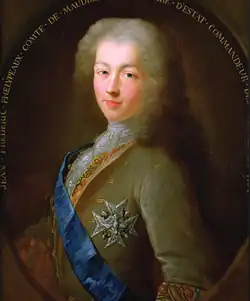
He was born at Versailles, of a family of administrative nobility, the son of Jérôme Phélypeaux, secretary of state for the marine and the royal household. Under the guidance of his father, his grandfather and his cousin Louis Phélypeaux, marquis de La Vrillière, Jean-Frederic was trained from childhood to be secretary of state to the king of France. Jean-Frederic had right en survivance to the position of secretary of state, under the Regent, Philippe II, Duke of Orléans, as his father Jerome had purchased the office with the right of inheritance.[1]
In 1718 at the age of 17, Jean became the minister of the royal household and Comte de Maurepas under the guardianship of his cousin La Vrillière. Shortly after he married the daughter of his cousin, Marie-Jeanne Phélypeaux de La Vrillière (1704-1793). Five years later on 16 August he began his duties as ministre de la marine to Louis XV administering the navy, colonies and seaborne trade.[1] In 1738 he was promoted to the Conseil du Roi, and in time aided the king, alongside several other ministers in making significant political decisions.[2] Jean continued his administrative career after the death of his guardian, and was ministre de la marine until 23 April 1749, when he was removed in a coup.[1]
Ministerial Career

Skilled in military and naval strategy, Maurepas enabled the French Navy to regain previously lost prestige and France was once again recognized as a maritime power. One way that he improved the French reputation was by focusing on the defense of France's sprawling empire in the New World, especially in the 1730s and 1740s.[3] His defense plans were aided by information on British naval manoeuvres, lists of what ships were coming to North America and detailed memoirs of ship construction. Jean-Frederic obtained this information through maintaining an intelligence service that was considered one of the most efficient in Europe.[4] This was only made possible due to the drastic funding increases he managed to obtain for the Troupes de la Marine. The typical budget appropriated to the marine from the mid-1720s to mid-1730s was 9 million livres; in 1739, however, Jean-Frederic managed to obtain a budget of 19.2 million livres.
In the following years he acquired budgets of 20 million livres in 1740, 26 million in 1741 and 27 million in 1742.[1] Over his career as administrator he held the positions of chamberlain of the royal household, minister of the marine, and director of the secret service, fulfilling his duties with efficiency and precision.[4] In 1749, Maurepas was removed by a coup led by the Duke of Richelieu, putting an end to his period of immense success.[2] He was exiled from Versailles for an epigram against Madame de Pompadour, and went to Bourges and then onto Pontchartrain.
Later Career under Louis XVI
Maurepas was an important influence on Louis XVI during his childhood and during the formative years of his reign. Despite his internal exile, Maurepas retained the confidence of the Dauphin and this enabled him to wield influence over the education of the then-Duke of Berry, Louis-Auguste. His choice of tutors for the prince led to the development of his scientific, particularly nautical, interests, that he later demonstrated as King. John Hardman argues that his role in the education of the prince was the key reason behind his appointment as chief minister when Louis acceded to the French throne.[5]
In 1774, he was duly appointed to minister of state to Louis XVI, as well as chief adviser in 1776, holding both positions until 1781.[1] He gave Turgot the direction of finance, placed Lamoignon-Malesherbes over the royal household and made Vergennes minister for foreign affairs. At the outset of his new career he showed his weakness by recalling to their functions, in deference to popular clamour, the members of the old Parlement ousted by Maupeou, thus reconstituting the most dangerous enemy of the royal power. This step, and his intervention on behalf of the American states, helped to pave the way for the French Revolution.[6]
Jealous of his personal ascendancy over Louis XVI, he intrigued against Turgot, whose disgrace in 1776 was followed after six months of disorder by the appointment of Jacques Necker. In 1781 Maurepas deserted Necker as he had done Turgot, and shortly after being informed of the Franco-American victory at Yorktown and whilst suffering from an episode of gout, he died at Versailles on 21 November 1781. In what was called a 'high favour', Louis allowed Maurepas's body was allowed to remain at Versailles until his funeral on the 23rd.[6][7]
Legacy
Maurepas is credited with contributions to the collection of facetiae known as the Etrennes de la Saint Jean (2nd ed., 1742). Four volumes of Memoires de Maurepas, purporting to be collected by his secretary and edited by J.L.G. Soulavie in 1792,[6] included information on the North American colonies, the fall of Louisbourg, trade in the Caribbean, the censorship of books and administration. He also recorded extensive information on all naval matters including naval construction, navigation sailing instructions and fighting at sea.[2] The collection of memoirs is now in the possession of Cornell University.
Lake Maurepas, Louisiana, USA was named for him, showing his surviving influence on the New World.[2]
See also
References

- 1 2 3 4 5 Rule, John C., "Jean-Frederic Phelypeaux, comte de Pontchartrain et Maurepas: Reflections on His Life and His Papers", The Journal of the Louisiana Historical Association Vol 6: 1965, p 365-377
- 1 2 3 4 McLynn, F. "An Eighteenth-Century Scots Republic? An Unlikely Project from Absolutist France", Scottish Historical Review Vol 59, Edinburgh University Press:1980, p 177
- ↑ Rule, John C."The Maurepas Papers: Portrait of a Minister", French Historical Studies Vol. 4, Duke University Press, 1965, p. 104.
- 1 2 Rule, John C."The Maurepas Papers: Portrait of a Minister", French Historical Studies Vol. 4, Duke University Press, 1965, p. 105.
- ↑ Hardman, John (2023). The Life of Louis XVI. New Haven and London: Yale University Press. p. 16. ISBN 978-0-300-27364-9.
- 1 2 3 One or more of the preceding sentences incorporates text from a publication now in the public domain: Chisholm, Hugh, ed. (1911). "Maurepas, Jean Frédéric Phélypeaux, Comte de". Encyclopædia Britannica. Vol. 17 (11th ed.). Cambridge University Press. p. 907.
- ↑ Hardman, John (2023). The Life of Louis XVI. New Haven and London: Yale University Press. p. 166. ISBN 978-0-300-27364-9.
