Brestovăț
Brestovăț | |
|---|---|
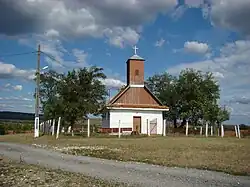 The Serbian wooden church in Lucareț | |
 Location in Timiș County | |
  Location in Romania | |
| Coordinates: 45°52′23″N 21°40′52″E / 45.87306°N 21.68111°E | |
| Country | Romania |
| County | Timiș |
| Established | 1440 (first attested) |
| Subdivisions | Brestovăț, Coșarii, Hodoș, Lucareț, Teș |
| Government | |
| • Mayor (2004–) | Eugen Dobra (PNL) |
Area | 103.17 km2 (39.83 sq mi) |
| Population (2021-12-01)[2] | 675 |
| • Density | 6.54/km2 (16.9/sq mi) |
| Time zone | UTC+02:00 (EET) |
| • Summer (DST) | UTC+03:00 (EEST) |
| Postal code | 307085–307089 |
| Vehicle reg. | TM |
| Website | www |
Brestovăț (Hungarian: Aga, until 1892 Bresztovác; German: Brestowatz; Slovak: Brestovec;[3] Serbian: Брестовац, romanized: Brestovac)[4] is a commune in Timiș County. It is composed of five villages: Brestovăț (commune seat), Coșarii, Hodoș, Lucareț and Teș.
History
Brestovăț first appears in written history as Breztolcz in 1440; at that time, it belonged to the Șoimoș Fortress.[5] It was destroyed during the Turkish occupation and resettled in 1718–1722.[5] Turks called it Aga, an unofficial name that persisted for a while and was taken over by Hungarians and later by the Romanian administration.
Between 1735 and 1737, 113 families of Montenegrin Serbs, mostly Orthodox, settled here.[6] In 1797, Brestovăț became the property of the Lukács brothers, who colonized a large number of Hungarian and Slovak settlers here.[6] Around 1828, now a property of Iosif Gaal, it was again colonized by Hungarians from Nógrád, Nyitra and Trencsén.[6] The colonizations do not stop here, because in 1840–1845, German settlers from Bohemia arrived in Brestovăț.
Demographics
- Orthodox (77.9%)
- Roman Catholics (8.29%)
- Baptists (1.48%)
- Greek Catholics (1.18%)
- Unknown (10.4%)
- Others (0.76%)
Brestovăț had a population of 675 inhabitants at the 2021 census, up 0.15% from the 2011 census. Most inhabitants are Romanians (85.77%), with a minority of Slovaks (2.96%). For 10.37% of the population, ethnicity is unknown.[7] By religion, most inhabitants are Orthodox (77.92%), but there are also minorities of Roman Catholics (8.29%), Baptists (1.48%) and Greek Catholics (1.18%). For 10.37% of the population, religious affiliation is unknown.[8]
| Census[9] | Ethnic composition | ||||||
|---|---|---|---|---|---|---|---|
| Year | Population | Romanians | Hungarians | Germans | Roma | Serbs | Slovaks |
| 1880 | 3,725 | 2,601 | 224 | 208 | – | 280 | 407 |
| 1890 | 3,934 | 2,684 | 259 | 235 | – | 298 | 442 |
| 1900 | 4,417 | 3,000 | 447 | 256 | – | 226 | 444 |
| 1910 | 4,471 | 2,933 | 517 | 151 | – | 367 | 425 |
| 1920 | 3,895 | 2,583 | 285 | 117 | – | – | – |
| 1930 | 3,853 | 2,764 | 216 | 188 | 105 | 107 | 455 |
| 1941 | 3,709 | 2,742 | 192 | 262 | – | – | – |
| 1956 | 3,210 | 2,481 | 144 | 73 | – | 112 | 397 |
| 1966 | 2,328 | 1,728 | 58 | 59 | 16 | 83 | 378 |
| 1977 | 1,364 | 873 | 42 | 44 | 9 | 52 | 338 |
| 1992 | 851 | 596 | 10 | 27 | – | 33 | 185 |
| 2002 | 818 | 589 | 19 | 16 | – | 43 | 151 |
| 2011 | 674 | 514 | 10 | 3 | 8 | 11 | 102 |
| 2021 | 675 | 579 | – | – | – | – | 20 |
Politics and administration
The commune of Brestovăț is administered by a mayor and a local council composed of 9 councilors. The mayor, Eugen Dobra, from the National Liberal Party, has been in office since 2004. As from the 2024 local elections, the local council has the following composition by political parties:[10]
| Party | Seats | Composition | ||||||
|---|---|---|---|---|---|---|---|---|
| National Liberal Party | 6 | |||||||
| Social Liberal Humanist Party | 2 | |||||||
| Social Democratic Party | 1 | |||||||
Gallery
 Roman Catholic church in Brestovăț
 Roman Catholic church in Coșarii
 Wooden church in Lucareț
 Orthodox church in Teș
References

- ↑ "Primăria Brestovăț". Ghidul Primăriilor.
- ↑ "2021 Romanian census". National Institute of Statistics. 1 December 2021.
- ↑ Ocelák, Radek; Tříska, Jiří, eds. (2019). Větev ztracená, nalezená: cestovní a úřední zprávy o Slovácích v Rumunsku z let 1930–1949. Rýmařov. ISBN 978-80-907333-1-2.
{{cite book}}: CS1 maint: location missing publisher (link) - ↑ Popov, Dejan (2018). Bugarski, Stevan (ed.). "Свештенство Епархије темишварске 1797. године" (PDF). Темишварски зборник. 10. Novi Sad: Матица српска: 177–197.
- 1 2 Szabó, M. Attila (2003). Erdély, Bánság és Partium történeti és közigazgatási helységnévtára. Miercurea Ciuc: Pro-Print Kiadó.
- 1 2 3 "Istoric". Primăria comunei Brestovăț.
- 1 2 "Populația rezidentă după etnie". RPL 2021. Institutul Național de Statistică.
- 1 2 "Populația rezidentă după religie". RPL 2021. Institutul Național de Statistică.
- ↑ Varga, E. Árpád. "Temes megye településeinek etnikai (anyanyelvi/nemzetiségi) adatai 1880-2002" (PDF). Archived from the original (PDF) on 2007-06-10. Retrieved 2021-09-10.
- ↑ "Alegeri locale 2024". Rezultate Vot.
