Clark (lunar crater)
 LRO WAC image | |
| Coordinates | 38°24′S 118°54′E / 38.4°S 118.9°E |
|---|---|
| Diameter | 52.11 km (32.38 mi)[1] |
| Depth | Unknown |
| Colongitude | 242° at sunrise |
| Eponym | Alvan Clark Alvan Graham Clark |
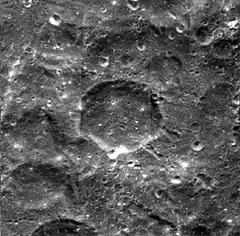


Clark is a lunar impact crater that lies in the southern hemisphere of the Moon's far side.[2] It is located midway between the larger walled plain named Van der Waals to the south and the similar-sized crater Pizzetti to the north.[3]
The inner wall of Clark lacks well-formed terraces, but instead forms a narrow ridge with a wide rampart sloping down to the central floor. The rim is roughly circular, but eroded in places. A small crater lies across the southern rim, and a tiny pair are located along the northeastern crest. There is a slight outward bulge along the wall along the west-southwestern side. The crater floor is marked by a number of tiny craterlets but otherwise relatively featureless, having no central peak.[4]: 117
This crater is named for American astronomer and telescope maker Alvan Clark (1804–1887) and his son Alvan Graham Clark (1832–1897).[5] Its designation was officially adopted by the International Astronomical Union in 1970.[1]
Satellite craters
By convention these features are identified on lunar maps by placing the letter on the side of the crater midpoint that is closest to Clark.
| Clark[4]: 295 | Latitude | Longitude | Diameter |
|---|---|---|---|
| F | 38.4° S | 122.5° E | 27 km |
References
- 1 2 "Clark". Gazetteer of Planetary Nomenclature. USGS Astrogeology Research Program. Retrieved 2025-03-08.
- ↑ Moore, Patrick (2000). The Data Book of Astronomy. CRC Press. p. 67. ISBN 978-1-4200-3344-1.
- ↑ Byrne, Charles J. (2008). The Far Side of the Moon. Springer. p. 26. ISBN 978-1-4899-8806-5.
- 1 2 Bussey, B.; Spudis, P. (2004). The Clementine Atlas of the Moon. New York: Cambridge University Press. ISBN 978-0-521-81528-4.
- ↑ Menzel, D. H.; et al. (1971). "Report on Lunar Nomenclature by the Working Group of Commission 17 of the IAU". Space Science Reviews. 12 (2): 136–186. Bibcode:1971SSRv...12..136M. doi:10.1007/BF00171763. S2CID 122125855.
Sources
- Price, Fred W. (1988). The Moon Observer's Handbook. Cambridge University Press. ISBN 978-0-521-33500-3.
- Rükl, Antonín (1990). Atlas of the Moon. Kalmbach Books. ISBN 978-0-913135-17-4.
- Wlasuk, Peter T. (2000). Observing the Moon. Springer. ISBN 978-1-85233-193-1.
| Physical properties |  | |
|---|---|---|
| Orbit | ||
| Surface and features | ||
| Science | ||
| Exploration | ||
| Time-telling and navigation | ||
| Phases and names | ||
| Daily phenomena | ||
| Related |
| |
