Chunxi Road
Interactive map of Chunxi Road | |
| Location | Jinjiang, Chengdu, Sichuan, China |
|---|---|
| Construction | |
| Inauguration | 1924 |
| Other | |
| Known for | Commercial district |

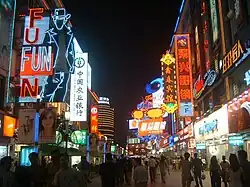
Chunxi Road (Chinese: 春熙路; pinyin: Chūnxī Lù) is a pedestrian street and the city's central business district located in Jinjiang District, central Chengdu, Sichuan, China. Established in 1924 to connect Chengdu's two main commercial areas at the time (Dongda Street and Shangye Chang), Chunxi Road has since evolved into the city's principal central business district.[1][2] It is currently served by Chunxi Road station on Line 2 and Line 3 of the Chengdu Metro.
The name Chunxi was taken from a passage in the Tao Te Ching evoking a lively crowd and the arrival of spring, and was chosen to convey commercial prosperity and bustling pedestrian activity.[1][3] The historic road consists of North, South, East, and West Chunxi Road, meeting around Zhongshan Square. The name is now also commonly applied to a much larger pedestrian, retail, dining, entertainment, and tourism district surrounding the original four streets.[4][5]
In 2022, the Ministry of Culture and Tourism and the National Development and Reform Commission included the Chunxi Road area in the first group of National Tourism and Leisure Blocks.[6] Later in 2022, the Ministry of Commerce designated the Chunxi Road business district as one of China's first National Demonstration Smart Business Districts.[7]
Layout and etymology
The original Chunxi Road is a group of four interconnected streets, which are Chunxi North Road (春熙北路), Chunxi South Road (春熙南路), Chunxi East Road (春熙东路), and Chunxi West Road (春熙西路), centered on Zhongshan Square (中山广场).[4] It lies between the historic commercial areas around Zongfu Road (总府路) to the north and Dongda Street (东大街) to the south. The modern tourism and leisure district extends beyond the four named streets. An official description issued when the area received national tourism status placed the pedestrian district between Shudu Avenue (蜀都大道) in the north and Dongda Street in the south, with Beixin Street to the west and Shamao Street (纱帽街) to the east. Its main pedestrian routes total approximately 1,840 m (1.14 mi), and the designated district covers about 274,000 m2 (68 acres).[8]
The name Chunxi derives from chapter 20 of the Tao Te Ching. The term combines ideas of springtime warmth and bustling prosperity and was intended to evoke crowds gathering in a flourishing commercial district.[1]
Historical accounts differ over the street's earliest name. Some local histories state that it was initially called Senwei Road (森威路), after the honorific title "Senwei General" held by Sichuan military ruler Yang Sen, and was renamed after his political position weakened.[3][2] Other accounts state that "Senwei Road" was proposed but rejected, after which scholar Jiang Ziyu (江子虞) selected the name Chunxi Road.[9] A study of historical maps held by the Chengdu Municipal Archives found that Chunxi Road first appeared by that name on a Chengdu map published in 1925.[2]
History
Origins
Before Chunxi Road was constructed, two of central Chengdu's most important commercial areas lay close to one another but were poorly connected. Dongda Street (东大街) had long been one of the city's major shopping streets, while the Shangye Chang (商业场) developed to the north in the late Qing dynasty. The latter opened in 1909 as the Chengdu Industrial Promotion Market (成都劝业场) and soon became an important concentration of shops and entertainment businesses.[10][11]
Between Dongda Street and the Shangye Chang were narrow lanes, former government compounds, and irregularly built shops. After taking control of Chengdu in 1924, Yang Sen pursued a program of municipal modernization that included road construction. He ordered a broad new street opened through the area to connect the two commercial centers.[2][1] Construction began in May 1924, and the new road was substantially complete by August.[9]
The project initially created a north–south route, followed by east–west branches. Local historical sources describe the early roadway as approximately 9 m (30 ft) wide, with sidewalks of about 2 m (6.6 ft).[12] Its four sections did not meet in exact straight lines, producing the offset intersection around the central square that remains characteristic of the street plan.[4]
Republican period
Commercial development followed rapidly. Banks, jewelers, pharmacies, watchmakers, clothing stores, restaurants, bookstores, and entertainment businesses opened along the street. A 1934 survey counted 157 businesses on Chunxi Road, including branches of several banks and prominent regional and national retailers.[13] By the 1930s and 1940s, Chunxi Road had become an important commercial and financial center in Chengdu.[14]
A small public space was created at the junction of the four road sections. A monument commemorating construction of Chunxi Road originally stood there. A standing statue of Sun Yat-sen was later erected on the monument in the late 1920s.[15] It was subsequently replaced by a seated bronze statue designed by sculptor Liu Kaiqu (刘开渠). The present statue depicts Sun in traditional dress holding a copy of his political writings and is one of the best-known historic features of the street.[16] The square surrounding it is known as Zhongshan Square.
Chunxi Road was also associated with Chengdu's developing popular culture. Cinemas, bookstores, restaurants, and other cultural businesses joined its retail establishments, making the street an important center of urban leisure as well as commerce.[4]
From 1949 to the 2000s
Following the establishment of the People's Republic of China in 1949, Chunxi Road remained an important retail street.[17] Commercial activity expanded further following China's economic reforms. During the 1980s, the nearby Qingnian Road market became an important concentration of small private retailers.[18] Chunxi Road's first modern night market opened in September 1992. Foreign-invested and national department stores entered the district during the 1990s, further changing its retail character.[18]
A large-scale reconstruction of the Chunxi Road commercial district began in 2001. The project ended the street's night market, reconstructed road surfaces and public spaces, and converted the core area into a modern pedestrian shopping district.[19] The renovated pedestrian street opened in 2002, drawing approximately 100,000 visitors on its opening day according to provincial historical records.[19]
The redevelopment introduced broad pedestrian paving, public seating and landscaping, lighting, sculptures, and larger retail spaces. It also strengthened links between Chunxi Road and surrounding shopping streets, gradually shifting the meaning of "Chunxi Road" from the four historic streets to a wider commercial district.[19][5]
Expansion of the commercial district
The district underwent another period of major redevelopment during the 2010s. Chengdu IFS (Chengdu International Finance Square) opened at Hongxing Road and Daci Temple Road in January 2014 as a large mixed-use retail, office, hotel, and residential complex.[20] The development became associated with the 15-meter-tall public artwork I Am Here, a giant panda sculpture by Australian artist Lawrence Argent that appears to climb the building's facade.[21]
Immediately east of the original Chunxi Road area, Taikoo Li Chengdu formally opened in April 2015. It was developed around the historic Daci Temple and features a low-rise, open-air layout with lanes, courtyards, and public squares. It incorporates preserved historic buildings alongside contemporary retail architecture.[22] It received a 2015 Urban Land Institute Global Award for Excellence.[23]
The development of IFS and Taikoo Li strengthened the connection between the historic pedestrian street and the Daci Temple–Hongxing Road area. By the 2020s, government planning documents treated Chunxi Road, Taikoo Li–IFS, Dongda Street, Yanshikou, and adjacent neighborhoods as components of a broader Chunxi Road fashion business district.[5]
Commercial and cultural significance
Chunxi Road has retained a prominent place in Chengdu's commercial culture since the 1920s. Its early merchants introduced new forms of retailing and advertising to the city. Businesses on the street were among Chengdu's early adopters of neon signs and amplified advertising, while restaurants and Western-style dining establishments contributed to changing urban consumption patterns.[14]
The district combines department stores, shopping malls, flagship stores, restaurants, cafes, cinemas, bookstores, hotels, and smaller street-facing businesses. Older local businesses coexist with national and international retail brands, reflecting the district's successive stages of development from a Republican-era commercial street to a contemporary shopping and tourism area.[1]
In January 2022, the Ministry of Culture and Tourism and the National Development and Reform Commission designated the Chunxi Road area as one of China's first 54 National Tourism and Leisure Blocks. The designation is given to urban districts combining cultural identity with tourism, recreation, dining, entertainment, shopping, accommodation, and public services.[6] In December 2022, the Ministry of Commerce designated the Chunxi Road commercial district as one of the country's first 12 National Demonstration Smart Business Districts.[7]
The Sichuan provincial government and Chengdu municipal government have subsequently identified the Chunxi Road–Taikoo Li commercial area as a priority commercial and tourism district in plans for Chengdu's development as an international consumption center.[24]
In 2024, Chunxi Road marked the centenary of its construction. Contemporary coverage by Economic Daily, Xinhua News Agency, Guangming Daily, and other national media described its transformation from a single commercial street into a larger commercial, cultural, and business district.[25][14][1]
Landmarks
Zhongshan Square

Zhongshan Square (中山广场) lies near the intersection of the four historic sections of Chunxi Road. Its principal landmark is the bronze seated statue of Sun Yat-sen designed by Liu Kaiqu.[16] An earlier standing statue had been erected on the Chunxi Road construction monument in the late 1920s. Historical photographs collected by the Chengdu Library have helped document the relationship between the earlier statue and the original road monument.[15]
The replacement statue depicts Sun seated in a long traditional robe and holding his writings on national reconstruction. It has remained a visual focal point of Chunxi Road through later redevelopments of the surrounding square.[16]
Chengdu IFS
Chengdu IFS (成都国际金融中心; formally known as Chengdu International Finance Square) stands on Hongxing Road (红星路) at the eastern edge of the traditional Chunxi Road pedestrian area. The complex opened in 2014.[20] Its best-known exterior feature is Lawrence Argent's I Am Here, a 15 m (49 ft) giant panda sculpture whose body hangs on the facade while its head is visible from an upper-level terrace.[21] The work has become widely associated with the modern visual identity of the Chunxi Road area.[14]
Taikoo Li and Daci Temple
Taikoo Li Chengdu lies east of Chunxi Road around Daci Temple. The development combines contemporary low-rise retail buildings with historic structures, lanes, courtyards, and open plazas. Its design was intended to respond to traditional Sichuan urban architecture and the historic setting of the temple.[22]
The project opened fully in 2015 and helped extend the principal pedestrian and retail activity of the Chunxi Road area eastward into the Daci Temple area.[22][5]
Transportation
The Chunxi Road area is served by Chunxi Road station on the Chengdu Metro. Line 2 began serving the district when it opened in September 2012. Line 3 opened in July 2016, making Chunxi Road station an interchange station between the two lines.[26] The station has pedestrian connections to major commercial properties in the district, while numerous municipal transit bus routes serve surrounding streets.[27]
The pedestrianization of the historic core and later development of adjacent malls have created a network of street-level and underground pedestrian routes linking Chunxi Road, Hongxing Road, Chengdu IFS, Taikoo Li, and neighboring shopping streets.[5]
See also

References
- 1 2 3 4 5 6 Li, Xiaodong; Zhou, Hongshuang (25 July 2024). "成都春熙路商圈:引领百年时尚 升腾人间烟火" [Chengdu's Chunxi Road business district: A century of fashion and urban vitality]. Guangming Daily (in Chinese). Archived from the original on 30 August 2024. Retrieved 20 August 2026 – via People's Daily Online.
- 1 2 3 4 "1924年军阀杨森下令修建成都春熙路" [Warlord Yang Sen ordered construction of Chengdu's Chunxi Road in 1924]. Sichuan Daily (in Chinese). 5 September 2014. Archived from the original on 20 August 2026. Retrieved 20 August 2026 – via People's Daily Online.
- 1 2 Guan, Hengqing (22 October 2024). "百年春熙 一路繁华" [A century of Chunxi: Prosperity along the road]. 四川省情网 [Sichuan Provincial Gazetteer] (in Chinese). Sichuan Provincial Local Chronicles Office. Retrieved 20 August 2026.
- 1 2 3 4 "川剧入耳 曲艺声声 成都老街深处 穿越百年的文艺时光" [Through a century of arts and culture in Chengdu's old streets]. Sichuan Daily (in Chinese). 26 March 2021. Archived from the original on 15 May 2021. Retrieved 20 August 2026 – via People's Daily Online.
- 1 2 3 4 5 "构建"一核两轴三区"空间功能布局 春熙路时尚商圈全新规划亮相" [New plan unveiled for the Chunxi Road fashion business district] (in Chinese). Sichuan Daily. 15 December 2023. Archived from the original on 15 January 2024. Retrieved 20 August 2026 – via Xinhua News Agency.
- 1 2 "文化和旅游部 国家发展改革委关于国家级旅游休闲街区名单的公告" [Announcement by the Ministry of Culture and Tourism and National Development and Reform Commission on the list of National Tourism and Leisure Blocks] (in Chinese). Ministry of Culture and Tourism of the People's Republic of China. 30 January 2022. Archived from the original on 22 December 2024. Retrieved 20 August 2026.
- 1 2 "商务部关于公布首批全国示范智慧商圈、 全国示范智慧商店名单的通知" [Notice from the Ministry of Commerce on Announcing the First Batch of National Demonstration Smart Commercial Districts and National Demonstration Smart Stores] (in Chinese). Ministry of Commerce of the People's Republic of China. 29 December 2022. Retrieved 20 August 2026.
- ↑ "首批国家级旅游休闲街区|四川省成都市锦江区春熙路:业态多元创新,文旅体商高度融合发展" [First National Tourism and Leisure Blocks: Chunxi Road, Jinjiang District, Chengdu]. 文旅中国 [China Culture and Tourism] (in Chinese). 5 February 2022. Archived from the original on 20 August 2026. Retrieved 20 August 2026.
- 1 2 "城史|春熙路"变迁史",你知道多少?" [City history: How much do you know about the transformation of Chunxi Road?]. The Paper (in Chinese). 8 September 2019. Archived from the original on 20 August 2026. Retrieved 20 August 2026.
- ↑ "成都地名溯源——濯锦"首善":何以锦江?" [Origins of Chengdu place names: How Jinjiang developed]. 四川省情网 [Sichuan Provincial Gazetteer] (in Chinese). Sichuan Provincial Local Chronicles Office. Retrieved 20 August 2026.
- ↑ "80年前的春熙路长啥样?成博策展人带你看懂成都近代史" [What did Chunxi Road look like 80 years ago?] (in Chinese). Chengdu Museum. 21 April 2019. Archived from the original on 20 August 2026. Retrieved 20 August 2026.
- ↑ "王缵绪与成都春熙路" [Wang Zanxu and Chengdu's Chunxi Road]. 四川省情网 [Sichuan Provincial Gazetteer] (in Chinese). Sichuan Provincial Local Chronicles Office. Retrieved 20 August 2026.
- ↑ "街巷志|渐被遗忘的成都百年商场" [Street chronicle: Chengdu's century-old shopping center]. Jiemian News (in Chinese). 11 December 2019. Archived from the original on 17 June 2024. Retrieved 20 August 2026.
- 1 2 3 4 Chen, Jian; Hu, Xu; Tang, Wenhao (23 August 2024). "新华社经济随笔:百年春熙路,一路向"新"行" [Xinhua economic commentary: A century of Chunxi Road and continual renewal] (in Chinese). Xinhua News Agency. Retrieved 20 August 2026 – via Sichuan Online.
- 1 2 "2500余张照片带你寻找成都记忆" [More than 2,500 photographs trace memories of Chengdu]. Chengdu Commercial Daily (in Chinese). 11 September 2020. Archived from the original on 20 August 2026. Retrieved 20 August 2026 – via People's Daily Online.
- 1 2 3 "成都街头的标志性雕塑,你都知道是怎么来的吗?" [How Chengdu's landmark street sculptures came to be]. Sichuan Daily (in Chinese). 4 December 2014. Archived from the original on 26 June 2026. Retrieved 20 August 2026.
- ↑ "众人熙熙 春风唤醒春熙路" [The crowds gather: Spring returns to Chunxi Road]. 四川省情网 [Sichuan Provincial Gazetteer] (in Chinese). Sichuan Provincial Local Chronicles Office. Retrieved 20 August 2026.
- 1 2 "22张珍贵老照片!满满都是几代四川人的春熙路回忆" [Twenty-two historic photographs recall generations of memories of Chunxi Road]. Sichuan Daily (in Chinese). 5 September 2019. Archived from the original on 20 August 2026. Retrieved 20 August 2026 – via Chuanguan News.
- 1 2 3 "70年,影响成都人的70件事" [Seventy events that influenced Chengdu in 70 years]. 四川省情网 (in Chinese). Sichuan Provincial Local Chronicles Office. Retrieved 20 August 2026.
- 1 2 "成都国际金融中心开业 90个国际品牌首次入驻成都" [Chengdu IFS opens, with 90 international brands entering Chengdu for the first time]. China Daily (in Chinese). 14 January 2014. Archived from the original on 20 August 2026. Retrieved 20 August 2026.
- 1 2 Gan, Tian (17 March 2014). "Giant panda scales Chengdu mall". China Daily. Archived from the original on 8 February 2026. Retrieved 20 August 2026.
- 1 2 3 "Swire Properties and Sino-Ocean Land Celebrate Grand Opening of Sino-Ocean Taikoo Li Chengdu" (Press release). Swire Properties. 24 April 2015. Archived from the original on 7 February 2026. Retrieved 20 August 2026.
- ↑ "Sino-Ocean Taikoo Li Chengdu selected as a global winner in the 2015 Urban Land Institute Global Awards for Excellence" (Press release). Swire Properties. 7 October 2015. Archived from the original on 12 June 2026. Retrieved 20 August 2026.
- ↑ "《成都市加快打造国际消费中心城市实施方案》印发" [Chengdu issues implementation plan for accelerating construction of an international consumption center city]. Chengdu Government Service Network (in Chinese). 28 February 2024. Retrieved 20 August 2026.
- ↑ Liu, Chang (22 April 2024). "百年春熙" [A century of Chunxi]. Economic Daily (in Chinese). Archived from the original on 20 August 2026. Retrieved 20 August 2026 – via People's Tribune.
- ↑ "成都地铁3号线一期工程开通试运营 新增更多人性化设计" [Phase I of Chengdu Metro Line 3 begins trial operation] (in Chinese). China National Radio. 31 July 2016. Archived from the original on 20 August 2026. Retrieved 20 August 2026 – via Xinhua.
- ↑ "【成都春熙路交通指南】成都春熙路怎么去 – 成都本地宝" [[Chengdu Chunxi Road Transport Guide] How to Get to Chengdu Chunxi Road – Chengdu Bendibao]. 成都本地宝. Archived from the original on 20 August 2026. Retrieved 20 August 2026.