Chronological calculus is a formalism for the analysis of flows of non-autonomous dynamical systems. It was introduced by A. Agrachev and R. Gamkrelidze in the late 1970s. The scope of the formalism is to provide suitable tools to deal with non-commutative vector fields and represent their flows as infinite Volterra series. These series, at first introduced as purely formal expansions, are then shown to converge under some suitable assumptions.
Operator representation of points, vector fields and diffeomorphisms
Let  be a finite-dimensional smooth manifold.
Chronological calculus works by replacing a non-linear finite-dimensional object, the manifold , with a linear infinite-dimensional one, the commutative algebra  . This leads to the following identifications:
- Points
 are identified with nontrivial algebra homomorphisms
 defined by
 .
- Diffeomorphisms
 are identified with -automorphisms
 defined by
 .
- Tangent vectors
 are identified with linear functionals
 satisfying the Leibnitz rule
 at
 .
- Smooth vector fields
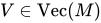 are identified with linear operators

satisfying the Leibnitz rule  .
In this formalism, the tangent vector  is identified with the operator
 .
We consider on the Whitney topology, defined by the family of seminorms

Regularity properties of families of operators on can be defined in the weak sense as follows:  satisfies a certain regularity property if the family
 satisfies the same property, for every
 . A weak notion of convergence of operators on can be defined similarly.
Volterra expansion and right-chronological exponential
Consider a complete non-autonomous vector field 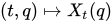 on , smooth with respect to and measurable with respect to
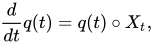
 . Solutions to
 , which in the operator formalism reads
 | | 1 |
define the flow of  , i.e., a family of diffeomorphisms
 ,
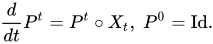
 . The flow satisfies the equation
 | | 2 |
Rewrite 2 as a Volterra integral equation  .
Iterating one more time the procedure, we arrive to

In this way we justify the notation, at least on the formal level, for the right chronological exponential
 | | 3 |
where  denotes the standard
 -dimensional simplex.
Unfortunately, this series never converges on ; indeed, as a consequence of Borel's lemma, there always exists a smooth function on which it diverges. Nonetheless, the partial sum

can be used to obtain the asymptotics of the right chronological exponential: indeed it can be proved that, for every ,  and
 compact, we have
 | | 4 |
for some  , where
 . Also, it can be proven that the asymptotic series
 converges, as
 , on any normed subspace
 on which is well-defined and bounded, i.e.,

Finally, it is worth remarking that an analogous discussion can be developed for the left chronological exponential  , satisfying the differential equation

Consider the perturbed ODE

We would like to represent the corresponding flow, 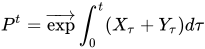 , as the composition of the original flow
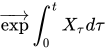 with a suitable perturbation, that is, we would like to write an expression of the form

To this end, we notice that the action of a diffeomorphism  on on a smooth vector field
 , expressed as a derivation on , is given by the formula

In particular, if  , we have

This justifies the notation

Now we write

and

which implies that

Since this ODE has a unique solution, we can write

and arrive to the final expression, called the variation of constants formula:
 | | 5 |
Finally, by virtue of the equality  , we obtain a second version of the variation of constants formula, with the unperturbed flow composed on the left, that is,
 | | 6 |
Sources
- Agrachev, Andrei A.; Sachkov, Yuri L. (2004). "Elements of Chronological Calculus". Control Theory from the Geometric Viewpoint. Encyclopaedia of Mathematical Sciences. Vol. 84. Springer. ISBN 9783662064047.
- Agrachev, Andrei A.; Gamkrelidze, Revaz V. (1978). "Exponential representation of flows and a chronological enumeration. (Russian)". Mat. Sb. New Series. 107 (149): 467–532, 639.
- Agrachev, Andrei A.; Gamkrelidze, Revaz V. (1980). "Chronological algebras and nonstationary vector fields. (Russian)". Akad. Nauk SSSR, Vsesoyuz. Inst. Nauchn. i Tekhn. Informatsii. 11: 135–176.
- Kawski, Matthias; Sussmann, Héctor (1997). Noncommutative power series and formal Lie-algebraic techniques in nonlinear control theory. European Consort. Math. Indust. Teubner, Stuttgart. pp. 111–128.
- Kawski, Matthias (2002). The combinatorics of nonlinear controllability and noncommuting flows. ICTP Lect. Notes, VIII. Abdus Salam Int. Cent. Theoret. Phys., Trieste. pp. 223–311.
- Sarychev, Andrey V. (2006). "Lie extensions of nonlinear control systems". Journal of Mathematical Sciences. 135 (4): 3195–3223. doi:10.1007/s10958-006-0152-4.