Chokepoints
 | |
| Author | Edward Fishman |
|---|---|
| Language | English |
| Subject | Current affairs, geopolitics, economic warfare, international relations |
| Genre | Nonfiction |
| Publisher | Portfolio |
| Publication date | 2025 |
| Publication place | United States |
| Pages | 560 |
| ISBN | 9780593712979 |
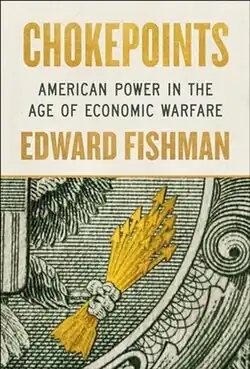
Chokepoints: American Power in the Age of Economic Warfare is a 2025 nonfiction book by Edward Fishman about the development and use of economic sanctions, export controls, and other forms of U.S. economic statecraft. It was published by Portfolio, an imprint of Penguin Random House, on February 25, 2025.
Synopsis
Fishman traces the development of American economic warfare through campaigns against nuclear program of Iran, sanctions on Russia after the annexation of Crimea, restrictions on China's access to advanced technology, and the measures imposed following the Russian invasion of Ukraine.
The book describes the dollar-based financial system, semiconductor supply chains, maritime services, and other networks as economic chokepoints that can be used to exert pressure on states dependent on them. Fishman also proposes an impossible trinity, arguing that economic interdependence, economic security, and geopolitical competition cannot all be sustained simultaneously.
Reception
Reviewers generally praised Fishman's work and access to policymakers while differing over the effectiveness and consequences of the policies he describes. In The Wall Street Journal, Daniel Yergin called the book a "compelling and dramatic narrative" and praised its account of the fragmentation of the global economy.[1] Katja Bego, writing in International Affairs, similarly praised its accessible reconstruction of policymaking, but noted that it also illustrates the limits of sanctions when targeted governments are willing to absorb their economic costs.[2]
In Foreign Policy, Keith Johnson praised Fishman's synthesis of two decades of economic warfare, but emphasized the book's warning that repeated use of American-controlled chokepoints gives other countries incentives to develop alternatives to the dollar-based and Western-led systems on which U.S. leverage depends.[3]
Alex Zerden of Lawfare praised the book's diplomatic history and technical account of sanctions, but argued that its emphasis on Iran, Russia, and China left less room for other instruments and cases, including financial regulation, North Korea, Venezuela, digital-asset evasion, and the humanitarian effects of sanctions.[4] In Survival, Chris Clague called Chokepoints an important contribution to geoeconomics and the "best behind-the-scenes account to date" of American economic coercion, while emphasizing the difficulty of translating economic pressure into geopolitical outcomes.[5]
Quinn Slobodian offered a more critical assessment in The New York Review of Books, arguing that Fishman stopped short of fully evaluating the reliability and consequences of economic coercion. He contended that repeated use of economic chokepoints has encouraged adversaries to develop alternatives and made some U.S. allies more skeptical of American economic warfare.[6]
The book also received reviews from Jacobin,[7] National Review,[8] and City Journal.[9]
References
- ↑ Yergin, Daniel (February 2025). "'Chokepoints' Review: The Dollar on Defense". The Wall Street Journal.
- ↑ Bego, Katja (July 2025). "Chokepoints: how the global economy became a weapon of war". International Affairs. 101 (4): 1534–1535. doi:10.1093/ia/iiaf115.
- ↑ Johnson, Keith (February 7, 2025). "America's Economic Warfare Is Sowing Its Own Demise". Foreign Policy.
- ↑ Zerden, Alex (March 17, 2025). "A Primer on 21st-Century Economic Weapons". Lawfare.
- ↑ Clague, Chris (2025). "Sanctions: Failure by Other Means". Survival. 67 (3): 171–178. doi:10.1080/00396338.2025.2508092.
- ↑ Slobodian, Quinn (June 11, 2026). "Damming the Big Ocean". The New York Review of Books.
- ↑ Blakeley, Grace (May 7, 2025). "The United States Has Overused Its Sanctions Weapon". Jacobin. Archived from the original on 2025-05-20.
- ↑ Ku, Julian (April 26, 2025). "Economies Are Now Battlefields". National Review.
- ↑ Bellafiore, Robert (2025-03-23). "The Age of Economic Warfare". City Journal. Archived from the original on 2025-08-12.