Checkpoint (rapid HIV testing facility)
| Founded | 21 June 2002 |
|---|---|
| Dissolved | 27 June 2008 |
| Type | Rapid HIV testing project |
| Purpose | Lowering the threshold for HIV testing |
| Location | |
| Services |
|
| Method | Determine HIV-1/2 rapid test |
| Funding | GlaxoSmithKline |
| Remarks | Nearly 5,000 people were tested during the project's operation |

Checkpoint was a rapid HIV testing project based in Amsterdam, the Netherlands.[1] The project, run entirely by volunteers, was in operation from 21 June 2002 until its closure on 27 June 2008. During that time nearly 5,000 people chose to be tested for HIV at the facility.
At the time of its founding local health authorities relied on an older testing protocol that required clients to wait one to two weeks for results. In contrast, Checkpoint's rapid test produced a reliable outcome within 15 to 20 minutes.
Rapid testing was convenient and encouraged more people to get tested. Earlier diagnosis led to more timely treatment which reduced the infectious period for the patient and hence the chance of infecting others.
When an increasing number of local health authorities began adopting rapid HIV testing, Checkpoint had fulfilled its purpose and was wound up.
Background
Research conducted in the Netherlands in 2000 found that only 42% of men who have sex with men (MSM) had ever been tested for HIV.[2] To lower the threshold for testing among this group, the Dutch HIV Association (HVN) sought to speed up testing.[3] GlaxoSmithKline provided financial support.
Principles
The initiative was guided by three core principles[4]:
- Rapid HIV testing was to be available to anyone who had incurred a risk of HIV infection, regardless of gender or sexual orientation.
- The testing procedure was required to include comprehensive pre-test and post-test counselling.
- Knowledge gained through the programme was to be systematically analysed and disseminated.
History
Initial Concerns
Initially, mainstream organisations in this field — including SOA Aids Nederland and the Municipal Health Services (GGD) — regarded it with some scepticism. The following objections had to be overcome:
- Checkpoint had selected the Determine rapid HIV test which was the only such test available at that time in the Netherlands. Although its reliability had already been established, this was not yet widely known.[5]
- Concerns were raised about the provisional nature of a positive rapid test result, which required confirmation by a Western blot (the gold standard). Studies from that period indicated that a significant proportion of people with a preliminary positive result did not return for confirmation testing.
- More contentious was the assumption that a seven-day wait for HIV test results would have a preventive effect on behaviour — a claim for which no scientific basis was ever established.[4] In practice, batch testing of large numbers of blood samples simultaneously was primarily a matter of logistics and cost: the price per test was lower when samples were processed together. Once initiated, laboratory results from all samples were available within an hour.
- There was also a financial dimension: laboratories stood to lose income if testing sites required only Western blot confirmations.[4]
Results

In the years of its operation Checkpoint was better able to reach higher-risk groups than was the Amsterdam Public Health Service (GGD).
Recognition
Recognition came in 2004 when, at the 15th World AIDS Conference in Bangkok, Checkpoint demonstrated that the rapid HIV test in the Netherlands lowered the threshold for MSM to have themselves tested, which meant that one of Checkpoint's aims had been realized.[4]
As of 2005, the Amsterdam City Council's public health service (the GGD) started offering rapid HIV tests to high-risk visitors to the STD outpatient clinic.
In 2006 the RIVM (Netherlands National Institute for Public Health and the Environment) advised the Ministry of Health to encourage the use of rapid HIV testing, to identify all obstacles to this, and to eliminate these obstacles.[5]
Closedown
When 60% of the local health authorities appeared to be using rapid HIV testing as part of their standard screening method or were busy implementing it, this project could be successfully wound up. During a large farewell event on 27 June 2008, the then Mayor of Amsterdam, Job Cohen, thanked all volunteers for their results.
Sharing learning globally
For one more year, foreign rapid HIV testing projects were supported. All source documentation was made available in digital form. The Checkpoint formula was adopted not only in the Netherlands but in many other cities: Aarhus, Athens, Barcelona, Basel, Cologne, Copenhagen, Dublin, Geneva, Helsinki, Lisbon, Ludwigshafen, Malmö, Mannheim, Munich, Nuremberg, Odense, Paris, Riga, Thessaloniki, Zagreb, and Zürich. The Checkpoints in Denmark, France, Sweden, and Switzerland received extensive support from Checkpoint Amsterdam. The Swiss Checkpoints have gone further, developing into Gay Health Centres. Not only did they perform tests for STDs and HIV, but they also offered support for HIV-positive persons and in general for coming out, general psychological care for gay men, training in safe drug usage, and assistance with smoking cessation and excessive alcohol use. In 2012 Checkpoints opened in Bern and Lausanne.[6]
Features of the project

Amsterdam Checkpoint employed the Determine rapid HIV test (third generation), with a 100% sensitivity and 99.75% specificity. [6] Positive or dubious results were checked using a Western blot test
Checkpoint positioned itself as a facility which shares the client's point of view.
- Gay-friendly, aimed at high-risk groups and anonymous if so desired
- Preferably with the knowledge of and in the presence of the partner, friends and family, who could give effective support in the case of testing positive* Outside office hours
- When the service began, everyone could attend without an appointment. However, demand exceeded supply, so it became necessary to work by appointment. HVN volunteers maintained the appointment schedule.
- When an appointment was made over the telephone, the client was asked whether they belonged to a high-risk group, what the reason was for wanting an HIV test and whether they were still in the window period for testing. This information enabled a better match to be made between a doctor or nurse and the client for the Friday evening.
- Effective pre- and post-test counseling. A volunteer trained in the paramedical field registered the client, talked about safe sex, and gave a condom demonstration.
- After this, a nurse or doctor conducted the HIV test, and communicated the outcome 15 minutes later.
- Clients testing positive were immediately referred to a support project run by HIV-positive volunteers who, in various languages, offer support during the 48 hours after testing positive
- If the client tested positive or the result was ambiguous, a blood sample was taken for a Western blot and an appointment was made for receipt of the confirmatory result a week later. In 79% of cases, the confirmatory result was received in person a week later. In contrast to the previous week, clients were noticeably less emotional at this second talk and had highly specific and practical questions to ask. Although initially a point of criticism, this second post-test talk was in fact regarded by the doctors, nurses, and clients as having added value.
- Vaccination against hepatitis A and B for groups at risk
- After testing, the Dutch HIV Association (HVN) Service Centre was available for advice or questions
Volunteers
This project was run by volunteers. Once selected, volunteers followed an internal training programme, depending on their experience and duties, before being allowed to operate independently. In 2007 Checkpoint became the second voluntary organization in Amsterdam and the 25th in the Netherlands to receive the Goed Geregeld [well organized] award from the Dutch Association of Voluntary Organizations (NOV): an award reflecting the high quality achieved.
Consultations and diagnoses
The following tables compare the number of tests and HIV diagnoses at Checkpoint and at the Amsterdam Public Health Service’s STI outpatient clinic. GGD Amsterdam refers to the local public health authority Gemeentelijke Gezondheidsdienst
| Test site | Test/diagnosis | Group | 2002 | 2003 | 2004 | 2005 | 2006 | 2007 | 2008 |
|---|---|---|---|---|---|---|---|---|---|
| Checkpoint | HIV tests | MSM | 213 | 477 | 531 | 438 | 360 | 397 | 174 |
| Checkpoint | HIV tests | Heterosexual men | 129 | 323 | 251 | 272 | 164 | 202 | 82 |
| Checkpoint | HIV tests | Women | 92 | 208 | 194 | 150 | 120 | 99 | 39 |
| Checkpoint | HIV tests | Total | 434 | 1,008 | 976 | 860 | 644 | 698 | 295 |
| GGD Amsterdam | HIV tests | MSM | 1,537 | 1,532 | 1,661 | 2,238 | 2,488 | 3,419 | 4,230 |
| GGD Amsterdam | HIV tests | Heterosexual men | 2,938 | 2,954 | 4,175 | 4,744 | 6,398 | 9,177 | 9,630 |
| GGD Amsterdam | HIV tests | Women | 3,415 | 3,626 | 5,039 | 5,564 | 7,712 | 11,340 | 11,760 |
| GGD Amsterdam | HIV tests | Total | 7,890 | 8,112 | 10,875 | 12,546 | 16,598 | 23,936 | 25,620 |
| Checkpoint | HIV-positive results | MSM | 14 | 21 | 21 | 26 | 23 | 11 | 14 |
| Checkpoint | HIV-positive results | Heterosexual men | 1 | 1 | 1 | 2 | 2 | 0 | 0 |
| Checkpoint | HIV-positive results | Women | 1 | 2 | 1 | 0 | 1 | 1 | 2 |
| Checkpoint | HIV-positive results | Total | 16 | 24 | 23 | 28 | 26 | 12 | 16 |
| GGD Amsterdam | HIV-positive results | MSM | 56 | 65 | 89 | 126 | 95 | 118 | 148 |
| GGD Amsterdam | HIV-positive results | Heterosexual men | 14 | 7 | 14 | 16 | 22 | 15 | 19 |
| GGD Amsterdam | HIV-positive results | Women | 12 | 15 | 17 | 21 | 18 | 29 | 11 |
| GGD Amsterdam | HIV-positive results | Total | 82 | 87 | 120 | 163 | 132 | 163 | 178 |
| Checkpoint | HIV-positive (%) | MSM | 6.6 | 4.4 | 4.0 | 5.9 | 6.4 | 2.8 | 8.0 |
| Checkpoint | HIV-positive (%) | Heterosexual men | 0.8 | 0.3 | 0.4 | 0.7 | 1.2 | 0.0 | 0.0 |
| Checkpoint | HIV-positive (%) | Women | 1.1 | 1.0 | 0.5 | 0.0 | 0.8 | 1.0 | 5.1 |
| GGD Amsterdam | HIV-positive (%) | MSM | 3.6 | 4.2 | 5.4 | 5.6 | 3.8 | 3.5 | 3.5 |
| GGD Amsterdam | HIV-positive (%) | Heterosexual men | 0.5 | 0.2 | 0.3 | 0.3 | 0.3 | 0.2 | 0.2 |
| GGD Amsterdam | HIV-positive (%) | Women | 0.4 | 0.4 | 0.3 | 0.4 | 0.2 | 0.3 | 0.1 |
In 2002 and 2008 Checkpoint was operational for 26 Friday evenings. For comparison, the corresponding results per group are given for the Amsterdam Public Health Service's STD Policlinic.[7] More detailed results (Dutch language) are to be found in 6 jaar Checkpoint, een samenvatting [6 years of Checkpoint: a summary].[4]
Trials
Detuned ELISA
Until early 2006 a Detuned ELISA test could still be requested in addition to a Western blot. This indicates whether the infections had occurred less than 6 months earlier or longer ago than this. It turned out that 63% of the infections were not recent.
General practitioners (family doctors)
A few GPs used the rapid HIV test in their practice. They noted that this encouraged patients who were otherwise reluctant to face a general STD investigation.
Mister B
In this Amsterdam leather and fetish shop testing sessions were held on Sunday afternoons. In this way Checkpoint hoped to reach MSM who visited leather bars more effectively. This turned out not to be the case, but it was attractive for less well-educated men who were taking high risks, regularly experimenting with recreational drugs and not resident in Amsterdam. The incidence rate among these clients was 5.6%.
Oral fluid
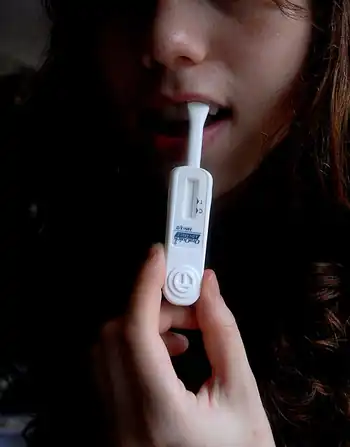
In collaboration with OraSure a pilot was conducted with 1000 OraQuick ADVANCE® Rapid HIV-1/2 oral fluid tests.[8] Initially this appeared to form the ideal HIV self-test, but during this pilot two false-negative outcomes were discovered.[9] In a slightly smaller-scale pilot in London a false-negative was noted on three occasions.[10]
Resources
- ↑ Broekhuizen A. "(14 june 2002) Checkpoint: een snelle aidstest, Algemeen Dagblad
- ↑ Hogeweg, J.A. en H.J. Hospers (2000) Monitoronderzoek 2000, Maastricht, Universiteit Maastricht Capaciteitsgroep Experimentele Psychologie
- ↑ Persbericht (14 juni 2002) Checkpoint, test je betrouwbaar, snel en anoniem op hiv, Amsterdam, Hiv Vereniging Nederland
- 1 2 3 4 Loon, C.L.J. Van and W.M. Koevoets (2008) 6 jaar Checkpoint, een samenvatting, Amsterdam, Hiv Vereniging Nederland
- ↑ Van den Berk, G.E.L. (2003). "Evaluation of the Rapid Immunoassay Determine HIV 1/2 for Detection of Antibodies to Human Immunodeficiency Virus Types 1 and 2". Journal of Clinical Microbiology. 41 (8): 3868–3869. doi:10.1128/JCM.41.8.3868-3869.2003. PMC 179847. PMID 12904410.
- ↑ Archived 23 April 2015 at the Wayback Machine
- ↑ Jaarverslagen SOA-polikliniek GG&GD Amsterdam (2002, 2003, 2004, 2005, 2006, 2007, 2008), Amsterdam, GG&GD
- ↑ Koevoets, W.M. and C.L.J. Van Loon (Augustus 2007) OraQuick®Advance™, een nieuwe hiv-sneltest…? Amsterdam, SOAAIDS Magazine Jaargang 4, nummer 3 – Archived 10 November 2013 at the Wayback Machine
- ↑ Loon, C.L.J. Van and W.M. Koevoets (December 2008) Foutnegatieve meldingen OraQuick®Advance™ Hiv 1/2 Amsterdam, SOAAIDS Magazine Jaargang 5, nummer 4 – Archived 10 November 2013 at the Wayback Machine
- ↑ Zelin J. (2008) An evaluation of the performance of OraQuick®Advance™ Rapid Hiv-1/2 Test in a high-risk population attending genitourinary medicine clinics in East London, International Journal of STD & AIDS Volume 19 pp. 665–667
