Chain rule for events
Finitely many events
For events  whose intersection has not probability zero, the chain rule states

Example 1
For  , i.e. four events, the chain rule reads

Example 2
We randomly draw 4 cards (one at a time) without replacement from deck with 52 cards. What is the probability that we have picked 4 aces?
First, we set  . Obviously, we get the following probabilities
 .
Applying the chain rule,
 .
Statement of the theorem and proof
Let  be a probability space. Recall that the conditional probability of an
 given
 is defined as
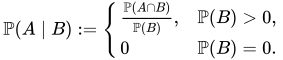
Then we have the following theorem.
Proof
The formula follows immediately by recursion

where we used the definition of the conditional probability in the first step.
Chain rule for discrete random variables
Two random variables
For two discrete random variables  , we use the events
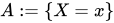 and
 in the definition above, and find the joint distribution as

or

where  is the probability distribution of
 and
 conditional probability distribution of given
 .
Finitely many random variables
Let  be random variables and
 . By the definition of conditional probability,

and using the chain rule, where we set  , we can find the joint distribution as

Example
For  , i.e. considering three random variables. Then, the chain rule reads

Bibliography
- René L. Schilling (2021), Measure, Integral, Probability & Processes - Probab(ilistical)ly the Theoretical Minimum (1 ed.), Technische Universität Dresden, Germany, ISBN 979-8-5991-0488-9
{{citation}}: CS1 maint: location missing publisher (link)
- William Feller (1968), An Introduction to Probability Theory and Its Applications, vol. I (3 ed.), New York / London / Sydney: Wiley, ISBN 978-0-471-25708-0
- Russell, Stuart J.; Norvig, Peter (2003), Artificial Intelligence: A Modern Approach (2nd ed.), Upper Saddle River, New Jersey: Prentice Hall, ISBN 0-13-790395-2, p. 496.
References
- ↑ Schilling, René L. (2021). Measure, Integral, Probability & Processes - Probab(ilistical)ly the Theoretical Minimum. Technische Universität Dresden, Germany. p. 136ff. ISBN 979-8-5991-0488-9.
{{cite book}}: CS1 maint: location missing publisher (link)
- ↑ Schum, David A. (1994). The Evidential Foundations of Probabilistic Reasoning. Northwestern University Press. p. 49. ISBN 978-0-8101-1821-8.
- ↑ Klugh, Henry E. (2013). Statistics: The Essentials for Research (3rd ed.). Psychology Press. p. 149. ISBN 978-1-134-92862-0.
- ↑ Virtue, Pat. "10-606: Mathematical Foundations for Machine Learning" (PDF).





