Celtis conferta subsp. amblyphylla
| Celtis conferta subsp. amblyphylla | |
|---|---|
 | |
Scientific classification  | |
| Kingdom: | Plantae |
| Clade: | Embryophytes |
| Clade: | Tracheophytes |
| Clade: | Angiosperms |
| Clade: | Eudicots |
| Clade: | Rosids |
| Order: | Rosales |
| Family: | Cannabaceae |
| Genus: | Celtis |
| Species: | |
| Subspecies: | C. c. subsp. amblyphylla |
| Trinomial name | |
| Celtis conferta subsp. amblyphylla | |
| Synonyms | |
| |
Celtis conferta subsp. amblyphylla, commonly known as cotton wood or cotton-wood, is a flowering plant in the hemp and hackberry family.
Description
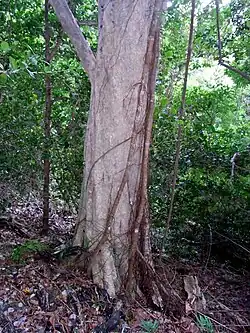
C. c. subsp. amblyphylla is a tree with whitish bark growing to approximately 16 m (52 ft) in height. Its thick, leathery, oval leaves are 5–9 cm (2–3+1⁄2 in) long and 2–4 cm (3⁄4–1+5⁄8 in) wide. Clusters of small flowers, 3–4 mm (1⁄8–3⁄16 in) long, appear on the tree from November to February. The tree's round, purple fruits are about 4 mm (3⁄16 in) in diameter.[1][2]
Distribution and habitat
The subspecies is endemic to Australia's subtropical Lord Howe Island in the Tasman Sea, where it is widespread in lowland forest. The only other subspecies, C. c. subsp. conferta, is endemic to New Caledonia.[1][2]
References
- 1 2 3 "Celtis conferta subsp. amblyphylla". Flora of Australia Online: Data derived from Flora of Australia Volume 49 (1994). Australian Biological Resources Study (ABRS). Retrieved 24 February 2014.
- 1 2 Hutton, Ian (1998). The Australian Geographic Book of Lord Howe Island. Sydney: Australian Geographic. p. 145. ISBN 978-1-876276-27-0.
External links
- "Celtis conferta subsp. amblyphylla (F.Muell.) P.S.Green". Atlas of Living Australia.