Carthaginian Navy
| Carthaginian Navy | |
|---|---|
 The battle between the Romans and the Carthaginians as depicted by a 19th-century artist | |
| Active | c. 800—c. early 146 BC |
| Disbanded | Early 146 BC |
| Allegiance | Carthage |
| Branch | Military of Carthage |
| Type | Navy |
| Size | approx. 300–500 ships |
| Engagements | |
| Commanders | |
| Notable commanders | |
The Carthaginian Navy played a significant role in ancient Carthage's commercial and colonial expansion in the 9th–2nd centuries BC. It developed the traditions of Phoenician shipbuilding and employed traditional ancient military tactics Unlike the army, which from the sixth century BC consisted primarily of mercenaries, the navy's personnel were recruited from among the citizens of Carthage and the Phoenician colonies It was based in several ports in the Western Mediterranean, with its main base in capital.
But while protecting the coast and trade routes was quite effective, the situation often played out differently in actual wars. Paradoxically, the Carthaginian navy did not play a decisive role in defeating the enemy. Thus, during the wars in Sicily, it was unable to effectively blockade Syracuse or intercept the troops of Agathocles when he decided to unleash military action in Africa. And later, during the Punic Wars, the Carthaginians' most resounding victories were won on land, not at sea. Conversely, defeat in the naval battle near the Aegates Islands sealed the fate of the Carthaginian presence in Sicily and their superiority at sea.
History
Wars with Tartessos and the Greeks
In matters of detail, especially warfare, the Carthaginians are superior in naval operations, both in skill and equipment. This is only to be expected, for their knowledge of seafaring goes back to remote antiquity, and they devote themselves to navigation more than any other people.
The first centuries of Carthaginian history were marked by the struggle of the Phoenician colonies with Tartessos, which was not inclined to cede trade routes to the overseas invaders without a fight. In the late 9th and early 8th centuries BC, Greek merchants appeared in the Western Mediterranean, and in the mid-8th and 7th centuries BC, Greek colonies also appeared in eastern Sicily. Around 600 BC, colonists from Phocaea founded their first settlement in the region, Massalia, near the mouth of the Rhone . In their westward movement, they met with the full support of Tartessos, which saw them as natural allies, and soon Greek cities appeared on the Iberian Peninsula. Under the influence of this new threat, the Phoenician colonies, partly voluntarily and partly under duress, united around Carthage, whose war against the Greeks became protracted. At the end of the 7th century BC. The Carthaginians lost access to Italy. Their situation became especially difficult after the Phocaeans built the city of Alalia on Corsica in the first half of the 7th century BC. Its inhabitants plundered their neighbors and passing merchant ships, apparently completely disrupting trade in the area.[2]
More successful were the wars waged by the Carthaginians under Malchus in Sicily in the mid-sixth century BC. They managed to conquer a significant territory there. Inspired by their success, Malchus's troops crossed to Sardinia, but suffered such a severe defeat that the Carthaginian authorities sentenced both the unfortunate commander and the remaining portion of his army to exile. The reforms and successful diplomacy of Mago I of Carthage led to significant political and military success after the fierce Battle of Alalia in 535 BC between the Carthaginian-Etruscan and Phocian fleets, the Greeks were forced to abandon Corsica. The route to Italy became free again. The Battle of Alalia had other far-reaching consequences. The Carthaginians again launched an active offensive in Sardinia, relying on local Phoenician settlements and establishing their own colonies. But the main thing was that this victory made it possible to completely isolate and then destroy Tartessos. This event occurred in the late 30s or early 20s of the sixth century BC. Nevertheless, the Carthaginians were soon defeated by the Massaliotes in the naval battle of Artemisium off the coast of Spain, although the victors failed to break their monopoly in this part of the Mediterranean.[3]
At the end of the 5th century BC, the Carthaginians renewed their struggle for Sicily. Their enemy was the largest Greek colony on the island, Syracuse. The Carthaginians hoped not only to seize the island but also to gain complete control of the sea routes approaching Italy. The wars, interspersed with more or less lengthy truces, proceeded with varying success there were times when the Carthaginians captured almost the entire island and approached the very walls of Syracuse (as, for example, in 405 BC), but there were also times when they were expelled from the island. One such campaign in 398 BC had particularly serious consequences for them. Syracusan troops managed to capture and destroy the Carthaginian colony of Motya. However, as early as 396 BC. The Carthaginians regained their positions but did not rebuild the destroyed city, instead founding a large city and port, Lilybaeum, in a more convenient location. The fighting sometimes spilled over into Africa, but this did not significantly affect its outcome.[4]
In 280 BC, the year of Pyrrhus' invasion of Italy , the Romans concluded a treaty with the Carthaginians, which included military assistance at sea. However, relations between Rome and Carthage were not cordial, as both sides feared their ally as much, if not more, than their enemy. When, in fulfillment of the treaty or under this pretext, a Carthaginian flotilla of 120 ships was sent to Rome's aid, the Senate politely thanked them and declined. Most likely, the "allies" acted against Pyrrhus virtually independently, although Diodorus Siculus preserved information that the Carthaginians lent their ships to the Romans to transport troops to Rhegium. When Pyrrhus crossed to Sicily, the Carthaginians found themselves alone and, having suffered a series of crushing defeats, lost almost everything except Lilybaeum, which they managed to hold only thanks to their naval dominance. The Carthaginian government was prepared to conclude a separate peace, accept its losses, and even provide its fleet to its recent adversary. However, the negotiations yielded no results, as Pyrrhus also demanded the cession of Lilybaeum. After Pyrrhus' exile and Rome's final subjugation of Italy, conflict with Carthage became only a matter of time.[5]
First Punic War
Before the First Punic War, the Roman navy was used only sporadically and was no match for the Carthaginian fleet, so it seemed Rome would never be able to overcome the enemy's superiority in this area. At the same time, Carthage could not achieve victory solely through naval forces, and its land forces were inferior to the enemy in combat qualities. The Romans successfully met the challenge having captured a grounded Carthaginian quinquereme, they used it as a model and, by 260 BC, had a fleet of 120 ships. Furthermore, the Romans employed a new tactic based on boarding. As a result, despite their initial failure, they managed to inflict a heavy defeat on the Carthaginian fleet that same year. This success shocked their contemporaries, especially the Romans themselves; Consul Gaius Duilius, who commanded the Roman fleet, was awarded exceptional honors in addition to a triumph. After this, the Roman command decided to strike at the very heart of Carthaginian territory. In the spring of 256 BC, four legions on 330 ships set sail for the African coast. The Carthaginians, who met the enemy at Cape Ecnomus, were routed again despite their numerical superiority. No longer expecting a military victory, the Carthaginian government attempted to withdraw from the war, accepting the loss of Sicily and Sardinia. But this was not enough for the Roman commander, Atilius Regulus. During negotiations, he demanded that the Carthaginians destroy their navy and commit to supplying ships to Rome. Accepting such conditions would have meant the end of Carthage as a great power and establishing its direct dependence on the Roman Republic. The Carthaginians reorganized their army, continued the war, and were able to drive the Romans out of Africa.[6]
Military operations focused on Sicily, where cities fell into Roman hands one after another. However, they were unable to completely blockade the last Carthaginian possessions from the sea. Carthaginian sailors penetrated the harbors on small sailing vessels. Wanting to turn the tide, the consul Publius Claudius Pulcher attempted to destroy the Carthaginian fleet in the harbor of Drepana, but the Carthaginians managed to surround the Roman ships and capture or destroy almost all of them, achieving their greatest victory of the entire war. The defeat was complemented by the destruction of Roman transport ships in the area of Gela and Camarina. As a result, even the incomplete naval blockade established by the Romans was eliminated.[7]
In 247 BC, Hamilcar Barca was appointed commander of the Carthaginian fleet in Sicily. He carried out devastating raids along the coast of Italy and was relatively successful against the Romans on the island itself. In 243 BC, Rome again—for the third time during the war—built a fleet, this time using private funds from its citizens. When the Roman armada appeared at sea, Hamilcar Barca found himself cut off from Carthage. The Carthaginian authorities decided to take measures to withdraw their troops from Sicily. A fleet was sent to the northern shores of the island, but the expedition was unsuccessful in the massive Battle of the Aegates Islands, the Carthaginians were defeated. Seeing no other option, the Carthaginian authorities authorized Hamilcar Barca to negotiate peace. With the state's resources exhausted (the Carthaginians were forced, albeit unsuccessfully, to seek a loan from Egypt), there was no longer any hope of restoring their naval power. Hamilcar was reluctantly forced to conclude peace, although on relatively lenient terms for Carthage, since Rome was also exhausted by the war.[8]
The Second and Third Punic Wars
During the Second Punic War, the main military actions took place on land in Italy, but a number of operations and major battles also took place at sea. The Carthaginians unsuccessfully attempted to recapture Sicily[9], ravaged the coast of Roman possessions[10], and intercepted Roman cargo ships carrying food.[11] In the Spanish theater in 217 BC, Hasdrubal Barca moved significant land forces and a strong fleet to the Iberus, but was defeated near the mouth of this river.[12] In 215 BC, a Carthaginian squadron and expeditionary force supported an anti-Roman uprising in Sardinia, led by the local aristocrat Hampsicore. Despite some defeats (such as at Clupeia during the Roman raid on the African coast[13]) the Carthaginian fleet remained combat-ready until the end of the war, and Publius Cornelius Scipio, who landed in Africa, had to reckon with the danger of having his communications cut off.[14] In the naval battle at Utica, the Carthaginians even managed to capture several Roman transport ships and take them to their capital.[15]
Following the Second Punic War, the Carthaginians surrendered all of their warships (their number may have reached 500), except for 10 triremes, to Rome.[16] Subsequently, the Romans repeatedly expressed suspicion that their defeated enemy, deprived of independence in foreign policy, was planning to restore its naval forces in defiance of the peace treaty. Thus, in 157 BC, a Roman embassy, which was resolving a dispute over land holdings between the Carthaginians and Massinissa, returned with the news that enormous reserves of materials needed for shipbuilding had been discovered in Carthage. It is unknown whether this referred to the construction of a military or a merchant fleet.[17] In 152 BC, another Roman embassy actually discovered warships, after which the Senate demanded that they be burned.[18] The Carthaginians sought to avoid war at all costs, but Rome issued an unacceptable ultimatum the inhabitants of the Carthaginian capital were to abandon it and settle elsewhere on their own territory, but at a considerable distance from the sea, which, for a city dependent on maritime trade, meant certain death. Consul Lucius Marcius Censorinus stationed his ships at the entrance to the Carthaginian harbors to help the terrified people submit to their fate. But the Carthaginians decided to fight and enthusiastically prepared for defense. To build ships, they recast copper statues and took wooden beams from public and private buildings.[19]
The siege of the city became protracted. The new Roman commander, Publius Cornelius Scipio Aemilianus, ordered the construction of a stone dam, which would block all exits from Carthage to the open sea. Successful completion of this work would completely close the blockade, and the Carthaginians began hastily and in great secrecy to dig a new canal from their harbors to the Mediterranean. They also began building new ships, and one fine day, to the great astonishment of the Romans, a fleet of 50 triremes and numerous smaller vessels departed from their ports. On the third day after this event, a naval battle took place. It lasted until sunset; neither side gained a significant advantage, and the Carthaginians decided to retreat. However, at the entrance to the harbor, where the small Punic ships blocked the path of their own larger vessels, the battle resumed. This time, the Romans used ramming attacks to disable and destroy most of the Carthaginian fleet. Thus, the Carthaginians' desperate attempt to break the naval blockade ended in failure. This is the last mention of the Carthaginian fleet in the sources. Soon, the Carthaginian state ceased to exist.[20]
Trade and discoveries

As early as the 8th and 7th centuries, the Mediterranean coast of modern-day Tunisia, Algeria, and Morocco was dotted with numerous Carthaginian colonies. In the mid-7th century BC, a Carthaginian settlement appeared on the island of Ebessus. By establishing colonies in various locations across the Mediterranean, the Carthaginian authorities sought to reduce social tensions within the state by removing "excess" populations, granting land to poor citizens, and increasing trade revenues. Furthermore, by locating colonies on coastal islands, peninsulas, and in locations suitable for establishing ports, they hoped to secure their dominance over trade routes. Settlements further inland were intended to ensure Carthage's dominance over the local population. In the 7th and 6th centuries BC. The Carthaginians made attempts on an exceptional scale to penetrate beyond the Pillars of Melqart (the Strait of Gibraltar), both to the south and to the north of the Atlantic.[21]
The largest colonization expedition is associated with the name of the outstanding naval commander Hanno; archaeological research on the Atlantic coast of Morocco allows us to date it with some certainty to the 7th–6th centuries BC. Hanno's campaign was a significant event in the life of Carthaginian society. By decision of the authorities, he was placed at the head of a massive fleet of 60 warships (pentecontera), carrying 30,000 men. Almost all of them were to constitute the population of several cities beyond Gibraltar, of which six were eventually founded.[22]
Carthaginian navigators also ventured into the depths of the Atlantic Ocean. There, they discovered a forested island on which they even established a settlement. Apparently, this was one of the Azores Islands, where a hoard of ancient coins was found in 1749, including some Carthaginian ones. However, these lands lay off the most important trade routes of the time, so the route to them was soon forgotten, and the fact of the discovery itself was preserved only in a greatly altered form in legends about the "islands of the blessed ."Probably at the end of the sixth century BC, Himilco made a sea voyage north of Gibraltar. The goal of his voyage, which lasted four months, was the Oestrimnid Islands, from where tin was brought in ancient times.[23]
After the destruction of Tartessos, the Carthaginians established a zone of exclusive trade in the Western Mediterranean, into which they did not allow outsiders. This situation was reinforced by a number of treaties, including the treaty with Rome of 510/509 BC. According to Strabo , the Carthaginians sank all foreign ships heading for the shores of Sardinia or the Strait of Gibraltar.[24] Numerous clashes between Carthage and the Greeks off the coast of Sicily and the Iberian Peninsula at the end of the sixth century BC did not change the situation. Thus, the Spartan prince Dorieus twice attempted to establish a colony on Carthaginian lands, and both times failed. Carthaginian dominance at sea was shaken only during the First Punic War.[25]
Types and design of ships
While being worthy successors of Phoenicia, the Carthaginians did not limit themselves to refining their traditional technologies. They made extensive use of Greek naval experience. They developed penteconters very early on, and in the 4th century BC other, more complex types of vessels—triremes and quinqueremes were developed.[26]
According to Polybius, the primary warship of the Carthaginians in the 3rd century BC was the quinquereme, although triremes and quadriremes were also used. One of the flotillas included a "seven-row" flagship, captured from Pyrrhus during his attack on Sicily. According to the prevailing opinion today, the number of vertical rows of oars, even on the largest ancient ships (polyremes), never exceeded three, and the numbers in the names of ship classes denoted the total number of rowers per vertical group of oars.[27][28]
A trireme was equipped with 170 oars, with 62 rowers stationed on the upper tier and 54 on each of the lower tiers. Ship sheds discovered during excavations revealed that quadriremes and quinqueremes were almost identical in size to triremes. This makes it all the more surprising that sources indicate that equipping a quadrireme with oars was cheaper than equipping a trireme. The only possible conclusion is that the quadrireme had fewer oars than a trireme. This implies that the oars were arranged in only two rows, with two rowers per oar. Regarding the quinquereme, it is logical to conclude that the oars were arranged in three rows, with two rowers per oar on the upper tiers where the hull is wider and one rower per oar on the lower tier. Since the trireme's crew consisted of 200 men, of whom 170 were rowers, it can be assumed that of the quinquereme's 300-man crew, 270 were rowers, manning 158 oars (58 on the upper deck, 54 on the middle deck, and 46 on the lower deck). By stating that the Carthaginian fleet of 350 ships had 150,000 men on board, Polybius implies that the crew of the Carthaginian ships was roughly equal in size to that of the Roman ships of the same period about 300 sailors and 120 soldiers.[29]
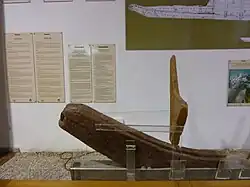
One of the most remarkable features of the fleets of Carthage and Rome in the third century BC was the remarkably rapid construction of their ships. For example, in 261 or 260 BC, the Romans built their first fleet of 120 ships in two months. Seven years later, a second flotilla of 200 ships was created in three months. In 1969–1971, the hull of a Carthaginian ship was discovered in shallow waters just north of Lilybaeum. This ship, along with another found nearby, are believed by radiocarbon dating to have dated to the period of the First Punic War. The marks of various shipwrights on the frames, which have survived to this day, suggest that the parts were mass-produced; this certainly explains the speed of construction.
The keel of one of the Lilybaeum ships was made of maple, the frames of oak, and the planking and fang-shaped parts of the ram of pine. The ships were planked flush, meaning the outer planking was attached first, and then the frames were inserted. The planks were joined using flat wooden tenons, which were held in place by wooden dowels. All Mediterranean ships discovered to date have been assembled in this manner. The planks were nailed to the frames from the outside, with the nails bent inward. The joints were sealed with a kind of putty, and then the hull was sheathed with lead sheets, and the ram was bound in bronze. According to H. Frost, both ships were liburnians a type of light, fast ship used by the Illyrians. It can be assumed that Philip V , an ally of Carthage, adopted this type of ship during the Second Punic War. However, there is no evidence in the sources that the Carthaginians themselves used liburnians in the 3rd century BC. The fast, light ship belonging to a certain Hannibal, nicknamed the Rhodian , which repeatedly broke the Roman blockade of Lilybaeum, was a quinquereme. This conclusion can be reached knowing that the Romans built a flotilla of quinqueremes, using the Rhodian's ship as a model. Even without taking this fact into account, the dimensions of the ship from Lilybaeum approximately 35 meters long and 5 meters wide, not counting the gunwale are very large. The ship sheds in Carthage, most likely designed for quinqueremes, were only 5.9 m wide. In depictions of warships on Carthaginian coins from Spain and reliefs, ship superstructures, a gunwale with a deck rising above it, and a ram corresponding to the Greek type (attached to a bottom stringer) are discernible. The coins also depict oval shields (clearly Celtiberian), fastened to straps along the rails.[30]
Like other fleets of the ancient world, Carthaginian ships tried to avoid going to sea during seasonal storms. It is believed that they traveled no more than 35 km per day. It is quite possible that they also sailed at night, as evidenced, on the one hand, by the definition of distance traveled in day and night found in the sources, and on the other, by the Carthaginians' knowledge of astronomy. Due to the geography of the Carthaginian empire and thanks to this knowledge, Carthaginian sailors not only navigated coastal areas, but also unhesitatingly ventured out to sea, particularly when sailing from Sardinia to Ibiza, and from there to the North African coast.[31]
Command and personnel

The fleet commander was appointed by the Carthaginian government. He had equal status with the commander of the land army (rab mahanate), and the two positions were rarely combined. Each ship had three officers, one of whom was a navigator. Unlike most infantry and cavalry, the sailors of the Carthaginian fleet were not mercenaries.[31] The standard complement of a quinquereme crew included about 300 rowers, recruited from among the citizens of Carthage and allied cities, such as Utica. In the later era, when there was a severe shortage of men during war, slaves could also be recruited as rowers. Due to their lower qualifications, they were used on larger ships, where there were two or more rowers per oar. This made it possible to combine the skills of an experienced rower with the physical strength of new recruits.[32]
Rowers could be used as infantry in landing operations, but not as boarding parties. The crews were also involved in the construction of siege weapons. In addition to rowers and sailors, large ships also carried warriors archers and marines armed with spears, javelins, and swords, who could capture enemy vessels. The discovery of the "Marsala ship" allowed us to learn more about the daily life of Carthaginian naval sailors. Their personal utensils, amphorae of various shapes, and traces of products included in their diet were found dried meat (poultry, horse meat, beef, goat meat, pork, and venison), almonds and walnuts, and wine.[32] The Carthaginians supposedly used a standard with a crescent and disk as their naval flag.[33][34]
Tactics

The Carthaginian fleet employed traditional Mediterranean tactics[35], based on the use of ramming and including two main techniques, called in Greek διέκπλους ("breakthrough") and περίπλους ("flank attack").[36] The main objective was to ram the enemy ship in the side or stern, or to break its oars by passing side to side and pulling in one's own. The sail was always lowered before the battle, and under oars the ship could reach a speed of 7-8 knots. To use such tactics, the crew had to not only demonstrate excellent training and teamwork, but also accurately calculate the force and direction of the blow, so that the bow of their ship did not become stuck in the rammed enemy's. After ramming the enemy, they fired at them with projectiles, and if necessary, they landed a boarding party.[32] To protect against a flank attack, especially from a numerically superior enemy, a fleet was constructed with one flank adjacent to the shoreline. While larger ships attempted to ram the enemy, smaller vessels were used to tow away damaged friendly ships and captured enemy ones.[32]
Polybius describes an incident where, having surprised the Roman fleet at anchor, the Carthaginian admiral burned some of the ships perhaps referring to the use of incendiary weapons.[37] And during the final defense of their capital, the Carthaginians used fire ships against the Roman ships canoes filled with brushwood, tow, resin and sulphur.[38] Ancient authors unanimously attest to the tactical superiority of the Carthaginians during the First Punic War, which was rich in naval battles. However, the Carthaginian navy was no match for the "corvus", which allowed the Romans to successfully deploy their more powerful infantry at sea.[32]
Ports
| External videos | |
|---|---|
| Reconstruction of the appearance of the Port of Carthage | |
 Puerto de Cartago 3D / Virtual Carthage Port |
According to Appian, who relied on a lost portion of Polybius's history, Carthage had two harbors a commercial harbor and a military harbor, located one behind the other and separated by a double wall. The first harbor (on the seaward side) accommodated merchant ships. Its entrance, about 20 meters wide, could be blocked by a chain if necessary. In the center of the military harbor was an island, where the naval commander's headquarters were located, rising above the surrounding buildings and fortifications, allowing the commander to observe the sea. Ship sheds and warehouses, designed to accommodate 200 ships, stretched along the island and the harbor itself. Two columns rose at the entrance to each shed, giving both the harbor and the island the appearance of a single continuous portico.[39]
In the southeastern part of ancient Carthage, there are two reservoirs one horseshoe-shaped, the other diamond-shaped. Excavations conducted in the 1970s confirmed that the military harbor was located here, as suggested by Appian's descriptions. In the center of the "horseshoe," the foundations of a huge structure were discovered, from which rows of rectangular stone blocks radiated in all directions. These rows, spaced 5.9 meters apart, can only be the foundations of ship sheds, and the central building was the naval commander's headquarters. In the mid-19th century, C. E. Böhle found similar rows of stone slabs in the northern part of the reservoir. The northern end of a later Roman harbor was also discovered. If it coincided with the location of the older one, then the harbor's circumference would have been over 1,100 meters: an area large enough to accommodate 160 ship sheds. Since there are 30 of them on the island, Appian's testimony that the sheds were designed to accommodate 200 ships is fully supported.
However, during the First Punic War, the Carthaginian fleet often far exceeded this number. In 256 BC, Carthage launched a flotilla of 350 decked warships. Carthage most likely also had auxiliary flotillas at its disposal, permanently stationed in Palermo and Lilybaeum. One cannot ignore the military harbor discovered during excavations on the territory of the Carthaginian colony of Motya, on an island off the western coast of Sicily, destroyed by Dionysius I.[30] In the 3rd century BC, New Carthage, founded by Hasdrubal the Fair in Carthaginian Spain, became an important commercial and military port.[40]
Gallery
Fragments of the so-called Marsala ship at the Baglio Anselmi Archaeological Museum, Marsala.


See also
Reference
- ↑ Polybius, VI. 52
- ↑ Shifman 2006, p. 51.
- ↑ Shifman 2006, p. 57–58.
- ↑ Shifman 2006, p. 59.
- ↑ Shifman 2006, p. 215–216.
- ↑ Shifman 2006, p. 217–218.
- ↑ Shifman 2006, p. 218.
- ↑ Shifman 2006, p. 220–222.
- ↑ Shifman 2006, p. 261–387.
- ↑ Shifman 2006, p. 262.
- ↑ Shifman 2006, p. 289.
- ↑ Shifman 2006, p. 301.
- ↑ Shifman 2006, p. 426.
- ↑ Shifman 2006, p. 444.
- ↑ Shifman 2006, p. 448.
- ↑ Shifman 2006, p. 461–463.
- ↑ Shifman 2006, p. 487.
- ↑ Shifman 2006, p. 490.
- ↑ Shifman 2006, p. 495–496.
- ↑ Shifman 2006, p. 502.
- ↑ Shifman 2006, p. 52–53.
- ↑ Shifman 2006, p. 54–55.
- ↑ Shifman 2006, p. 56.
- ↑ Strabo. Geographica, XVII, I, 19.
- ↑ Shifman 2006, p. 57.
- ↑ Shifman 2006, p. 49.
- ↑ Murray, William M. (2012). The Age of Titans: The Rise and Fall of the Great Hellenistic Navies. Onassis Series in Hellenic Culture. New York: Oxford University Press. ISBN 978-0195388640.
{{cite book}}: CS1 maint: ref duplicates default (link) - ↑ Casson, Lionel (1994). Ships and Seafaring in Ancient Times. Austin: University of Texas Press. ISBN 978-0292711624.
{{cite book}}: CS1 maint: ref duplicates default (link) - ↑ Connolly 2000, p. 272.
- 1 2 Connolly 2000, p. 271.
- 1 2 Dridi 2008.
- 1 2 3 4 5 Cartwright 2016.
- ↑ Connolly 2000, p. 148.
- ↑ Rodionov 2017, p. 40.
- ↑ Rodionov 2017, p. 39.
- ↑ Coggins, Jack (2009). Оружие времен Античности. Эволюция вооружения Древнего мира (in Russian). Translated by Kaydalov, V. D. Moscow: Центрполиграф. p. 220. ISBN 978-5-9524-4187-3.
- ↑ Mironov, V. B. (2007). Ancient Rome. History of Russian and World Culture. Moscow: Veche. p. 752. ISBN 5-9533-1786-7.
- ↑ Shifman 2006, p. 497.
- ↑ Appian,The Foreign Wars
- ↑ Shifman 2006, p. 61.
Sources
- Rodionov, E. A. (2017). "Carthaginian Navy". Warriors of Carthage: The First Complete Encyclopedia of the Punic Wars. The Greatest Warriors in History. Moscow: Eksmo–Yauza. p. 480. ISBN 978-5-699-99485-4.
{{cite book}}: CS1 maint: ref duplicates default (link)
- Dridi, Hédi (2008). "Navy". Carthage and the Punic World. Guides to Civilizations. Moscow: Veche. p. 400. ISBN 978-5-9533-3781-6.
{{cite book}}: CS1 maint: ref duplicates default (link)
- Connolly, Peter (2000). "Harbours; The Carthaginian Navy". Greece and Rome at War. Moscow: Eksmo-Press. p. 320. ISBN 5-04-005183-2.
{{cite book}}: CS1 maint: ref duplicates default (link)
- Shifman, Ilya S. (2006). Carthage. Saint Petersburg: Saint Petersburg University Press. p. 518. ISBN 5-288-03714-0.
{{cite book}}: CS1 maint: ref duplicates default (link) - Cartwright, Mark (9 June 2016). "Carthaginian Naval Warfare". World History Encyclopedia. Retrieved 8 August 2026.
{{cite web}}: CS1 maint: ref duplicates default (link)