Cardinals created by Pius IX

Pope Pius IX (r. 1846–1878) created 123 cardinals in 23 consistories.
21 December 1846

Pius created four cardinals at his first consistory, two of them in pectore.[1]
| Name | Title when named cardinal | Country |
|---|---|---|
| Gaetano Baluffi (1788–1866) | Archbishop-bishop of Imola |  Papal States |
| Pietro Marini (1794–1863) | Vice-Camerlengo of the Holy Roman Church | Papal States |
Cardinals in pectore
| Name | Title when named cardinal | Country | Revealed as Cardinal |
|---|---|---|---|
| Raffaele Fornari (1787–1854) | Apostolic Nuncio to France | Papal States |
30 September 1850 |
| Giuseppe Bofondi (1795–1867) | Dean of the Sacred Roman Rota | Papal States |
11 June 1847 |
11 June 1847

| Name | Title when named cardinal | Country |
|---|---|---|
| Pierre Giraud (1791–1850) | Archbishop of Cambrai |  France |
| Jacques-Marie Antoine Célestin Dupont (1792–1859) | Archbishop of Bourges | France |
| Giacomo Antonelli (1806–1876) | Treasurer General of the Reverend Apostolic Camera | Papal States |
17 January 1848
| Name | Title when named cardinal | Country |
|---|---|---|
| Carlo Vizzardelli (1791–1851) | Secretary of the Sacred Congregation for Extraordinary Ecclesiastical Affairs | Papal States |
30 September 1850

| Name | Title when named cardinal | Country |
|---|---|---|
| Paul-Thérèse-David d'Astros (1772–1851) | Archbishop of Toulouse | France |
| Juan José Bonel y Orbe (1782–1857) | Archbishop of Toledo |  Spain |
| Giuseppe Cosenza (1788–1863) | Bishop of Andria |  Two Sicilies |
| Jacques-Marie-Adrien-Césaire Mathieu (1796–1875) | Archbishop of Besançon | France |
| Judas José Romo y Gamboa (1779–1855) | Archbishop of Sevilla | Spain |
| Thomas-Marie-Joseph Gousset (1792–1866) | Archbishop of Reims | France |
| Maximilian Joseph Gottfried Sommerau Beeckh (1769–1853) | Archbishop of Olomouc |  Austria |
| Johannes von Geissel (1796–1864) | Archbishop of Cologne |  Prussia |
| Pedro Paulo de Figueiredo da Cunha e Melo (1770–1855) | Archbishop of Braga |  Portugal |
| Nicholas Wiseman (1802–1865) | Vicar Apostolic of London District |  United Kingdom |
| Giuseppe Pecci[a] (1776–1855) | Bishop of Gubbio | Papal States |
| Melchior von Diepenbrock (1798–1853) | Bishop of Breslau | Prussia |
| Roberto Giovanni F. Roberti (1788–1867) | Auditor General of the Reverend Apostolic Camera | Papal States |
15 March 1852

| Name | Title when named cardinal | Country |
|---|---|---|
| Domenico Lucciardi (1796–1864) | Archbishop-bishop of Senigallia | Papal States |
| Ferdinand-François-Auguste Donnet (1795–1882) | Archbishop of Bordeaux | France |
| Gerolamo Marquese d'Andrea (1812–1868) | Secretary of the Sacred Congregation of the Council | Two Sicilies |
| Carlo Luigi Morichini (1805–1879) | Treasurer General of the Reverend Apostolic Camera | Papal States |
Cardinals in pectore
| Name | Title when named cardinal | Country | Revealed as Cardinal |
|---|---|---|---|
| Michele Viale-Prelà (1798–1860) | Apostolic Nuncio to Austria | France |
7 March 1853 |
| Giovanni Brunelli (1795–1861) | Apostolic Nuncio to Spain | Papal States |
7 March 1853 |
7 March 1853

| Name | Title when named cardinal | Country |
|---|---|---|
| János Scitovszky (1785–1866) | Archbishop of Esztergom | Austria |
| François-Nicholas-Madeleine Morlot (1795–1862) | Archbishop of Tours | France |
| Giusto Recanati OFM Cap (1789–1861) | Assistant to the papal throne | Papal States |
| Domenico Savelli (1792–1864) | Vice-Camerlengo of the Holy Roman Church | France |
| Prospero Caterini (1795–1881) | Assessor of the Sacred Congregation of the Inquisition | Papal States |
| Vincenzo Santucci (1796–1861) | Secretary of the Sacred Congregation for Extraordinary Ecclesiastical Affairs | Papal States |
19 December 1853

| Name | Title when named cardinal | Country |
|---|---|---|
| Gioacchino Pecci (1810–1903)[b] | Archbishop-bishop of Perugia | Papal States |
Cardinal in pectore
| Name | Title when named cardinal | Country | Revealed as Cardinal |
|---|---|---|---|
| Camillo di Pietro (1806–1884) | Apostolic Nuncio to Portugal | Papal States |
16 June 1856 |
17 December 1855

| Name | Title when named cardinal | Country |
|---|---|---|
| Joseph Othmar Rauscher (1797–1875) | Archbishop of Vienna | Austria |
| Karl-August von Reisach (1800–1869) | Archbishop of Munich |  Bavaria |
| Clément Villecourt (1787–1867) | Bishop of La Rochelle | France |
| Francesco Gaude OP (1809–1860) | Consultor of the Sacred Congregation of Bishops and Regulars |  Sardinia |
16 June 1856

| Name | Title when named cardinal | Country |
|---|---|---|
| Mykhajlo Levitsky (1774–1858) | Archbishop of Kyiv–Galicia of the Ukrainians | Austria |
| Juraj Haulik (1788–1869) | Archbishop of Zagreb | Austria |
| Alessandro Barnabò (1801–1874) | Secretary of the Sacred Congregation of the Propagation of the Faith | Papal States |
| Gaspare Grassellini CO (1796–1875) | Pro-legate to Bologna | Two Sicilies |
| Francesco de' Medici di Ottaiano (1808–1857) | Prefect of the Prefecture of the Papal Household | Two Sicilies |
15 March 1858

| Name | Title when named cardinal | Country |
|---|---|---|
| Cirilo de Alameda y Brea OFM (1781–1872) | Archbishop of Toledo | Spain |
| Antonio Benedetto Antonucci (1798–1879) | Bishop of Ancona and Umana | Papal States |
| Manuel Joaquín Tarancón y Morón (1782–1862) | Bishop of Sevilla | Spain |
| Enrico Orfei (1800–1870) | Bishop of Cesena | Papal States |
| Giuseppe Milesi Pironi Ferretti (1817–1873) | Minister of Commerce, Fine Arts and Public Works of the Papal States | Papal States |
| Pietro de Silvestri (1803–1875) | Dean of the Sacred Roman Rota | Papal States |
| Teodolfo Mertel (1806–1899)[c] | Minister of the Interior and of Grace and Justice | Papal States |
25 June 1858
| Name | Title when named cardinal | Country |
|---|---|---|
| Manuel Bento Rodrigues da Silva CRSJE (1800–1869) | Patriarch of Lisbon | Portugal |
27 September 1861
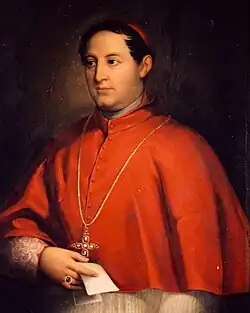
| Name | Title when named cardinal | Country |
|---|---|---|
| Alexis Billiet (1783–1873) | Archbishop of Chambéry | France |
| Carlo Sacconi (1808–1889) | Apostolic Nuncio to France |  Italy |
| Miguel García Cuesta (1803–1873) | Archbishop of Santiago de Compostela | Spain |
| Gaetano Bedini (1806–1864) | Archbishop-bishop of Viterbo and Tuscanella | Papal States |
| Fernando de la Puente y Primo de Rivera (1808–1867) | Archbishop of Burgos | Spain |
| Angelo Quaglia (1802–1872) | Secretary of the Sacred Congregation of the Council | Papal States |
| Antonio Maria Panebianco OFM Conv (1808–1885) | Consultor of the Sacred Congregation of the Inquisition, and Sacred Congregation for Extraordinary Ecclesiastical Affairs | Italy |
16 March 1863

| Name | Title when named cardinal | Country |
|---|---|---|
| Giuseppe Luigi Trevisanato (1801–1877) | Patriarch of Venice | Austria |
| Antonio Saverio De Luca (1805–1883) | Apostolic Nuncio to Austria | Italy |
| Giuseppe Andrea Bizzarri (1802–1877) | Secretary of the Sacred Congregation of Bishops and Regulars | Papal States |
| Luis de la Lastra y Cuesta (1803–1876) | Archbishop of Valladolid | Spain |
| Jean Baptiste François Pitra OSB (1812–1889) | Prior Emeritus of Saint-Germain-des-Prés | France |
| Filippo Maria Guidi OP (1815–1879) | Professor of Theology at University of Vienna | Italy |
| Francesco Pentini (1797–1869) | Dean of the Reverend Apostolic Camera | Papal States |
11 December 1863
| Name | Title when named cardinal | Country |
|---|---|---|
| Henri-Marie-Gaston Boisnormand de Bonnechose (1800–1883) | Archbishop of Rouen | France |
22 June 1866

Pius announced the creation of five cardinals during a secret consistory on 22 June 1866, with three belonging to the rank of cardinal-priest (Cullen, Hohenlohe, and Bilio), and two to the rank of cardinal-deacon (Matteucci and Consolini). Cullen was the first Irish cardinal.[2] The cardinals received their cardinalitial ring and title at a public consistory on June 25.[3]
| Name | Title when named cardinal | Country |
|---|---|---|
| Paul Cullen (1803–1878) | Archbishop of Dublin | United Kingdom |
| Gustav Adolf Hohenlohe (1823–1896) | Almoner of His Holiness | Bavaria |
| Luigi Bilio B (1826–1884) | Consultor for the Commission of Roman and Universal Inquisition, and Sacred Congregation of the Index | Italy |
| Antonio Matteucci (1802–1866) | Vice-Camerlengo of the Holy Roman Church | Italy |
| Domenico Consolini (1806–1884) | Vice-President of the Secretariat of State | Italy |
13 March 1868

Pius announced the creation of nine cardinals during a secret consistory on the morning of 13 March 1868. He elevated Borromeo and Capalti to the rank of cardinal-deacon, with the remaining seven cardinals belonging to the rank of cardinal-priest.[4]
Bonaparte, Gonella, Berardi, Monaco La Valletta, Borromeo, and Capalti received their cardinalitial hat, ring, and title at a public consistory on March 16.[5] Ferrieri and Barili later received theirs at a secret consistory on September 24.[6]
| Name | Title when named cardinal | Country |
|---|---|---|
| Lucien Louis Joseph Napoleon Bonaparte (1828–1895) | Protonotary apostolic | Papal States |
| Innocenzo Ferrieri (1810–1887) | Apostolic Nuncio to Portugal | Italy |
| Matteo Eustachio Gonella (1802–1866) | Archbishop-bishop of Viterbo and Tuscanella | Papal States |
| Lorenzo Barili (1801–1875) | Apostolic Nuncio to Spain | Italy |
| Giuseppe Berardi (1810–1878) | Substitute for General Affairs of the Apostolic Secretariat | Papal States |
| Juan Ignacio Moreno y Maisanove (1817–1884) | Archbishop of Valladolid | Spain |
| Raffaele Monaco La Valletta (1827–1896) | Assessor of the Commission of Roman and Universal Inquisition | Italy |
| Edoardo Borromeo (1822–1881) | Prefect of the Prefecture of the Holy Apostolic Palaces | Italy |
| Annibale Capalti (1811–1877) | Secretary of the Sacred Congregation of the Propagation of the Faith | Papal States |
22 December 1873

Nascimento received his cardinal's hat, ring and titular church at a ceremony on 25 June 1877, whilst Guibert received his cardinal's hat as well.[7] Regnier received his hat on 31 December 1877.[8]
| Name | Title when named cardinal | Country |
|---|---|---|
| Inácio do Nascimento de Morais Cardoso (1811–1883) | Patriarch of Lisbon | Portugal |
| René-François Régnier (1794–1881) | Archbishop of Cambrai | France |
| Maximilian Joseph von Tarnóczy (1806–1876) | Archbishop of Salzburg |  Austria-Hungary |
| Flavio Chigi (1810–1885) | Apostolic Nuncio to France | Italy |
| Alessandro Franchi (1819–1878) | Apostolic Nuncio Emeritus to Spain | Italy |
| Joseph-Hippolyte Guibert OMI (1802–1886) | Archbishop of Paris | France |
| Mariano Falcinelli Antoniacci OSB Cas (1806–1874) | Apostolic Nuncio to Austria-Hungary | Italy |
| Mariano Benito Barrio y Fernández (1805–1876) | Archbishop of Valencia |  Spain |
| Luigi Oreglia di Santo Stefano (1828–1913) | Apostolic Nuncio to Portugal | Italy |
| János Simor (1813–1891) | Archbishop of Esztergom | Austria-Hungary |
| Camillo Tarquini SJ (1810–1874) | Theologian of the Sacred Apostolic Penitentiary | Italy |
| Tommaso Martinelli OESA (1827–1888) | Consultor of the Sacred Congregation of the Index | Italy |
15 March 1875

Pius created eleven cardinals in his March 1875 consistory, reserving the names of five of them in pectore. Bartolini was given the rank of cardinal-deacon, while the remaining five cardinals announced at the time joined the rank of cardinal-priest.[9][10]
McCloskey was the first American cardinal.[11] He received the red biretta from Archbishop James Roosevelt Bayley in a ceremony at St. Patrick's Old Cathedral on 27 April 1875. Deschamps received his cardinalitial hat at a ceremony on 25 June 1877[7] while Manning received his on 31 December 1877.[8]
At the time of his assignment, Ledóchowski had been in prison since 3 February 1874 for resisting the Kulturkampf.[12][13] He was released and exiled from Poland on 3 February 1876,[14] and subsequently received his ring and titular church from Pope Pius at a ceremony on 7 April 1876.[15]

| Name | Title when named cardinal | Country |
|---|---|---|
| Pietro Gianelli (1807–1881) | Secretary of the Sacred Congregation of the Council | Italy |
| Mieczysław Halka Ledóchowski (1822–1902) | Archbishop of Gniezno and of Poznań |  Germany |
| John McCloskey (1810–1885) | Archbishop of New York |  United States |
| Henry Edward Manning (1808–1892) | Archbishop of Westminster | United Kingdom |
| Victor-Auguste-Isidor Deschamps CSsR (1810–1883) | Archbishop of Mechelen |  Belgium |
| Domenico Bartolini (1813–1887) | Secretary of the Sacred Congregation of Rites | Italy |

Cardinal in pectore
| Name | Title when named cardinal | Country | Revealed as Cardinal |
|---|---|---|---|
| Ruggero Luigi Emidio Antici Mattei (1811–1883) | Auditor General of the Reverend Apostolic Camera | Italy |
17 September 1875 |
| Salvatore Nobili Vitelleschi (1818–1875) | Secretary of the Sacred Congregation of Bishops and Regulars | Italy |
17 September 1875 |
| Giovanni Simeoni (1816–1892) | Apostolic Nuncio to Spain | Italy |
17 September 1875 |
| Lorenzo Ilarione Randi (1818–1887) | Vice-Camerlengo of the Holy Roman Church of the Reverend Apostolic Camera | Italy |
17 September 1875 |
| Bartolomeo Pacca, iuniore[d] (1817–1880) | Prefect of the Prefecture of the Holy Apostolic Palaces | Italy |
17 September 1875 |
17 September 1875
In this consistory, Pius created one cardinal, and revealed the names of the five cardinals that had been named in pectore on March 15. Among the in pectore cardinals who were published, Pacca and Randi were given the rank of cardinal-deacon, while the remaining three cardinals were elevated to the rank of cardinal-priest. Additionally, Brossais-Saint-Marc was also elevated to the rank of cardinal-priest.[16]
Among the cardinals made in pectore, Vitelleschi, Randi, and Pacca received their rings and titles at a ceremony on 23 September,[17] while Antici Mattei received his on 28 January 1876.[18] Simeone was the last to receive his ring and titular church, doing so on 18 December 1876.[19]
Cardinal Brossais-Saint-Marc received his titular church and cardinal ring at a ceremony on 3 April 1876[20] and his cardinalitial hat on 31 December 1877.[21]
| Name | Title when named cardinal | Country |
|---|---|---|
| Godefroy Brossais-Saint-Marc (1803–1878) | Archbishop of Rennes | France |
3 April 1876

Pius announced the creation of two cardinals on 3 April 1876, raising both to the rank of cardinal-priest. They received their rings and titular church in a ceremony held on April 7.[22]
| Name | Title when named cardinal | Country |
|---|---|---|
| Bartolomeo D’Avanzo (1811–1884) | Bishop of Calvi | Italy |
| Johannes Baptist Franzelin SJ (1816–1886) | Consultor for the Sacred Congregation for Extraordinary Ecclesiastical Affairs, Sacred Congregation of the Propagation of the Faith, and Sacred Congregation of the Council | Austria-Hungary |
12 March 1877

At a consistory on 12 March 1877, Pius created 11 cardinals. He elevated Nina, Sbaretti, and De Falloux as cardinal-deacons, while the remaining 8 cardinals were made cardinal-priests.[23]
At a ceremony shortly after, Pius bestowed the cardinal's ring, hat and cardinalitial title to Apuzzo, Howard, Canossa, Serafini, Nina, Sbarretti, and De Falloux.[24] Meanwhile, Benavides, Paya, and Caverot received theirs at a ceremony on 25 June[25], while Garcia Gil received his on September 21.[26]
| Name | Title when named cardinal | Country |
|---|---|---|
| Francisco de Paula Benavides y Navarrete (1810–1895) | Patriarch of West Indies[e] | Spain |
| Francesco Saverio Apuzzo (1807–1880) | Archbishop of Capua | Italy |
| Manuel García Gil OP (1802–1881) | Archbishop of Zaragoza | Spain |
| Edward Henry Howard (1829–1892) | Titular bishop of Neocaesarea in Ponto | United Kingdom |
| Miguel Payá y Rico (1811–1891) | Archbishop of Santiago de Compostela | Spain |
| Louis-Marie Caverot (1806–1887) | Archbishop of Lyon | France |
| Luigi di Canossa (1809–1900) | Bishop of Verona | Italy |
| Luigi Serafini (1808–1894) | Bishop of Viterbo and Tuscanella | Italy |
| Lorenzo Nina (1812–1885) | Assessor of the Commission of Roman and Universal Inquisition | Italy |
| Enea Sbarretti (1808–1884) | Secretary of the Sacred Congregation of Bishops and Regulars | Italy |
| Frédéric de Falloux du Coudray (1815–1884) | Regent of the Apostolic Chancery | France |
22 June 1877

Pope Pius created three cardinals, all belonging to the order of cardinal-priest. They received their hat, ring and titular church at a ceremony on 25 June 1877.[7]
| Name | Title when named cardinal | Country |
|---|---|---|
| Josip Mihalovic (1814–1891) | Archbishop of Zagreb | Austria-Hungary |
| Johann Rudolf Kutschker (1810–1881) | Archbishop of Vienna | Austria-Hungary |
| Lucido Parocchi (1833–1903) | Archbishop of Bologna | Italy |
28 December 1877
Pius created two cardinals at a secret consistory on 28 December 1877. Moretti was made a cardinal-priest, while Pellegrini a cardinal-deacon. They received their cardinal's hat and cardinalitial title at a ceremony on 31 December 1877.[8]
| Name | Title when named cardinal | Country |
|---|---|---|
| Vincenzo Moretti (1815–1881) | Archbishop of Ravenna | Italy |
| Antonio Pellegrini (1812–1887) | Dean of the Reverend Apostolic Camera | Italy |
Planned Elevations
Juan Cayetano Gómez de Portugal y Solís, the Bishop of Michoacán, was slated to be elevated to the cardinalate in 1850, but he died on 4 April 1850. Shortly after his death, a letter arrived from Cardinal Giacomo Antonelli announcing that Pope Pius IX is planning to elevate him to the dignity of Cardinal.[27] He would have been the first cardinal from Latin American and the American continent.
In a letter addressed on 6 March 1856, Prosper Guéranger claimed that he refused an offer from Pius on November 1855 to be made a cardinal, as he did not want to move to Rome.[28] As a result, Clément Villecourt was made a cardinal instead.
Ahead of the consistory on 27 September 1861, Pius reportedly offered the cardinalate to Ignazio Alberghini, the Dean of the Sacred Roman Rota. Alberghini declined the promotion, instead retiring on September 16.[29] Also intended for this consistory was Angelo Ramazzotti, the Patriarch of Venice, despite the latter's objections on account of his poor health and financial hardship.[30] Before he could be elevated however, Ramazzotti died on September 24.
Pius had intended to elevate Leon Michał Przyłuski, Archbishop of Gniezno, to the cardinalate in 1865, but the latter died on 12 March 1865, before the consistory could be held to make him a cardinal.[31][32]
Pius planned to elevate Andrea Pila, the Auditor General of the Reverend Apostolic Camera, to the College of Cardinals on 24 April 1868. However, Pila died the day before the consistory, in which he would have been the only elevation.[33]
Ahead of the opening of the First Vatican Council on 8 December 1869, Pius wanted to name a Barnabite cardinal. He approached Carlo Vercellone, who refused on account of old age and poor health and instead proposed the name of Luigi Bilio.[34]
According to Cruz[35] through a story relayed by Ramón Ángel Jara, Mariano Casanova reportedly claimed that Pius was impressed by the performance of José Hipólito Salas, the Bishop of Concepcion, at the First Vatican Council and offered Salas to remain in Rome as a member of the College of Cardinals. Salas would have been the first cardinal from South America, but refused the honor due to his desire to spend his last years in Chile.
Xavier de Mérode, the Almoner of His Holiness, died of acute pneumonia on 11 July 1874, a few months before the consistory that would have made him a cardinal.[36]
Augusto Negroni, the Auditor General of the Reverend Apostolic Camera, was offered the cardinalate but declined in favor of joining the Jesuits on 20 June 1874.[37]
Notes
- ↑ Not to be confused with Giuseppe Pecci, who would be made cardinal on 1879. Neither related to him, nor Gioacchino Pecci, who would be made a cardinal on 1853.
- ↑ Elected as Pope Leo XIII (1878–1903)
- ↑ Lay cardinal
- ↑ Not to be confused with his grand-uncle Bartolomeo Pacca.
- ↑ Titular see based in Rome.
References
- ↑ Martina, Giacomo (1974). Pio IX (1846-1850), Volume 1 (in Italian). Università Gregoriana Editrice. p. 519. ISBN 9788876524592. Retrieved 22 July 2018.
- ↑ Acta Sanctae Sedis Vol I, p. 705.
- ↑ Acta Sanctae Sedis Vol II, p. 5.
- ↑ Acta Sanctae Sedis Vol III, p. 496-498.
- ↑ Acta Sanctae Sedis Vol III, p. 553-554.
- ↑ Acta Sanctae Sedis Vol IV, p. 225.
- 1 2 3 Acta Sanctae Sedis Vol X 1877, p. 211-212, 217.
- 1 2 3 Acta Sanctae Sedis Vol X 1877, p. 425-426.
- ↑ "Italy: The New Cardinals". Evangelical Christendom. 16. J.S. Phillips: 108–9. 1 April 1875. Retrieved 24 July 2018.
- ↑ Acta Sanctae Sedis Vol VIII, p. 304-305.
- ↑ "Cardinals of the U.S.A.", The Catholic Transcript, Volume XXVIII, Number 26, 3 December 1925
- ↑ "Mieczysław Ledóchowski". Gniezno Diocese Webpage (in Polish). Archived from the original on 12 August 2020. Retrieved 1 July 2026.
- ↑ Staszewski, Rafał. "Prymas zniewolonego narodu. Mieczysław Halka-Ledóchowski". Klimontow City Webpage (in Polish). Retrieved 1 July 2026.
- ↑ Catholic Encyclopedia: Miecislas Halka Ledochowski. New Advent. Retrieved 12 July 2026.
- ↑ Acta Sanctae Sedis Vol IX, p. 190.
- ↑ Acta Sanctae Sedis Vol VIII, p. 623-624.
- ↑ Acta Sanctae Sedis Vol VIII, p. 627.
- ↑ Acta Sanctae Sedis Vol IX, p. 73, 83-84.
- ↑ Acta Sanctae Sedis Vol IX, p. 516, 523.
- ↑ Acta Sanctae Sedis Vol IX, p. 171-172, 184.
- ↑ Acta Sanctae Sedis Vol X, p. 425-426.
- ↑ Acta Sanctae Sedis Vol IX, p. 184-190.
- ↑ Acta Sanctae Sedis Vol X, p. 62-63.
- ↑ Acta Sanctae Sedis Vol X, p. 104.
- ↑ Acta Sanctae Sedis Vol X, p. 211-212, 217.
- ↑ Acta Sanctae Sedis Vol X, p. 305, 375.
- ↑ Calderón, Cipriano (1996). "El papel de América Latina en la Nueva Evangelización rumbo al Tercer Milenio". Nueva Evangelización rumbo al Tercer Milenio. V Congreso Internacional de la Reconciliación (in Spanish). Lima, Peru: Ediciones Vida y Espiritualidad. p. 84. Retrieved 1 August 2026.
- ↑ Oury, Guy-Marie (2000). Dom Guéranger : moine au cœur de l'Église (in French). Publications de l’École française de Rome. p. 326-327. ISBN 978-2-7283-0666-4.
- ↑ Boutry 2002, p. 490.
- ↑ Cagliaroli, Pietro (1862). Vita di sua eccellenza reverendissima monsignore Angelo Ramazzotti patriarca di Venezia (in Italian). Stabilimento Minelli. p. 283-284.
- ↑ Klimkiewicz, Witold (1987–88). Kardynał Ledóchowski na tle swej epoki 1822-1902 (in Polish). Vol. II. Księgarnia Świętego Wojciecha. p. 26-27. ISBN 83-7015-104-3.
- ↑ "Leon Przyłuski". Gniezno Diocese Webpage (in Polish). Archived from the original on 12 August 2020. Retrieved 1 July 2026.
- ↑ Boutry 2002, p. 617-618.
- ↑ Cagni, Luigi (16 March 1962). "Pie IX donne la pourpre à un Barnabite". L'Osservatore Romano (in French). p. 4-5.
- ↑ Cruz, Domingo Benigno (1921). El illmo. sr. dn. José Hipólito Salas: obispo de Concepción, 1812-1883 (in Spanish). Imprenta Cervantes. p. 305-306.
- ↑ Catholic Encyclopedia: Frédéric-François-Xavier Ghislain de Mérode. New Advent. Retrieved 12 July 2026.
- ↑ Boutry 2002, p. 600.
Sources
- Boutry, Philippe (2002). Souverain et Pontife : recherches prosopographiques sur la curie romaine à l'âge de la restauration, 1814-1846 (in French). Publications de l’École française de Rome. ISBN 978-2-7283-0666-4.
- Acta Sanctae Sedis (PDF). Vol. I. 1865–66. Retrieved 1 July 2026.
- Acta Sanctae Sedis (PDF). Vol. II. 1867. Retrieved 1 July 2026.
- Acta Sanctae Sedis (PDF). Vol. III. 1867. Retrieved 1 July 2026.
- Acta Sanctae Sedis (PDF). Vol. IV. 1868. Retrieved 1 July 2026.
- Acta Sanctae Sedis (PDF). Vol. VIII. 1874–75. Retrieved 1 July 2026.
- Acta Sanctae Sedis (PDF). Vol. IX. 1876. Retrieved 1 July 2026.
- Acta Sanctae Sedis (PDF). Vol. X. 1877. Retrieved 1 July 2026.
Additional sources
- Martin, Frederick, ed. (1876). "Church of Rome". The Statesman's Yearbook. Macmillan and Co.: 301ff. Retrieved 23 July 2018.
On December 1, 1875.... The following list gives the names of these fifty-seven cardinals, together with their office, or dignity, if any, their nationality, year of birth, and year of nomination....
- Miranda, Salvador. "Consistories for the creation of Cardinals 19th Century (1800-1903): Pius IX". The Cardinals of the Holy Roman Church. Florida International University. OCLC 53276621.