Cantor (crater)
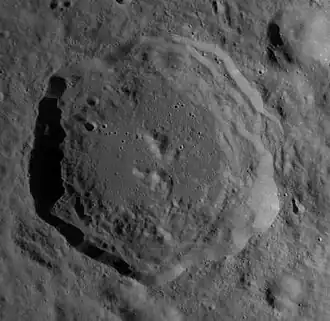 LRO WAC mosaic | |
| Coordinates | 38°02′N 118°41′E / 38.04°N 118.69°E |
|---|---|
| Diameter | 75.72 km (47.05 mi)[1] |
| Depth | Unknown |
| Colongitude | 241° at sunrise |
| Eponym | Georg Cantor Moritz Cantor |


Cantor is a lunar impact crater that is located on the northern hemisphere on the far side of the Moon.[2] This formation dates to the Late Imbrian epoch of the lunar geologic timescale.[3] The outer rim of the crater has a distinctly hexagonal shape, and is slightly longer in the north–south direction. The interior walls are multiply terraced, although less so along the western rim. There is a low central peak at the midpoint of the floor, with multiple ridges nearby.[4]: 30
The terrain surrounding Cantor is heavily impacted with many small craters. The old and heavily eroded crater H. G. Wells is located to the northeast. To the southeast is Kidinnu.[2]
This crater is named for Russian-German mathematician Georg Cantor (1845–1918)[5] and German math historian Moritz Cantor (1829–1920); the two men are distantly related.[6] Prior to being formally adopted by the IAU in 1970,[1] Cantor was called Crater 121.[7]
Satellite craters
By convention these features are identified on lunar maps by placing the letter on the side of the crater midpoint that is closest to Cantor.[8]
| Cantor[4]: 294 | Latitude | Longitude | Diameter |
|---|---|---|---|
| C | 39.5° N | 120.3° E | 21 km |
| T | 37.9° N | 113.4° E | 23 km |
References
- 1 2 "Cantor". Gazetteer of Planetary Nomenclature. USGS Astrogeology Research Program.
- 1 2 Byrne, Charles J. (2008). The Far Side of the Moon. Springer. pp. 96–97, 107. ISBN 978-1-4899-8806-5.
- ↑ Tompkins, Stefanie; Pieters, Carle M. (January 1999). "Mineralogy of the lunar crust: Results from Clementine". Meteoritics & Planetary Science. 34 (1): 25–41. Bibcode:1999M&PS...34...25T. doi:10.1111/j.1945-5100.1999.tb01729.x.
- 1 2 Bussey, B.; Spudis, P. (2004). The Clementine Atlas of the Moon. New York: Cambridge University Press. ISBN 978-0-521-81528-4.
- ↑ Menzel, D. H.; et al. (1971). "Report on Lunar Nomenclature by the Working Group of Commission 17 of the IAU". Space Science Reviews. 12 (2): 136–186. Bibcode:1971SSRv...12..136M. doi:10.1007/BF00171763. S2CID 122125855.
- ↑ Singer, Isidore; Chessin, Alexander S. (1906). "Cantor, Georg". Jewish Encyclopedia. Retrieved 2026-06-24.
- ↑ "Lunar Farside Chart (LFC-1A)" (2nd ed.). Lunar and Planetary Institute. October 1967. Retrieved 2026-04-26.
- ↑ Grego, P. (2015). "Satellite Crater". In Hargitai, H.; Kereszturi, Á. (eds.). Encyclopedia of Planetary Landforms. New York, NY: Springer. doi:10.1007/978-1-4614-3134-3_328.
Sources
- Price, Fred W. (1988). The Moon Observer's Handbook. Cambridge University Press. ISBN 978-0-521-33500-3.
- Rükl, Antonín (1990). Atlas of the Moon. Kalmbach Books. ISBN 978-0-913135-17-4.
- Wlasuk, Peter T. (2000). Observing the Moon. Springer. ISBN 978-1-85233-193-1.
External links
 Media related to Cantor (lunar crater) at Wikimedia Commons
| Physical properties |  | |
|---|---|---|
| Orbit | ||
| Surface and features | ||
| Science | ||
| Exploration | ||
| Time-telling and navigation | ||
| Phases and names | ||
| Daily phenomena | ||
| Related |
| |
