The type locality of the Candeleros Formation is Candeleros Hill in Neuquén Province, after which the formation was named by Wichmann in 1929.[2] This formation unconformably overlies the Lohan Cura Formation, and it is fused with the Huincul Formation, also a unit of the Neuquén Group. The sediments of the latter are of lighter greenish and yellow colors and the fused boundary between the Candeleros and Huincul formations is easily recognizable.[3]
The Candeleros Formation is almost 300 metres (980ft) thick in some sections. Overall, the formation represents a part of the ancient Kokorkom desert with braided river system, made up mostly of sandstones and conglomerates. There are also isolated sections that represent eolian (wind-blown) deposition, as well as siltstones deposited under swamp conditions. Paleosols (soil deposits) are common in some sections as well.[1][3] The base of the formations age is correlated to the "Violaceous Sandstones" whose age is estimated at 98.6 ± 2.5 Ma.[4] In 2010, Tunik and colleagues estimated the youngest maximum depositional age of the Candeleros Formation around 98.6 ± 2.5 Ma based on the youngest single grain from the underlying Rayoso Formation, supporting the proposed Cenomanian age.[5] However, Ignacio J. Maniel and colleagues criticized the reliability of this dating method in 2026, since potential contamination or loss of lead isotopes can result in a dating over 10 million years younger than the actual maximum depositional age; the authors suggested that the Candeleros Formation is most certainly dated to the early Albian age, approximately 111.4 ± 1.1 Ma, using zircon U-Pb dating based on the youngest statistical population and maximum likelihood age of four samples (one tuff and three basal sandstones) from the Candeleros Formation and a single tuff sample from the overlying Huincul Formation, the latter of which was also dated to the Albian at approximately 106.2 ± 1.0 Ma.[6]
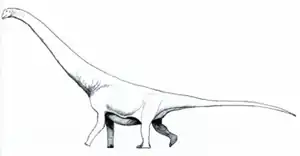
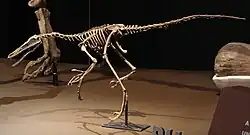
The Candeleros Formation has a very diverse fossil fauna, including fish, frogs, mammals, rhynchocephalians, snakes, turtles, notosuchians, pterosaurs, and abundant dinosaurs including rebbachisaurid and titanosaurian sauropods and diverse theropods, and the enigmatic armored Jakapil.
Ichnofossils found in the formation include those assigned to Sousaichnum monettae, Limayichnus major, Bressaniichnus patagonicus, Deferraiichnum mapuchense, and Picunichnus benedettoi.[7]
A holotype specimen, MPCA PV 1294, consists of an articulated skull and lower jaw and the second individual, MPCA PV 1295, is represented by the middle to posterior parts of a skull
An anterior half of the skull with an articulated mandible, lacking the most anterior portion of the rostrum and also preserves part of the postcranium
↑Tunik, M.; Folguera, A.; Naipauer, M.; Pimentel, M.; Ramos, V.A. (2010). "Early uplift and orogenic deformation in the Neuquén Basin: Constraints on the Andean uplift from U–Pb and Hf isotopic data of detrital zircons". Tectonophysics. 489 (1–4): 258–273. doi:10.1016/j.tecto.2010.04.017.
↑Baez, Ana & Trueb, Linda & Calvo, Jorge. (2000). The earliest known pipoid frog from South America: A new genus from the Middle Cretaceous of Argentina. Journal of Vertebrate Paleontology. 20. 490-500. 10.1671/0272-4634(2000)020%5B0490:TEKPFF%5D2.0.CO;2.
↑Lerzo, Lucas N.; Fernández-Baldor, Fidel Torcida; Canale, Juan I.; Whitlock, John A.; Otero, Alejandro; Gallina, Pablo A. (2024-08-13). "They all floated in the Cretaceous: new rebbachisaurid (Sauropoda, Diplodocoidea) with a highly pneumatized skeleton from the Upper Cretaceous (lower Cenomanian) of Patagonia, Argentina". Historical Biology. 37 (8): 1795–1808. doi:10.1080/08912963.2024.2383708. ISSN0891-2963.
↑Fernández-Dumont, M. L.; Apesteguía, S.; Pol, D.; Bona, P.; Pérez Mayoral, J.; Vega, N. (2026). "A new early peirosaurid terrestrial crocodile (Notosuchia) from La Buitrera (Candeleros Formation), Río Negro, Argentina". Historical Biology: An International Journal of Paleobiology. doi:10.1080/08912963.2026.2683112.
↑Maniel, I.J.; de la Fuente, M. S.; Zhuo, J.I. (2021). "The first Cearachelyini (Pelomedusoides, Bothremydidae) turtle from the Upper Cretaceous of Patagonia, and an overview of the occurrence and diversity of Pelomedusoides in Patagonia". Cretaceous Research. 125 104869. Bibcode:2021CrRes.12504869M. doi:10.1016/j.cretres.2021.104869. hdl:11336/171501.
Wichmann, R (1929). "Los Estratos con Dinosaurios y su techo en el este del Territorio del Neuquén ("The dinosaur-bearing strata and their upper limit in eastern Neuquén Territory")". Dirección General de Geología, Minería e Hidrogeología Publicación. 32: 1–9.